Limiting the Magnitude of Future Climate Change

Limiting the Magnitude of Future Climate Change

AA.VV

45,24 €
IVA incluido
Disponible
Editorial:
National Academies Press
Año de edición:
2010
ISBN:
9780309145978
45,24 €
IVA incluido
Disponible

Selecciona una librería:

  • Librería Samer Atenea
  • Librería Aciertas (Toledo)
  • Kálamo Books
  • Librería Perelló (Valencia)
  • Librería Elías (Asturias)
  • Donde los libros
  • Librería Kolima (Madrid)
  • Librería Proteo (Málaga)

Climate change, driven by the increasing concentration of greenhouse gases in the atmosphere, poses serious, wide-ranging threats to human societies and natural ecosystems around the world. The largest overall source of greenhouse gas emissions is the burning of fossil fuels. The global atmospheric concentration of carbon dioxide, the dominant greenhouse gas of concern, is increasing by roughly two parts per million per year, and the United States is currently the second-largest contributor to global emissions behind China. Limiting the Magnitude of Future Climate Change, part of the congressionally requested America’s Climate Choices suite of studies, focuses on the role of the United States in the global effort to reduce greenhouse gas emissions. The book concludes that in order to ensure that all levels of government, the private sector, and millions of households and individuals are contributing to shared national goals, the United States should establish a ’budget’ that sets a limit on total domestic greenhouse emissions from 2010-2050. Meeting such a budget would require a major departure from business as usual in the way the nation produces and uses energy-and that the nation act now to aggressively deploy all available energy efficiencies and less carbon-intensive technologies and to develop new ones. With no financial incentives or regulatory pressure, the nation will continue to rely upon and ’lock in’ carbon-intensive technologies and systems unless a carbon pricing system is established-either cap-and-trade, a system of taxing emissions, or a combination of the two. Complementary policies are also needed to accelerate progress in key areas: developing more efficient, less carbon-intense energy sources in electricity and transportation; advancing full-scale development of new-generation nuclear power, carbon capture, and storage systems; and amending emissions-intensive energy infrastructure. Research and development of new technologies that could help reduce emissions more cost effectively than current options is also strongly recommended.
Artículos relacionados

  • Analysis of Global Change Assessments
    Global change assessments inform decision makers about the scientific underpinnings of a range of environmental issues, such as climate change, stratospheric ozone depletion, and loss of biodiversity. Dozens of assessments have been conducted to date by various U.S. and international groups, many of them influencing public policies, technology development, and research directio...
    Disponible

    54,60 €

  • Evaluating Progress of the U.S. Climate Change Science Program
    The U.S. Climate Change Science Program (CCSP) coordinates the efforts of 13 federal agencies to understand why climate is changing, to improve predictions about how it will change in the future, and to use that information to assess impacts on human systems and ecosystems and to better support decision making. Evaluating Progress of the U.S. Climate Change Science Program is t...
    Disponible

    47,32 €

  • Observing Weather and Climate from the Ground Up
    Detailed weather observations on local and regional levels are essential to a range of needs from forecasting tornadoes to making decisions that affect energy security, public health and safety, transportation, agriculture and all of our economic interests. As technological capabilities have become increasingly affordable, businesses, state and local governments, and individual...
    Disponible

    60,84 €

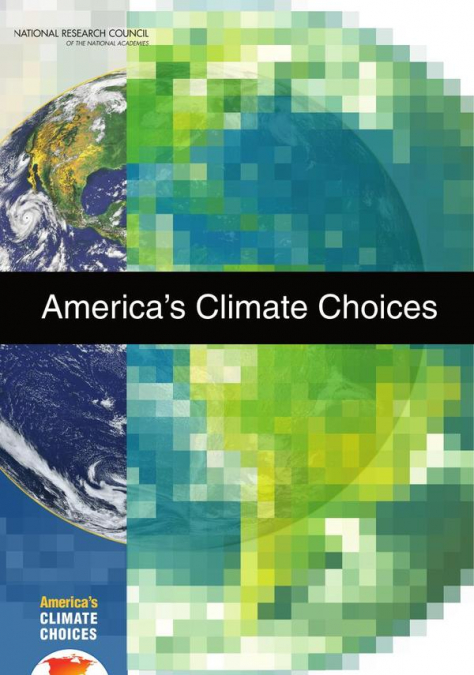
  • America’s Climate Choices
    Climate change is occurring. It is very likely caused by the emission of greenhouse gases from human activities, and poses significant risks for a range of human and natural systems. And these emissions continue to increase, which will result in further change and greater risks. America’s Climate Choices makes the case that the environmental, economic, and humanitarian risks po...
    Disponible

    27,04 €

  • Climate Stabilization Targets
    Emissions of carbon dioxide from the burning of fossil fuels have ushered in a new epoch where human activities will largely determine the evolution of Earth’s climate. Because carbon dioxide in the atmosphere is long lived, it can effectively lock the Earth and future generations into a range of impacts, some of which could become very severe. Emissions reductions decisions ma...
    Disponible

    58,19 €

  • When Weather Matters
    The past 15 years have seen marked progress in observing, understanding, and predicting weather. At the same time, the United States has failed to match or surpass progress in operational numerical weather prediction achieved by other nations and failed to realize its prediction potential; as a result, the nation is not mitigating weather impacts to the extent possible.This boo...
    Disponible

    54,60 €