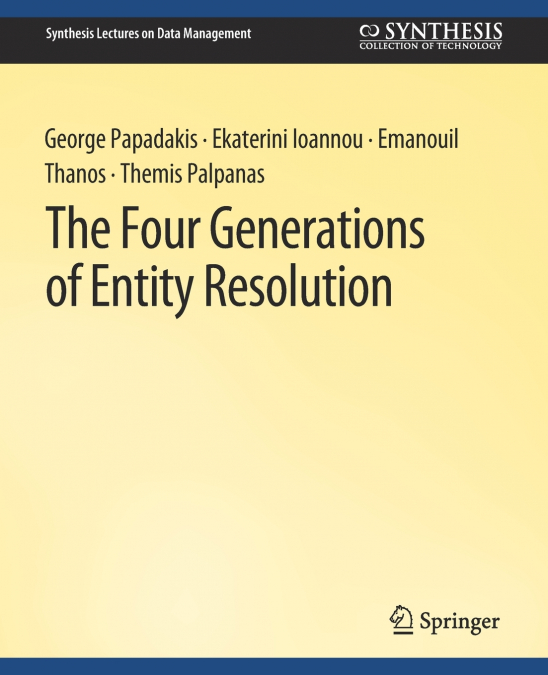
The Four Generations of Entity Resolution

The Four Generations of Entity Resolution

Ekaterini Ioannou / Emanouil Thanos / George Papadakis

75,52 €
IVA incluido
Disponible
Editorial:
Springer Nature B.V.
Año de edición:
2021
Materia
Guías de Internet y servicios en línea
ISBN:
9783031007507
75,52 €
IVA incluido
Disponible

Selecciona una librería:

  • Librería Samer Atenea
  • Librería Aciertas (Toledo)
  • Kálamo Books
  • Librería Perelló (Valencia)
  • Librería Elías (Asturias)
  • Donde los libros
  • Librería Kolima (Madrid)
  • Librería Proteo (Málaga)

Entity Resolution (ER) lies at the core of data integration and cleaning and, thus, a bulk of the research examines ways for improving its effectiveness and time efficiency. The initial ER methods primarily target Veracity in the context of structured (relational) data that are described by a schema of well-known quality and meaning. To achieve high effectiveness, they leverage schema, expert, and/or external knowledge. Part of these methods are extended to address Volume, processing large datasets through multi-core or massive parallelization approaches, such as the MapReduce paradigm. However, these early schema-based approaches are inapplicable to Web Data, which abound in voluminous, noisy, semi-structured, and highly heterogeneous information. To address the additional challenge of Variety, recent works on ER adopt a novel, loosely schema-aware functionality that emphasizes scalability and robustness to noise. Another line of present research focuses on the additional challenge of Velocity, aiming to process data collections of a continuously increasing volume. The latest works, though, take advantage of the significant breakthroughs in Deep Learning and Crowdsourcing, incorporating external knowledge to enhance the existing words to a significant extent. This synthesis lecture organizes ER methods into four generations based on the challenges posed by these four Vs. For each generation, we outline the corresponding ER workflow, discuss the state-of-the-art methods per workflow step, and present current research directions. The discussion of these methods takes into account a historical perspective, explaining the evolution of the methods over time along with their similarities and differences. The lecture also discusses the available ER tools and benchmark datasets that allow expert as well as novice users to make use of the available solutions.

Artículos relacionados

  • Transformation of Knowledge, Information and Data
    Patrick Van Bommel
    ...
  • Advanced Geospatial Practices in Natural Environment Resource Management
    Today, the relentless depletion of natural resources has reached a critical juncture, demanding innovative solutions. Advanced Geospatial Practices in Natural Environment Resource Management dives into the intricate tapestry of issues jeopardizing ecosystems. This book systematically dissects the fundamental drivers, traces the historical evolution, and elucidates the underlyin...
  • Advanced Geospatial Practices in Natural Environment Resource Management
    Today, the relentless depletion of natural resources has reached a critical juncture, demanding innovative solutions. Advanced Geospatial Practices in Natural Environment Resource Management dives into the intricate tapestry of issues jeopardizing ecosystems. This book systematically dissects the fundamental drivers, traces the historical evolution, and elucidates the underlyin...
    Disponible

    274,88 €

  • Accelerate Model Training with PyTorch 2.X
    Maicon Melo Alves
    Dramatically accelerate the building process of complex models using PyTorch to extract the best performance from any computing environmentKey Features- Reduce the model-building time by applying optimization techniques and approaches- Harness the computing power of multiple devices and machines to boost the training process- Focus on model quality by quickly evaluating differe...
    Disponible

    64,00 €

  • Information Theory for Data Science
    Changho Suh
    Information theory deals with mathematical laws that govern the flow, representation and transmission of information, just as the field of physics concerns laws that govern the behavior of the physical universe. The foundation was made in the context of communication while characterizing the fundamental limits of communication and offering codes (sometimes called algorithms) to...
  • Theory of Decision Under Uncertainty
    Itzhak Gilboa
    ...
    Disponible

    49,52 €