 Librería Samer Atenea
 Kálamo Books
 Librería Elías (Asturias)
 Librería Kolima (Madrid)
 Librería Proteo (Málaga)
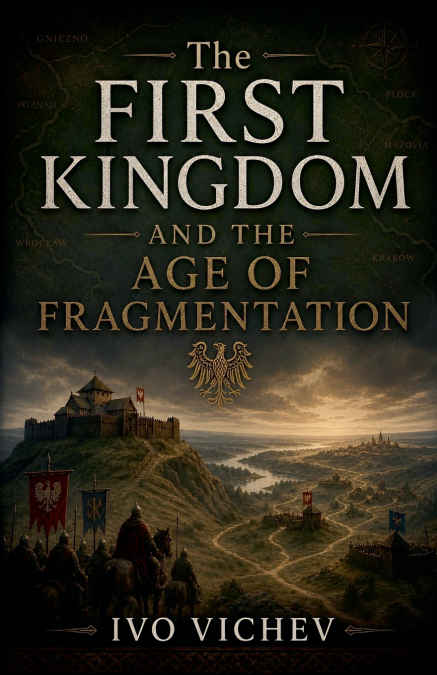
The First Kingdom and the Age of Fragmentation is the second volume in Ivo Vichev’s History of Poland series, a serious narrative history of medieval Poland from the final years of Mieszko I to the reign of Casimir the Great.This volume follows the making, breaking, and rebuilding of the first Polish kingdom. It begins with the damaged document known as the Dagome iudex, the succession crisis after Mieszko I’s death, and the ruthless seizure of power by Bolesław Chrobry. From there, it traces the rise of the early Piast state through the Congress of Gniezno, the cult of Saint Adalbert, the wars with the Holy Roman Empire, the road to Kiev, and Bolesław’s coronation as the first king of Poland in 1025.But the kingdom Bolesław left behind was not secure. After his death, Poland entered one of the most dangerous periods in its early history. Mieszko II inherited royal authority, foreign enemies, dynastic rivals, and a state stretched beyond its institutional strength. The result was collapse: invasion, rebellion, pagan reaction, the flight of rulers, the sack of sacred centres, and the near-destruction of the Piast monarchy.The book then follows the long reconstruction under Casimir the Restorer, the renewed ambition of Bolesław the Bold, the murder of Bishop Stanisław, the troubled rule of Władysław Herman, and the powerful reign of Bolesław Krzywousty. His Testament of 1138 divided the realm among his sons and opened the age of fragmentation, when Poland became a political landscape of rival Piast dukes, provincial courts, broken senioral authority, and competing claims to Kraków.Across the following centuries, the Polish lands faced pressure from every direction. The rise of Silesia, Mazovia, Greater Poland, Lesser Poland, and Pomerania reshaped the old kingdom into a fractured political world. German settlement, Church power, urban growth, ducal rivalry, Mongol invasion, and the arrival of the Teutonic Order all changed the balance of power. The seizure of Gdańsk by the Teutonic Knights became one of the defining wounds of medieval Polish history.From that fractured world emerged Władysław Łokietek, the small duke who refused to vanish. His long struggle for Kraków, his battles against rivals, his conflict with the Teutonic Order, and his coronation in 1320 marked the return of the Polish kingdom. Yet reunification remained incomplete. It was Casimir the Great who gave the recovered monarchy its deeper structure: law, administration, diplomacy, castles, towns, royal courts, and a political system strong enough to survive the end of the direct Piast royal line.This is not a simple story of national rise. It is a history of fragile institutions, dynastic violence, royal ambition, frontier war, Church authority, foreign pressure, law, memory, and survival. The Polish kingdom did not move smoothly from foundation to strength. It broke, contracted, adapted, and slowly learned how to outlive the rulers who claimed it.Written for readers of medieval history, Polish history, European history, royal history, and the Piast dynasty, The First Kingdom and the Age of Fragmentation tells the story of how Poland survived the collapse of its first monarchy, endured the age of divided duchies, and returned as a kingdom under kings who understood that power needed more than blood. It needed institutions, memory, law, and stone.