 Librería Samer Atenea
 Kálamo Books
 Librería Elías (Asturias)
 Librería Kolima (Madrid)
 Librería Proteo (Málaga)
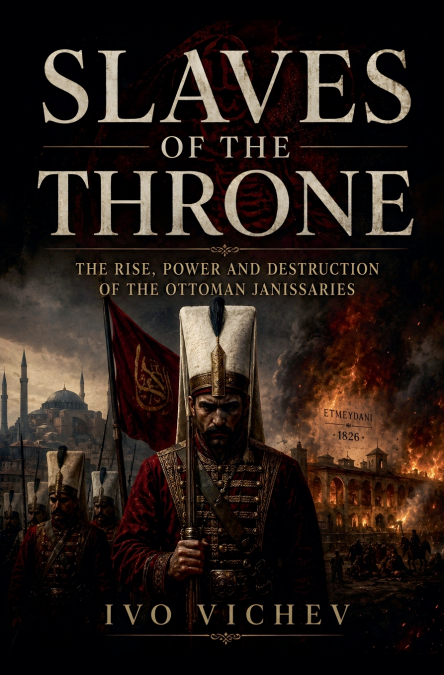
For nearly five centuries, the Janissaries stood at the centre of Ottoman power.They began as the sultan’s dependent infantry: boys drawn from Christian communities, converted to Islam, trained for imperial service and placed inside a system designed to give the Ottoman ruler soldiers whose careers depended entirely upon the throne. They helped conquer Constantinople, fought from the Balkans to Persia and Egypt, adopted firearms early, and became one of the most recognisable military institutions of the early modern world.But the institution did not remain what its founders had created.Over generations, the Janissaries became more than soldiers. They built families, entered trades, lent money, formed neighbourhood connections and embedded themselves in the economic and political life of Istanbul. Their pay certificates circulated far beyond the barracks. Their regimental cauldrons became symbols of corporate identity and rebellion. Their commanders could influence government. Their collective action could help determine who occupied the Ottoman throne.The same system created to make soldiers dependent on the sultan eventually produced an institution powerful enough to challenge him.Slaves of the Throne traces that transformation from the Ottoman frontier of the fourteenth century to the destruction of the Janissary corps in 1826.It follows the development of the devşirme, the levy that brought thousands of Christian boys into Ottoman service; the rise of the Janissary barracks and the culture of the ocak, or hearth; the corps at Constantinople, Chaldiran, Rhodes and Mohács; its role in succession crises, uprisings and palace politics; and its gradual expansion into the commercial and social world of the Ottoman capital.The story is not a simple decline from disciplined warriors into corrupt soldiers.The Janissaries were changing because the empire around them was changing. Recruitment altered. Pay lost value. Military technology changed. Soldiers became householders, craftsmen and merchants. Political influence expanded. Reforming sultans repeatedly discovered that an institution deeply rooted in the capital could not simply be ordered out of existence.Selim III tried. He lost his throne.Mahmud II prepared differently.In June 1826, after years of political and military preparation, the final confrontation came at Istanbul’s Etmeydanı. Artillery was turned against the Janissary barracks. The Yeni Odalar burned. Captured Janissaries were executed, exiled or hunted down. Their organisation was abolished, their symbols attacked and their place in Ottoman life deliberately dismantled.The Ottoman government called it the Auspicious Incident.For the men inside the barracks, it was annihilation.Drawing on Ottoman records, chronicles, diplomatic reports, court documents, registers and modern scholarship, Ivo Vichev reconstructs the Janissaries as they actually developed: not merely as battlefield troops, palace conspirators or symbols of Ottoman decline, but as a military, political, economic and social institution whose history became inseparable from the empire itself.Slaves of the Throne: The Rise, Power and Destruction of the Ottoman Janissaries is the story of how the Ottoman state created an army to serve the throne, how that army learned to defend its own interests, and why, in the end, the throne decided it could survive only by destroying it.