
The Evolution of the Euclidean Elements

The Evolution of the Euclidean Elements

W.R. Knorr

465,41 €
IVA incluido
Disponible
Editorial:
Springer Nature B.V.
Año de edición:
1980
Materia
Filosofía occidental: antigua, hasta c. 500
ISBN:
9789027711922
465,41 €
IVA incluido
Disponible

Selecciona una librería:

  • Librería Samer Atenea
  • Librería Aciertas (Toledo)
  • Kálamo Books
  • Librería Perelló (Valencia)
  • Librería Elías (Asturias)
  • Donde los libros
  • Librería Kolima (Madrid)
  • Librería Proteo (Málaga)

The present work has three principal objectives: (1) to fix the chronology of the development of the pre-Euclidean theory of incommensurable magnitudes beginning from the first discoveries by fifth-century Pythago­ reans, advancing through the achievements of Theodorus of Cyrene, Theaetetus, Archytas and Eudoxus, and culminating in the formal theory of Elements X; (2) to correlate the stages of this developing theory with the evolution of the Elements as a whole; and (3) to establish that the high standards of rigor characteristic of this evolution were intrinsic to the mathematicians’ work. In this third point, we wish to counterbalance a prevalent thesis that the impulse toward mathematical rigor was purely a response to the dialecticians’ critique of foundations; on the contrary, we shall see that not until Eudoxus does there appear work which may be described as purely foundational in its intent. Through the examination of these problems, the present work will either alter or set in a new light virtually every standard thesis about the fourth-century Greek geometry. I. THE PRE-EUCLIDEAN THEORY OF INCOMMENSURABLE MAGNITUDES The Euclidean theory of incommensurable magnitudes, as preserved in Book X of the Elements, is a synthetic masterwork. Yet there are detect­ able seams in its structure, seams revealed both through terminology and through the historical clues provided by the neo-Platonist commentator Proclus.

Artículos relacionados

  • The Nature of Things
    Lucretius Lucretius
    De rerum natura (On the Nature of Things) is a 1st century BC didactic poem by the Roman poet and philosopher Lucretius with the goal of explaining Epicurean philosophy to a Roman audience. Lucretius presents the principles of atomism; the nature of the mind and soul; explanations of sensation and thought; the development of the world and its phenomena; and explains a variety o...
  • Pompeii
    Fergus Mason
    Pompeii was one of most advanced cities of its time; it had a complex water system, gymnasium, and an amphitheater. Despite it's advancements, there was one thing it wasn't ready for: Mount Vesuvius—the volcano that led to its ultimate doom.  The 79 AD eruption of Mount Vesuvius was one of the worst disasters in all of European history. In a near instant, over 15,000 p...
    Disponible

    10,36 €

  • Middle Platonism and Neoplatonism, Volume 1
    Stephen Gersh
    'It is generally agreed that those types of philosophy that are loosely called ’Platonic’ and ’Neoplatonic’ played a crucial role in the history of European culture during the centuries between antiquity and the Renaissance. However, until now no scholar has attempted to describe the evolution of these forms of thought in a single comprehensive academic study.' So writes Stephe...
  • Middle Platonism and Neoplatonism, Volume 2
    Stephen Gersh
    It is generally agreed that those types of philosophy that are loosely called 'Platonic' and 'Neoplatonic' played a crucial role in the history of European culture during the centuries between antiquity and the Middle Ages. However, until now no scholar has attempted to describe the evolution of these forms of thought in a single comprehensive academic study. Middle Platonism a...
  • Porphyry’s Commentary on Ptolemy’s Harmonics
    Andrew Barker
    ...
    Disponible

    77,17 €

  • The Roots of Platonism
    John Dillon
    ...
    Disponible

    25,29 €

Otros libros del autor

  • Textual Studies in Ancient and Medieval Geometry
    W.R. Knorr
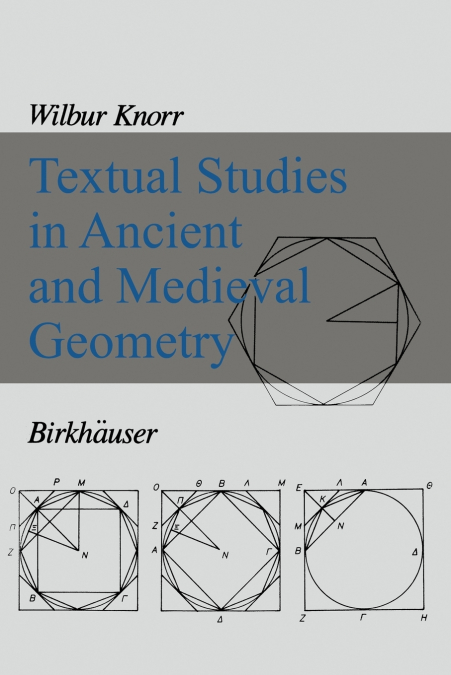
    For textual studies relating to the ancient mathematical corpus the efforts by the Danish philologist, 1. L. Heiberg (1854-1928), are especially significant. Beginning with his doctoral dissertation, Quaestiones Archimedeae (Copen­ hagen, 1879), Heiberg produced an astonishing series of editions and critical studies that remain the foundation of schol...
    Disponible

    131,14 €