 Librería Samer Atenea
 Kálamo Books
 Librería Elías (Asturias)
 Librería Kolima (Madrid)
 Librería Proteo (Málaga)
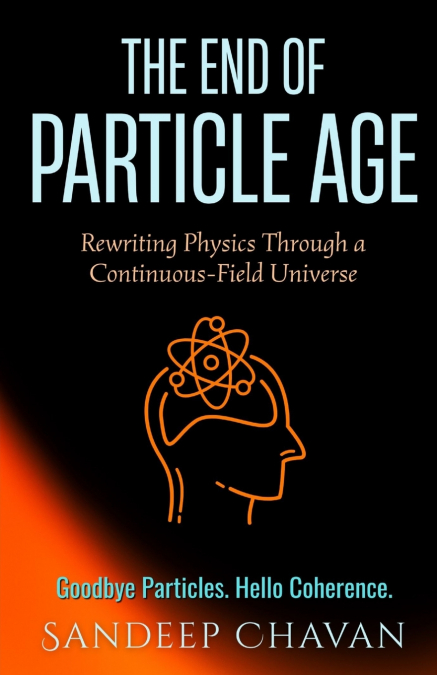
For more than a century, modern physics has been built on particles, forces, and invisible constructs that explain less while contradicting more. Each new discovery has added layers of abstraction-virtual particles, wave-particle duality, dark matter, dark energy, singularities-turning clarity into complexity and coherence into patchwork.The End of Particle Age presents a decisive shift away from this fragmented worldview.In this bold and rigorously reasoned work, independent physicist and philosopher Sandeep J. Chavan proposes a continuous-field reinterpretation of physical reality based on his original frameworks: Universal Energy Dynamics (UED) and Ripple Field Dynamics (RFD). Rather than treating the universe as a collection of discrete objects, this book reveals reality as the behavior of a single, continuous field-where matter, light, gravity, and motion emerge from ripple structures, gradients, coherence, and equilibrium-seeking dynamics.Particles are reinterpreted as stable field patterns.Forces dissolve into gradient behavior.Quantum paradoxes vanish as coherence transitions.Cosmological mysteries no longer require invisible substances or speculative fixes.Across a carefully structured narrative, the book dismantles the particle worldview and rebuilds physics from the field up. Electrons become ripple-knots, photons become alignment propagation, gravity becomes natural gradient flow, and black holes are understood as high-density field states rather than singularities. The long-standing conflict between quantum mechanics and relativity is shown to be an artifact of fragmented assumptions, not a fundamental problem of nature.Beyond theory, The End of Particle Age explores the practical consequences of a field-centric universe-opening pathways toward field engineering, gravity control through gradient shaping, coherence-based computation, ripple-aligned energy systems, and future medical technologies rooted in field stability rather than biochemical intervention.Written in a clear, conversational style without heavy mathematics, this book is designed for physicists, researchers, engineers, students, and serious science readers who seek conceptual clarity rather than technical intimidation. It does not ask the reader to abandon science, but to complete it.This is not a rebellion against physics.It is a correction of its assumptions.The End of Particle Age marks the transition from fragmentation to continuity-and invites the reader into the emerging Field Age of science.