
The Empty Cradle of Democracy

The Empty Cradle of Democracy

Alexandra Halkias

50,20 €
IVA incluido
Disponible
Editorial:
Duke University Press
Año de edición:
2004
Materia
Cuestiones éticas: aborto y control de la natalidad
ISBN:
9780822333234
50,20 €
IVA incluido
Disponible

Selecciona una librería:

  • Librería Samer Atenea
  • Librería Aciertas (Toledo)
  • Kálamo Books
  • Librería Perelló (Valencia)
  • Librería Elías (Asturias)
  • Donde los libros
  • Librería Kolima (Madrid)
  • Librería Proteo (Málaga)

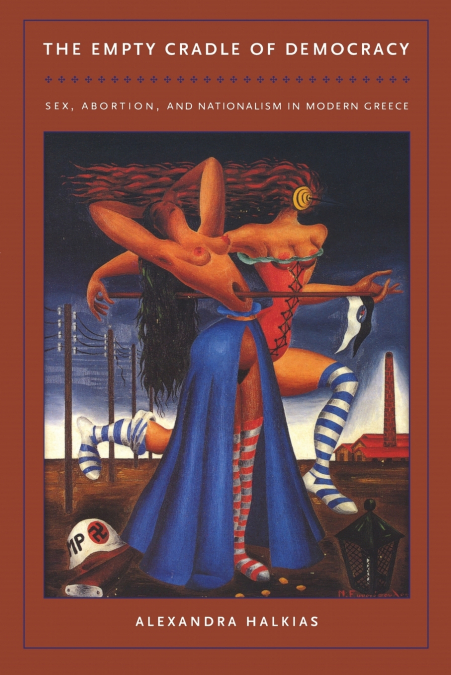
During the 1990s, Greece had a very high rate of abortion at the same time that its low birth rate was considered a national crisis. The Empty Cradle of Democracy explores this paradox. Alexandra Halkias shows that despite Greek Orthodox beliefs that abortion is murder, many Greek women view it as 'natural' and consider birth control methods invasive. The formal public-sphere view is that women destroy the body of the nation by aborting future citizens. Scrutiny of these conflicting cultural beliefs enables Halkias’s incisive critique of the cornerstones of modern liberal democracy, including the autonomous 'individual' subject and a polity external to the private sphere. The Empty Cradle of Democracy examines the complex relationship between nationalism and gender and re-theorizes late modernity and violence by exploring Greek representations of human agency, the fetus, national identity, eroticism, and the divine.Halkias’s analysis combines telling fragments of contemporary Athenian culture, Greek history, media coverage of abortion and the declining birth rate, and fieldwork in Athens at an obstetrics/gynecology clinic and a family-planning center. Halkias conducted in-depth interviews with one hundred and twenty women who had had two or more abortions and observed more than four hundred gynecological exams at a state family-planning center. She reveals how intimate decisions and the public preoccupation with the low birth rate connect to nationalist ideas of race, religion, freedom, resistance, and the fraught encounter between modernity and tradition. The Empty Cradle of Democracy is a startling examination of how assumptions underlying liberal democracy are betrayed while the nation permeates the body and understandings of gender and sexuality complicate the nation-building projects of late modernity.
Artículos relacionados

  • Birth controlled
    Amrita Pande
    This book analyses the world of selective reproduction by a critical analysis of three modes of controlling birth, namely contraception, reproductive violence, and repro-genetic technologies. All population control policies target and vilify women (Black women in particular), and coerce them into subjecting their bodies to state and medical surveillance; Birth controlled argues...
    Disponible

    43,62 €

  • Sacred Rights
    Daniel C. Maguire
    ...
    Disponible

    71,76 €

  • How Ethical Systems Change
    Elyshia Aseltine / Sheldon Ekland-Olson
    Roe v. Wade came like a bolt from the blue, but support had been building for years. For many, the idea that life in the womb was not fully protected under the Constitution was simply not acceptable. Political campaigns were organized and protests launched, including the bombing of clinics and the killing of abortion providers. Questions about the protection and support of life...
    Disponible

    70,94 €

  • Abortion and the Private Practice of Medicine
    Jonathan B. Imber
    Originally published in 1986, Abortion and the Private Practice of Medicine was the first book to look at abortion from the perspective of physicians in private practice. Jonathan B. ...
    Disponible

    89,71 €

  • Anthropology of Pregnancy Loss
    Rosanne Cecil
    Contemporary, historical and oral-history accounts from regions as diverse as rural North India, urban America, South Africa and Northern Ireland, provide a fascinating insight into the experience and management of miscarriage across a number of different cultures. ...
    Disponible

    73,29 €

  • Birth Control and Controlling Birth
    Betty B. Hoskins / Helen B. Holmes / Michael Gross
    Women most fully experience the consequences of human reproductive technologies. Men who convene to evaluate such technologies discuss Itthem ': the women who must accept, avoid, or even resist these technologies; the women who consume technologies they did not devise; the women who are the objects of policies made by of women is neither sought nor li...