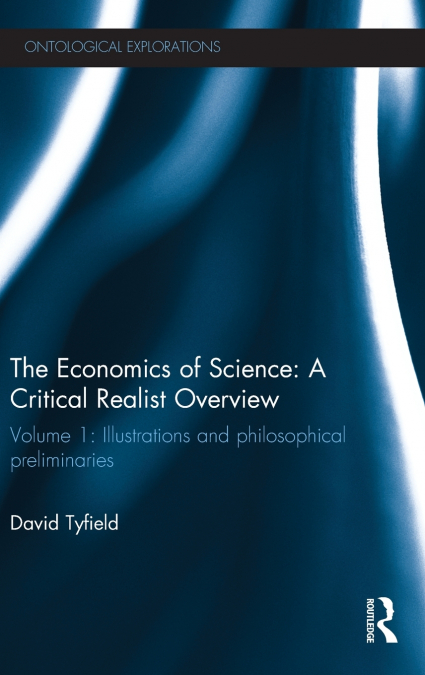
The Economics of Science

The Economics of Science

David Tyfield

88,14 €
IVA incluido
Disponible
Editorial:
Taylor & Francis Ltd
Año de edición:
2011
Materia
Influencia de la ciencia y la tecnología sobre la sociedad
ISBN:
9780415688796
88,14 €
IVA incluido
Disponible

Selecciona una librería:

  • Librería Samer Atenea
  • Librería Aciertas (Toledo)
  • Kálamo Books
  • Librería Perelló (Valencia)
  • Librería Elías (Asturias)
  • Donde los libros
  • Librería Kolima (Madrid)
  • Librería Proteo (Málaga)

Dramatic and controversial changes in the funding of science over the past two decades have stimulated a huge literature trying to set out an 'economics of science'. Whether broadly in favour or against these changes, the vast majority of these frameworks employ ahistorical analyses that cannot conceptualise, let alone address, the questions of 'why have these changes occurred?' and 'why now?' This book argues that the fundamental underlying problem in all cases is the ontological shallowness of these theories, which can only be remedied by attention to ontological presuppositions. Accordingly, Tyfield sets out an introduction to the existing literature on the economics of science together with novel discussion of the field from a critical realist perspective in ways that also develop critical realism as a philosophical project. The first of two volumes, this book explores substantive illustrations of the social challenges associated with the commercialization of science before turning to a critical engagement with critical realism’s critique of mainstream economics that underpins the project as a whole.

Artículos relacionados

  • Interactive Media Use and Youth
    Modern advancements in technology have changed the way that young people use interactive media. Learning from such methods was not even considered until recently. It is now slowly defining the landscape of contemporary pedagogical practices. Interactive Media Use and Youth: Learning, Knowledge Exchange and Behavior provides a comprehensive collection of knowledge based on diffe...
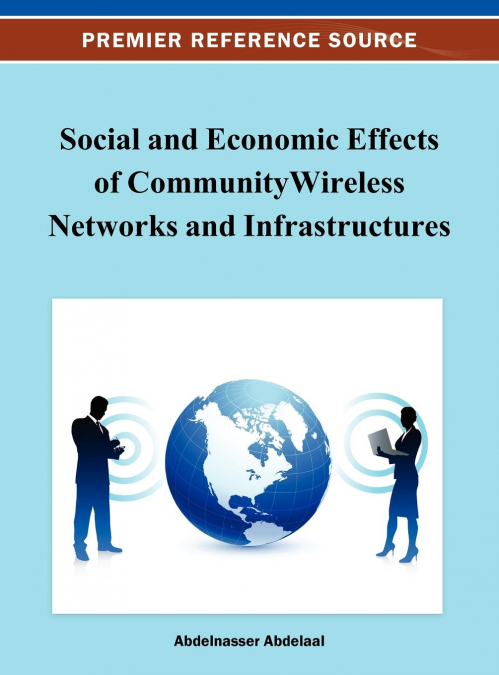
  • Social and Economic Effects of Community Wireless Networks and Infrastructures
    Abdelaal
    It is surprising to think that in today’s rapidly evolving world of technology, over half of the globe still does not have access to high speed internet. Creating community wireless networks has in the past been a way to provide remote communities with internet and network access. Social and Economic Effects of Community Wireless Networks and Infrastructures highlights the succ...
  • The New Atlantis
    Francis Bacon
    In this work, Bacon portrayed a vision of the future of human discovery and knowledge, expressing his aspirations and ideals for humankind. The novel depicts the creation of a utopian land where 'generosity and enlightenment, dignity and splendour, piety and public spirit' are the commonly held qualities of the inhabitants of 'Bensalem'. ...
  • Sport 2.0
    Andy Miah
    ...
    Disponible

    28,86 €

  • Productivity Machines
    Corinna Schlombs
    ...
    Disponible

    48,52 €

  • Open Space
    Mariel Borowitz
    ...
    Disponible

    38,25 €

Otros libros del autor

  • Liberalism 2.0 and the Rise of China
    David Tyfield
    What can we do in this period of historic, global turbulence? Mainstream narratives have no plausible account of how to stop exacerbating the multiple, overlapping challenges; much less begin to address them meaningfully. The only thing everyone agrees is innovation will be needed. But what is innovation? Usually, it is understood as new technologies that will ’solve’ specific ...
    Disponible

    77,15 €

  • Liberalism 2.0 and the Rise of China
    David Tyfield
    Exploring evidence from the key arenas of low-carbon innovation, including in the pivotal location of a rising China, this book describes the global systemic crisis of a neoliberal world order and the embryonic emergence of an alternative global power regime of a ’liberalism 2.0’. ...
  • The Economics of Science
    David Tyfield
    Dramatic and controversial changes in the funding of science over the past two decades have stimulated a huge literature trying to set out an 'economics of science'. Whether broadly in favour or against these changes, the vast majority of these frameworks employ ahistorical analyses that cannot conceptualise, let alone address, the questions of 'why have these changes occurred?...