Inicio > Humanidades > Historia > The Early Years of the 20th Century -1900- 1906
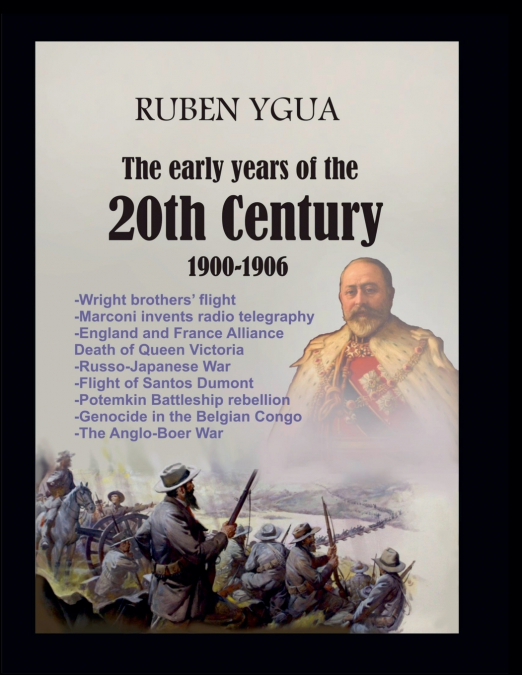
The Early Years of the 20th Century  -1900- 1906

The Early Years of the 20th Century -1900- 1906

Ruben Ygua

27,68 €
IVA incluido
Consulta disponibilidad
Editorial:
Ruben Ygua
Año de edición:
2025
Materia
Historia
ISBN:
9798232244743

Selecciona una librería:

  • Librería Desdémona
  • Librería Samer Atenea
  • Librería Aciertas (Toledo)
  • Kálamo Books
  • Librería Perelló (Valencia)
  • Librería Elías (Asturias)
  • Donde los libros
  • Librería Kolima (Madrid)
  • Librería Proteo (Málaga)

THE FAILURE OF THE BALANCE POWER THEORYThe French Revolution and the Napoleonic Wars had spread the concept of democracy throughout most of the European continent, thus spreading the idea that populations sharing an ethnic origin, a language and the same political ideals had the right to form independent states. However, the principle of national self-determination was totally ignored by the dynastic and reactionary forces that decided the fate of European affairs at the Congress of Vienna in 1815. Many of the peoples who wanted their autonomy were subjected to local dynasties or other nations. For example, the German states, integrated into the German Confederation, were divided into numerous ducats, principalities, and kingdoms according to the terms of the Vienna Congress; Italy was also divided into several political units, some of which were under foreign control; the Flemish and French Belgians of the Austrian Netherlands were subordinated to Dutch rule by decision of Congress.The revolutions and strong nationalist movements of the 19th century succeeded in annulling much of the reactionary impositions agreed in Vienna. Belgium gained independence from the Netherlands in 1830; the unification of Italy was completed in 1861, and that of Germany in 1871. However, nationalist conflicts remained unresolved in other areas of Europe at the beginning of the 20th century, causing tensions within the regions involved and between various European nations. One of the most important nationalist currents, Pan-Slavism, played a fundamental role in the events that preceded the war.The nationalist spirit was also evident in the economic field. The Industrial Revolution, which began in Great Britain at the end of the 18th century, in France at the beginning of the 19th century and in Germany from 1870 onwards, led to a large increase in manufactured goods, forcing these countries to seek new markets abroad. The area in which the European policy of economic expansion was mainly developed was Africa, where the respective colonial interests frequently came into conflict. The economic rivalry over the dominance of African territory between France, Germany and Great Britain was on the verge, from 1898 to 1914, of provoking a war in Europe on several occasions.As a result of international tensions, European nations took both domestic and foreign policy measures between 1871 and 1914 that, in turn, increased the danger of conflict; maintained numerous permanent armies, which they constantly expanded through peacetime recruitments; and built larger ships. Great Britain, influenced by the development of the German Navy, which began in 1900, and by the course of the Russo-Japanese War, modernized its fleet under the direction of Admiral Sir John Fisher. The war between Russia and Japan had demonstrated the effectiveness of long-range naval armament. Advances in other areas of military technology and organization stimulated the formation of staffs capable of drawing up very precise mobilization and attack plans, often integrated into programs that could not be cancelled once initiated.Leaders in all countries became aware that rising expenditures on armaments would eventually lead to national bankruptcies or war; for this reason, attempts were made to promote global disarmament on several occasions, notably at the Hague Conferences of 1899 and 1907. However, international rivalry had reached such a point that no effective agreement could be reached to decide on international disarmament.

Artículos relacionados

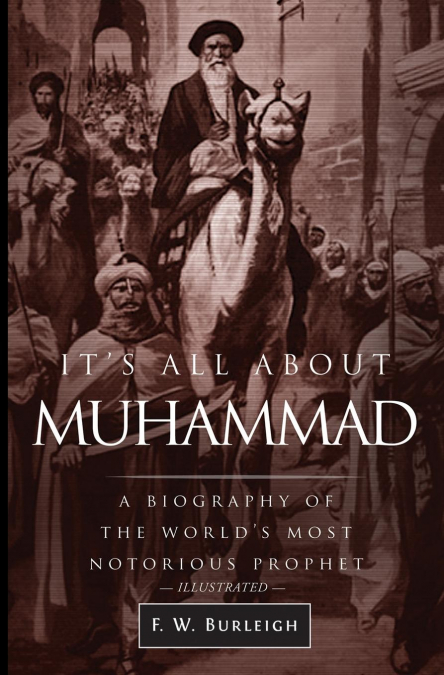
  • It’s All About Muhammad
    F. W. Burleigh / FWBurleigh
    Why all the car bombs, beheadings, and mass murders in the Middle East? Why the relentless killing of non-Muslims throughout the world by the followers of Muhammad's religion? Why Boston, Chattanooga, Paris, San Bernardino? People blame verses of the Koran for all of this, but it's not about the Koran.Author F. W. Burleigh draws on an academic, investigative, and litera...
    Disponible

    25,99 €

  • Raising Freedom's Banner
    Paul Harris
    World wide history of peaceful street demonstrations from their earliest beginning in eighteenth century England to their use throughout the world in the twenty-first century. Describes why some demonstration movements succeeded and others failed. Contrasts demonstrations within the law with civil disobedience demonstrations. Describes Peterloo, the Chartists, the Suffragettes,...
    Disponible

    23,59 €

  • Gifford Pinchot and the First Foresters
    Bibi Gaston
    In 2005, six tattered blue boxes were unearthed in the Library of Congress’s Pinchot Collection in Washington D.C. Inside were 5,000 pages of letters describing the work of early resource conservation professionals. The boxes were labeled simply “The Old Timers.” Penned between the years 1937–1941 by the first class of American Forest Rangers to serve under President Theodo...
  • Waipi’o Valley
    Jeffrey L. Gross
    Waipi’o Valley: A Polynesian Journey from Eden to Eden recounts the remarkable migrations of the Polynesians across a third of the circumference of the earth. Their amazing journey began from Kalana i Hau’ola, the biblical “Garden of Eden” located along the shore of the Persian Gulf, extended to the Indus River Valley of ancient Vedic India, to Egypt where some ancestors of the...
    Disponible

    18,64 €

  • Floralia
    June Rainsford Butler
    A century characterized by a growing interest in science, the opportunity for travel, and leisure for gardening furnishes the setting for Butler’s book. The rise of landscape gardening in England is traced, and the origin and history of its most famous gardens are given. The close relation between England and America in the field of horticulture is also discussed.Originally pub...
    Disponible

    61,20 €

  • Nyerere and Africa
    Godfrey Mwakikagile
    This is the fourth edition of 'Nyerere and Africa: End of an Era. It is also the largest and includes new material not found in previous editions. The work is a comprehensive study of the political career of President Julius Nyerere spanning half a century. The author takes a critical look at Nyerere's policies and influence in the domestic and international arenas for an obje...

Otros libros del autor

  • Russo- Japanese War - 1904-1905
    Ruben Ygua
    The expansion of the great European powers in Asia and the Pacific threatened to strangle Russian naval communications, which could only use the port of Vladivostok during the summer months. For the tsar, it was vital to conquer a port in warm waters that would remain active throughout the year. That is why Port Arthur became the main objective of Russian politics in the East.J...
  • The War of the Castilian Succession - 1701-1713
    Ruben Ygua
    1701- January 18 - Berlin: in a luxurious ceremony, Frederick is crowned King of Prussia, with the emperor support and approval.January 20 - An alliance is signed between the Netherlands, England and Denmark, to launch operations against French trade in the Spanish colonies.January 22 - Phillip V entered Irun between great parties and acclamations.January 26 - Philip V entered ...
  • The History of Brazil
    Ruben Ygua
    We have excessively complicated the study of the past by giving greater importance to nationalist, religious, and moral opinions and interests, relegating historical facts to the background and subordinating them to the interests of the system that claims to educate us. It is time to simplify and respect our ancestors by striving to know what really happened in the past, not ju...
  • Men and Women of the Roman Empire
    Ruben Ygua
    Men and women of the Roman Empire aims to bring together not only the great political names of the history of Rome but also all those who, in one way or another relate to the Eternal City in classical times: poets, writers, geographers, architects, philosophers, teachers, prominent women, and so on.I preferred to organize each mini biography in chronological order and not as it...
  • Seven Years’ War - 1756-1763
    Ruben Ygua
    1756- WAR BEGINSJanuary 17- The Treaty of Westminster is signed, alliance between England and Prussia. January 20-South America: Guarani War, combat of Batoví, Governor Viana personally kills Cacique Sepé with a pistol shot. He is succeeded in the Guarani leadership by the cacique Nicolás Ñanguirú. January 27 - Austria: birth of the composer Wolfgang Amadeus Mozart. February 5-...
  • The Great Epidemics in History
    Ruben Ygua
    We inhabit an unstable planet; the continental masses are in permanent movement, breaking up to separate or approaching each other.This displacement translates into earthquakes, volcanic eruptions, alteration of ocean currents and the formation and elevation of mountain ranges, all of which profoundly affect the climate, forcing evolutions, the emergence of new species or extin...