
The Discovery of Things

The Discovery of Things

Wolfgang-Rainer Mann

147,33 €
IVA incluido
Consulta disponibilidad
Editorial:
Princeton University Press
Año de edición:
2000
Materia
Filosofía occidental: antigua, hasta c. 500
ISBN:
9780691010205

Selecciona una librería:

  • Librería Samer Atenea
  • Librería Aciertas (Toledo)
  • Kálamo Books
  • Librería Perelló (Valencia)
  • Librería Elías (Asturias)
  • Donde los libros
  • Librería Kolima (Madrid)
  • Librería Proteo (Málaga)

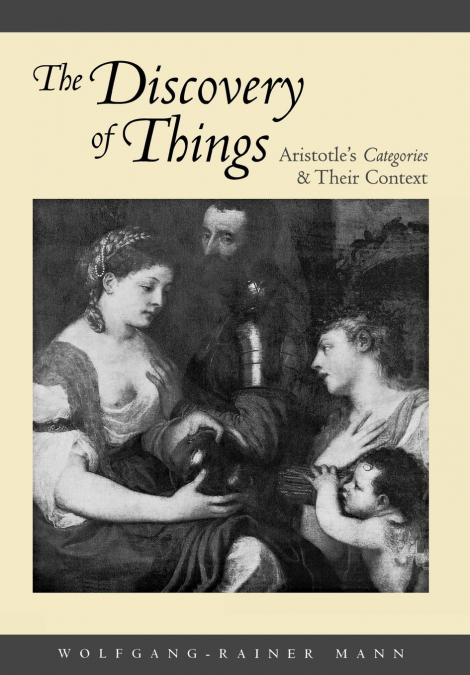
Aristotle’s Categories can easily seem to be a statement of a naïve, pre-philosophical ontology, centered around ordinary items. Wolfgang-Rainer Mann argues that the treatise, in fact, presents a revolutionary metaphysical picture, one Aristotle arrives at by (implicitly) criticizing Plato and Plato’s strange counterparts, the 'Late-Learners' of the Sophist. As Mann shows, the Categories reflects Aristotle’s discovery that ordinary items are things (objects with properties). Put most starkly, Mann contends that there were no things before Aristotle. The author’s argument consists of two main elements. First, a careful investigation of Plato which aims to make sense of the odd-sounding suggestion that things do not show up as things in his ontology. Secondly, an exposition of the theoretical apparatus Aristotle introduces in the Categories--an exposition which shows how Plato’s and the Late-Learners’ metaphysical pictures cannot help but seem inadequate in light of that apparatus. In doing so, Mann reveals that Aristotle’s conception of things--now so engrained in Western thought as to seem a natural expression of common sense--was really a hard-won philosophical achievement. Clear, subtle, and rigorously argued, The Discovery of Things will reshape our understanding of some of Aristotle’s--and Plato’s--most basic ideas.

Artículos relacionados

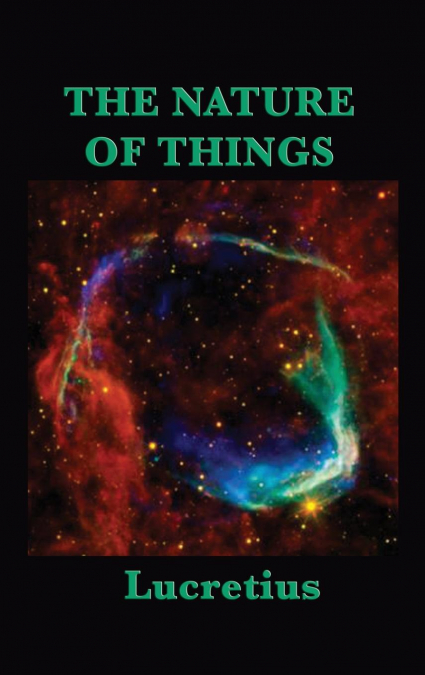
  • The Nature of Things
    Lucretius Lucretius
    De rerum natura (On the Nature of Things) is a 1st century BC didactic poem by the Roman poet and philosopher Lucretius with the goal of explaining Epicurean philosophy to a Roman audience. Lucretius presents the principles of atomism; the nature of the mind and soul; explanations of sensation and thought; the development of the world and its phenomena; and explains a variety o...
  • Pompeii
    Fergus Mason
    Pompeii was one of most advanced cities of its time; it had a complex water system, gymnasium, and an amphitheater. Despite it's advancements, there was one thing it wasn't ready for: Mount Vesuvius—the volcano that led to its ultimate doom.  The 79 AD eruption of Mount Vesuvius was one of the worst disasters in all of European history. In a near instant, over 15,000 p...
    Disponible

    10,36 €

  • Middle Platonism and Neoplatonism, Volume 1
    Stephen Gersh
    'It is generally agreed that those types of philosophy that are loosely called ’Platonic’ and ’Neoplatonic’ played a crucial role in the history of European culture during the centuries between antiquity and the Renaissance. However, until now no scholar has attempted to describe the evolution of these forms of thought in a single comprehensive academic study.' So writes Stephe...
  • Middle Platonism and Neoplatonism, Volume 2
    Stephen Gersh
    It is generally agreed that those types of philosophy that are loosely called 'Platonic' and 'Neoplatonic' played a crucial role in the history of European culture during the centuries between antiquity and the Middle Ages. However, until now no scholar has attempted to describe the evolution of these forms of thought in a single comprehensive academic study. Middle Platonism a...
  • Porphyry’s Commentary on Ptolemy’s Harmonics
    Andrew Barker
    ...
    Disponible

    77,17 €

  • The Roots of Platonism
    John Dillon
    ...
    Disponible

    25,29 €