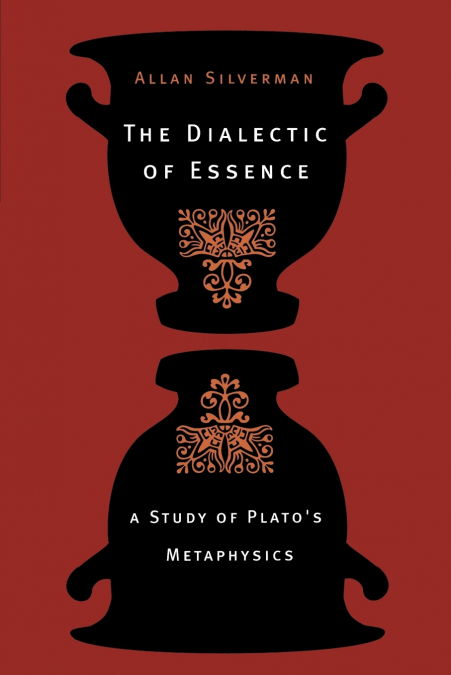

The Dialectic of Essence

The Dialectic of Essence

Allan Silverman

85,54 €
IVA incluido
Disponible
Editorial:
Princeton University Press
Año de edición:
2002
Materia
Filosofía occidental: antigua, hasta c. 500
ISBN:
9780691091792
85,54 €
IVA incluido
Disponible

Selecciona una librería:

  • Librería Samer Atenea
  • Librería Aciertas (Toledo)
  • Kálamo Books
  • Librería Perelló (Valencia)
  • Librería Elías (Asturias)
  • Donde los libros
  • Librería Kolima (Madrid)
  • Librería Proteo (Málaga)

The Dialectic of Essence offers a systematic new account of Plato’s metaphysics. Allan Silverman argues that the best way to make sense of the metaphysics as a whole is to examine carefully what Plato says about ousia (essence) from the Meno through the middle period dialogues, the Phaedo and the Republic, and into several late dialogues including the Parmenides, the Sophist, the Philebus, and the Timaeus. This book focuses on three fundamental facets of the metaphysics: the theory of Forms; the nature of particulars; and Plato’s understanding of the nature of metaphysical inquiry. Silverman seeks to show how Plato conceives of 'Being' as a unique way in which an essence is related to a Form. Conversely, partaking ('having') is the way in which a material particular is related to its properties: Particulars, thus, in an important sense lack essence. Additionally, the author closely analyzes Plato’s idea that the relation between Forms and particulars is mediated by form-copies. Even when some late dialogues provide a richer account of particulars, Silverman maintains that particulars are still denied essence. Indeed, with the Timaeus’s introduction of the receptacle, there are no particulars of the traditional variety. This book cogently demonstrates that when we understand that Plato’s concern with essence lies at the root of his metaphysics, we are better equipped to find our way through the labyrinth of his dialogues and to better appreciate how they form a coherent theory.

Artículos relacionados

  • The Nature of Things
    Lucretius Lucretius
    De rerum natura (On the Nature of Things) is a 1st century BC didactic poem by the Roman poet and philosopher Lucretius with the goal of explaining Epicurean philosophy to a Roman audience. Lucretius presents the principles of atomism; the nature of the mind and soul; explanations of sensation and thought; the development of the world and its phenomena; and explains a variety o...
  • Pompeii
    Fergus Mason
    Pompeii was one of most advanced cities of its time; it had a complex water system, gymnasium, and an amphitheater. Despite it's advancements, there was one thing it wasn't ready for: Mount Vesuvius—the volcano that led to its ultimate doom.  The 79 AD eruption of Mount Vesuvius was one of the worst disasters in all of European history. In a near instant, over 15,000 p...
    Disponible

    10,36 €

  • Middle Platonism and Neoplatonism, Volume 1
    Stephen Gersh
    'It is generally agreed that those types of philosophy that are loosely called ’Platonic’ and ’Neoplatonic’ played a crucial role in the history of European culture during the centuries between antiquity and the Renaissance. However, until now no scholar has attempted to describe the evolution of these forms of thought in a single comprehensive academic study.' So writes Stephe...
  • Middle Platonism and Neoplatonism, Volume 2
    Stephen Gersh
    It is generally agreed that those types of philosophy that are loosely called 'Platonic' and 'Neoplatonic' played a crucial role in the history of European culture during the centuries between antiquity and the Middle Ages. However, until now no scholar has attempted to describe the evolution of these forms of thought in a single comprehensive academic study. Middle Platonism a...
  • Porphyry’s Commentary on Ptolemy’s Harmonics
    Andrew Barker
    ...
    Disponible

    77,17 €

  • The Roots of Platonism
    John Dillon
    ...
    Disponible

    25,29 €