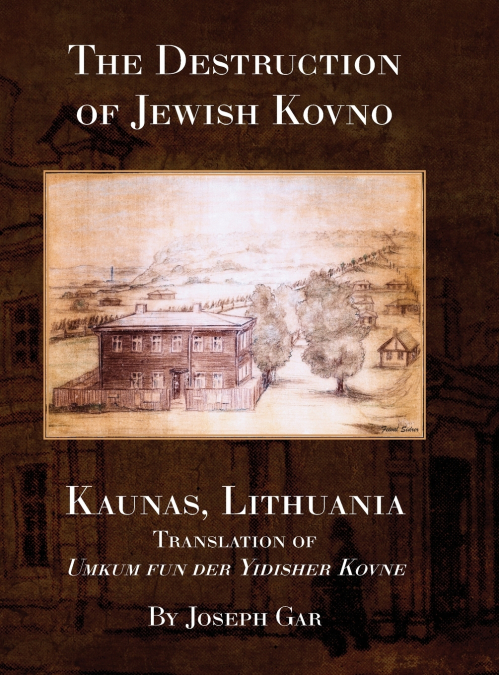

The Destruction of Jewish Kovno (Kaunas, Lithuania)

The Destruction of Jewish Kovno (Kaunas, Lithuania)

Ettie Zilber

54,24 €
IVA incluido
Consulta disponibilidad
Editorial:
JewishGen
Año de edición:
2023
Materia
Historia social y cultural
ISBN:
9781954176652

Selecciona una librería:

  • Librería Samer Atenea
  • Librería Aciertas (Toledo)
  • Kálamo Books
  • Librería Perelló (Valencia)
  • Librería Elías (Asturias)
  • Donde los libros
  • Librería Kolima (Madrid)
  • Librería Proteo (Málaga)

The ghetto in Kovno has its own tragic place in history because of the cruelty of conditions there and the revolt of Jews towards the end of its days. The dire circumstances of the ghetto became more widely known after World War II with the discovery of secret archives, diaries, drawings, and photographs that had been buried in the ground when the ghetto was destroyed. These told the story of Jewish community’s defiance, oppression, resistance, and death.Between 1920 and 1939, Kovno, located in central Lithuania, was the country’s capital and largest city. From a small provincial city, it grew into a modern city, and became heir to the best traditions of the historically famous Lithuanian Jewry, with traditions from the nucleus of Jewishness, culture, learning, modern social-political movements, and people of Israel. Kovno had a Jewish population of approximately 32,000, about one-fourth of the city’s total population, before the Germans and their Lithuanian auxiliaries began their systematic massacres in 1941. This book was written in the years just after the war and drew on interviews with Kovno survivors after their liberation, many of them in Displaced Persons camps. The Preface says that This is the first book laying out a detailed account of what happened in the Ghetto.At its peak, the ghetto held an estimated 29,000 people, most of whom were later sent to concentration and extermination camps or were shot after being rounded up and crowded into the notorious '9th Fort,' one of several that had been constructed under the Russian Empire in the late nineteenth century for the defense of the city. The book describes the fort as one of the most horrible Nazi mass annihilation sites in Lithuania. Kovno was liberated by the Red Army on August 1, 1944. A few days later, little by little, the few miraculously surviving Jews started to return to the city. Everyone’s first job was to run and see what the destruction of the Ghetto looked like.The images that they saw on the site of the former Ghetto were horrific. In the Ghetto not a single house was left intact. All the wooden houses were completely burned. The large, massive walls of the walled block of houses were lying in ruins, like after an earthquake. Throughout entire areas of the Ghetto the monstrous skeletons of dead and burned Jews were seen.One of the last chapters in the book ends this way:On the seventh day of mourning, we bow our heads in great awe to the scattered holy ashes of our murdered and burned men and women, from elderly to babies, we whisper the ancient Jewish prayer: 'That their souls should be wrapped in bundles of life.'
Artículos relacionados

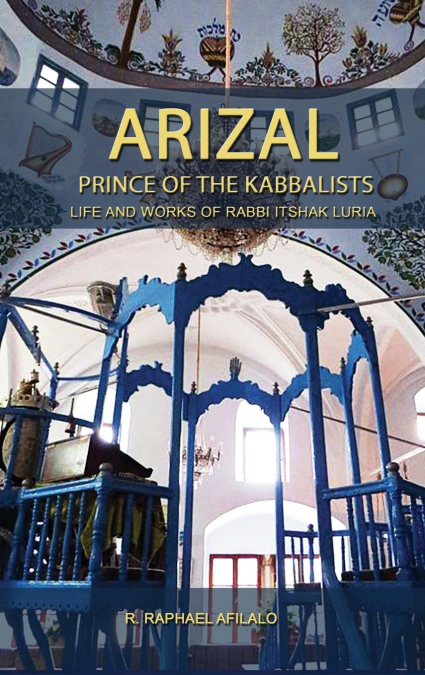
  • Arizal
    Raphael Afilalo
    The Ari overflowed with Torah. He was expert in Scripture, Mishnah, Talmud, Midrash, Maaseh Bereishit and Maaseh Merkavah. About all the different levels of prophecy, their details and from which level the prophets had their revelations.  He understood the whistling of the trees, the grass and stones, the language of the birds and other animals, the conversations of angels, the...
  • Rose-tinted Memory
    Michael S Fryer
    “Those who deny Auschwitz would be ready to remake it”.  ~ Primo Levi, Holocaust survivor and author Seventy years after the mass murder of the Jews of Europe, Holocaust denial and Holocaust revisionism are creeping into our overall perception of what actually happened.Christendom has not ‘denied’ Holocaust, but it has attempted to create a memory of Holocaust which suggests th...
    Disponible

    8,84 €

  • Pan Kapitan of Jordanow
    William Leibner
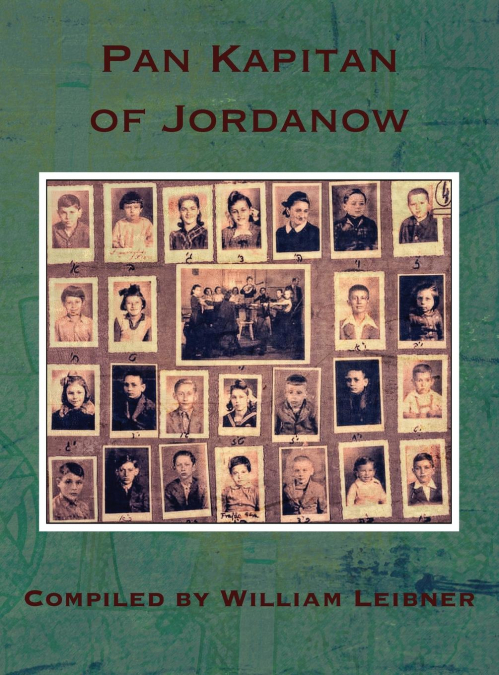
    Yeshayahu Drucker devoted a good part of his life to rescuing Jewish children from non-Jewish homes. Many parents had given their children to Polish neighbors for safekeeping during the war. Unfortunately most of the parents did not survive the Shoah. At the end of the war, there was no one to claim the children and they remained with the “adopted” Polish families. Following hi...
  • Holy Dissent
    Glenn Dynner
    BThe religious communities of early modern Eastern Europe—particularly those with a mystical bent—are typically studied in isolation. Yet the heavy Slavic imprint on Jewish popular mysticism and pervasive Judaizing tendencies among Christian dissenters call into question the presumed binary quality of Jewish-Christian interactions. In Holy Dissent: Jewish and Christian Mystics ...
  • AL-FARD
    Ali Mahdi Muhammad
    The Al-Fard, or the The Dawn, has captured the early rays of Our history. This history is essential if we are to be brought face to face with the One true and living God of the universe. The purpose of this writing is to bring the reader step by step, one degree at a time to the reality of God in person. The teachings of Our Father elevates the believer to the level of Godhood ...
  • Wild Things. Nature and the Social Imagination
    HISTORIES OF HUMAN CONSTRUCTIONS OF NATUREWild Things: Nature and the Social Imagination assembles eleven substantive and original essays on the cultural and social dimensions of environmental history. They address a global cornucopia of social and ecological systems, from Africa to Europe, North America and the Caribbean, and their temporal range extends from the 1830s into th...

Otros libros del autor

  • A Holocaust Memoir of Love & Resilience
    Ettie Zilber
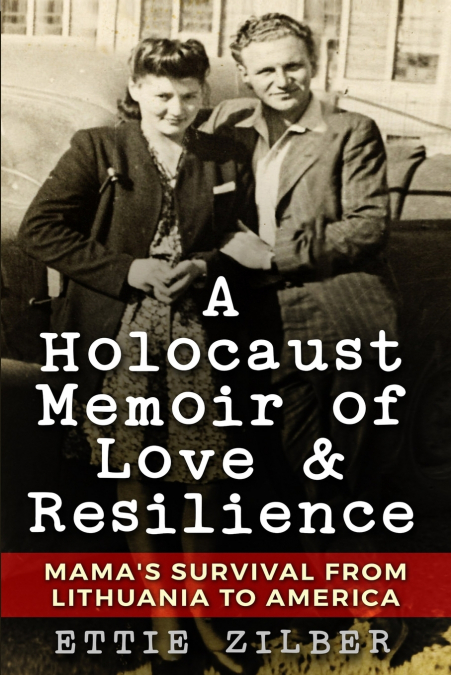
    With the Nazi occupation of Kovno (Lithuania), her life changed forever. Zlata Santocki Sidrer was Jewish, but she survived the horrors of the Holocaust.Gone was her normal life and her teenage dream of becoming a doctor. Instead, she witnessed untold deprivations, massacres, imprisonment, hunger and slave labor before being transported to the Stutthof Concentration Camp. Her s...
    Disponible

    21,12 €

  • Third Culture Kids - The Children of Educators in International Schools
    Ettie Zilber
    The concept of Third Culture Kids (TCKs), children who follow their globetrotting parents around the world, is not a new one and has been widely studied. However, there is one specific group of TCKs who have, until now, been largely ignored - EdKids, the children of international school educators. In this new work, Dr Ettie Zilber brings together all the material she has collec...