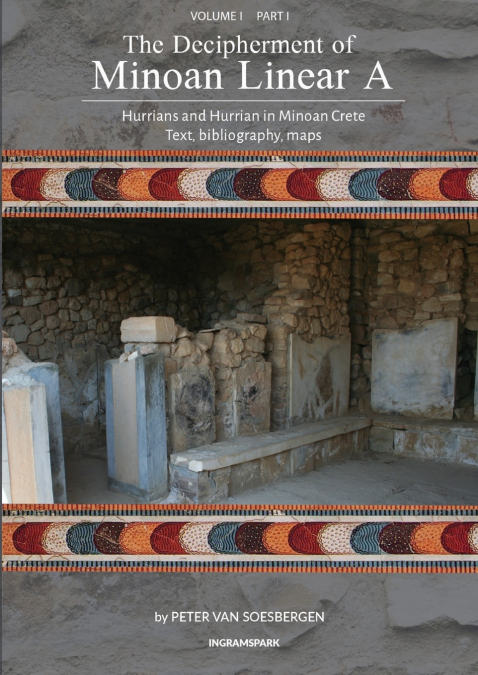

The Decipherment of Minoan Linear A, Volume I, Part I

The Decipherment of Minoan Linear A, Volume I, Part I

Peter George van Soesbergen

84,86 €
IVA incluido
Disponible
Editorial:
Peter G. van Soesbergen
Año de edición:
2022
Materia
Historia social y cultural
ISBN:
9789083275406
84,86 €
IVA incluido
Disponible

Selecciona una librería:

  • Librería Samer Atenea
  • Librería Aciertas (Toledo)
  • Kálamo Books
  • Librería Perelló (Valencia)
  • Librería Elías (Asturias)
  • Donde los libros
  • Librería Kolima (Madrid)
  • Librería Proteo (Málaga)

The Minoan Linear A script has mystified scholars over the last 70 years. The first Linear A clay tablets discovered from 1900 A.D. at Knossos, Phaistos and Hagia Triada puzzled some of the greatest minds in the linguistic field, especially after Michael Ventris’s decipherment of the younger related script of Linear B as Mycenaean Greek in 1952. Many attempts to identify Linear A as Semitic, Hittite, Luwian and even Greek resulted into failure. Some people thought that a 'Rosetta stone' was crucial for the decipherment of Linear A. Disappointment even led to the view that the language written with Linear A might be extinct and remain unknown. Through systematic linguistic research, Peter van Soesbergen has established that the Linear A script records an agglutinative language. Hurrian, the dominant language of the kingdom of Mitanni (Northern Iraq, Eastern Anatolia, Syria), turned out to be the best candidate, especially because dominance of Mitanni in the Near East was approximately contemporary with Minoan Linear A in Crete. The excavations at Urkish / Tell Mozan showed that Hurrians were already present in Syria in the third millennium B.C.    The Decipherment of Minoan Linear A, Volume I, reads like a detective novel, as the evidence is revealed page by page. Van Soesbergen has been able to identify lots of Hurrian personal names, ethnics, toponyms and theonyms in Linear A. Important are the typical Hurrian grammatical forms with Hurrian suffixes. While the extensive linguistic evidence may be challenging to the layman, the wealth of information contained within the entire works remains rewarding and enlightening.    Volume I, Part I and II, comprise the main text in the series The Decipherment of Minoan Linear A, whereas Volume I, Parts III-VI, offer the indices to the main text and glossaries at the same time. Volume II, Parts I (Arkhanes - Kea) and Part II (Khania - Zakros), contain the Corpus of transliterated Linear A texts.     The spiral Linear A inscription a-re-ne-si-di-jo-pi-ke-pa-ja-su-l/ra-i-te-l/ra-me-a-ja-ku (KN Zf 13) on a gold signet-ring from the necropolis of Mavro Spilio near Knossos probably consists of six sequences: a-re-ne (,) si-di-jo-pi (,) ke-pa-ja (,) su-l/ra-i (,) te-l/ra-me (,) a-ja-ku, that can be analysed as {Ar-ene=š} {Šid=i-j=o/umbi} {Kebaja} {zul(l)=ai} {Telame} {Aya=k(k)=un}, and be translated: ’In order that [the priest] Ar-ene (’Give, oh God !’) may connect (final debitive zul(l)=ai) Ši(n)dijombi and Kebaja (in wedlock with this wedding-ring), oh Great Ajak(k)un (vocative) !’.    Can it be accidental that Linear A te-l/ra-me = Hurrian telame / talame / talme ’great’ precedes a-ja-ku in this inscription and that we have here the Linear A prototypes of Tελαμών (Telamon) and his father Aἰακóς (Ajakos), grandfather of the ’Great’ Aἴας (Ajas), together in one inscription ? A-ya-ku-un is a Hurrian divine name, cf. E. Laroche, Glossaire de la langue hourrite, Paris 1980, 40, s.v. ayakki: Nom divin: a-ya-ku-un = oug. a-ya-ku, RS quadr. 137 IV b 15 (Série An, No 48) ?
Artículos relacionados

  • Arizal
    Raphael Afilalo
    The Ari overflowed with Torah. He was expert in Scripture, Mishnah, Talmud, Midrash, Maaseh Bereishit and Maaseh Merkavah. About all the different levels of prophecy, their details and from which level the prophets had their revelations.  He understood the whistling of the trees, the grass and stones, the language of the birds and other animals, the conversations of angels, the...
  • Rose-tinted Memory
    Michael S Fryer
    “Those who deny Auschwitz would be ready to remake it”.  ~ Primo Levi, Holocaust survivor and author Seventy years after the mass murder of the Jews of Europe, Holocaust denial and Holocaust revisionism are creeping into our overall perception of what actually happened.Christendom has not ‘denied’ Holocaust, but it has attempted to create a memory of Holocaust which suggests th...
    Disponible

    8,84 €

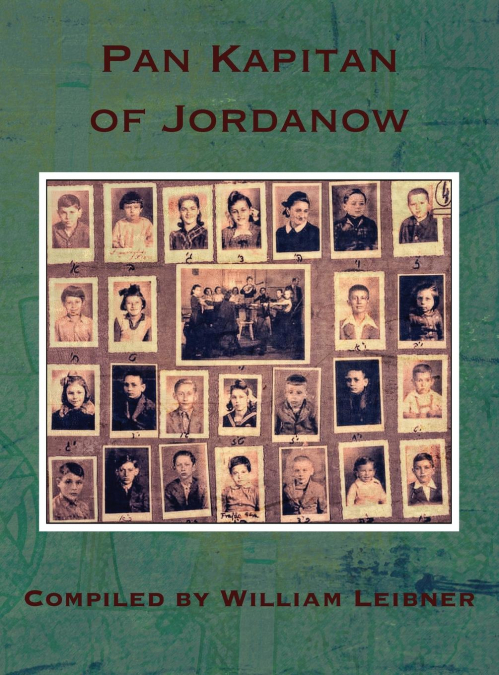
  • Pan Kapitan of Jordanow
    William Leibner
    Yeshayahu Drucker devoted a good part of his life to rescuing Jewish children from non-Jewish homes. Many parents had given their children to Polish neighbors for safekeeping during the war. Unfortunately most of the parents did not survive the Shoah. At the end of the war, there was no one to claim the children and they remained with the “adopted” Polish families. Following hi...
  • Holy Dissent
    Glenn Dynner
    BThe religious communities of early modern Eastern Europe—particularly those with a mystical bent—are typically studied in isolation. Yet the heavy Slavic imprint on Jewish popular mysticism and pervasive Judaizing tendencies among Christian dissenters call into question the presumed binary quality of Jewish-Christian interactions. In Holy Dissent: Jewish and Christian Mystics ...
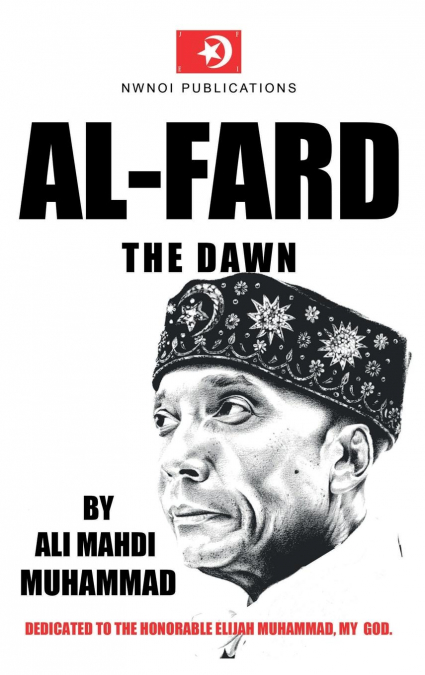
  • AL-FARD
    Ali Mahdi Muhammad
    The Al-Fard, or the The Dawn, has captured the early rays of Our history. This history is essential if we are to be brought face to face with the One true and living God of the universe. The purpose of this writing is to bring the reader step by step, one degree at a time to the reality of God in person. The teachings of Our Father elevates the believer to the level of Godhood ...
  • Wild Things. Nature and the Social Imagination
    HISTORIES OF HUMAN CONSTRUCTIONS OF NATUREWild Things: Nature and the Social Imagination assembles eleven substantive and original essays on the cultural and social dimensions of environmental history. They address a global cornucopia of social and ecological systems, from Africa to Europe, North America and the Caribbean, and their temporal range extends from the 1830s into th...

Otros libros del autor

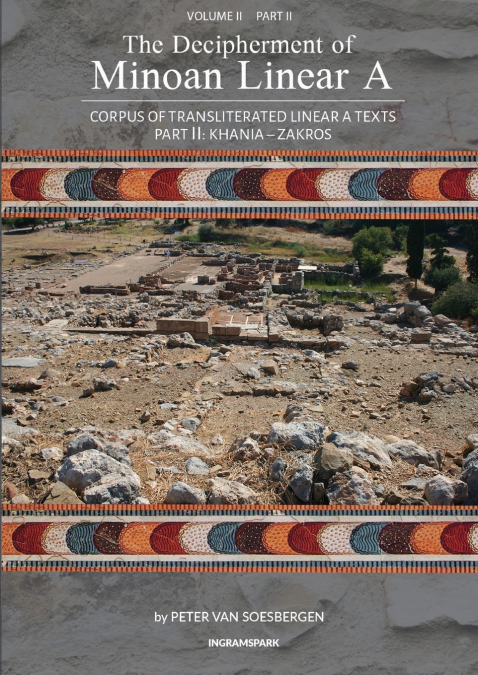
  • The Decipherment of Minoan Linear A, Volume II, Part II
    Peter George van Soesbergen
        For a long time many scholars hesitated to transliterate Minoan Linear A as long as there was no decisive evidence that the phonetic values of Linear A signs were essentially the same as those of their Linear B counterparts. The question as to whether graphic identity of Linear A and B signs does or does not reflect phonetic identity was tested with the help of computer met...
    Disponible

    84,90 €

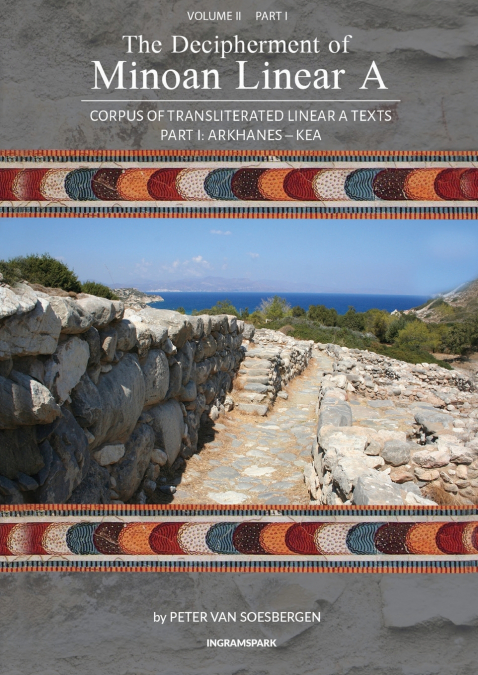
  • The Decipherment of Minoan Linear A, Volume II, Part I
    Peter George van Soesbergen
        For a long time many scholars hesitated to transliterate Minoan Linear A as long as there was no decisive evidence that the phonetic values of Linear A signs were essentially the same as those of their Linear B counterparts. The question as to whether graphic identity of Linear A and B signs does or does not reflect phonetic identity was tested with the help of computer met...
    Disponible

    84,54 €

  • The Decipherment of Minoan Linear A, Volume I, Part II
    Peter George van Soesbergen
    Volume I, Part II, comprises (together with Part I) the main text in the series The Decipherment of Minoan Linear A. Volume I, Parts III-VI, are the indices to the main text and glossaries at the same time.   The author shows that the Holy Trinity of the main Hurrian Gods, Tešub, Ḫebat and their son Šarruma is addressed in a sophisticated, poetic way, usually at the beginning o...
    Disponible

    84,92 €

  • The Decipherment of Minoan Linear A, Volume I, Part III
    Peter George van Soesbergen
        Overall there is a great unity of evidence visible in all Minoan palatial centres, villas and farm-houses. The administrative clay tablets with Linear A inscriptions offer mainly lists of personal names, consisting of Hurrian ’sentence names’ and so-called ’one-word’ names comparable with those from Near-Eastern and Anatolian centres. It is significant that we find both ’Ol...
    Disponible

    84,90 €

  • The Decipherment of Minoan Linear A, Volume I, Part V
    Peter George van Soesbergen
        One feature of Minoan-Hurrian appears to corresponds specifically with the evidence from Nippur, where Hurrian personal names are attested with the theophorous element irmi / ermi as a variant of erwi at Nuzi and ewri / ibri ’Lord’ and ’king’ in the Tušratta letter and elsewhere, cf. Ir-me/mi-ta-at-ta and Ir-me-ta-ta at Nippur (Clay PNCP, 93), to be read Erme/i-tatta, i.e. ...
    Disponible

    84,87 €

  • The Decipherment of Minoan Linear A, Volume I, Part VI
    Peter George van Soesbergen
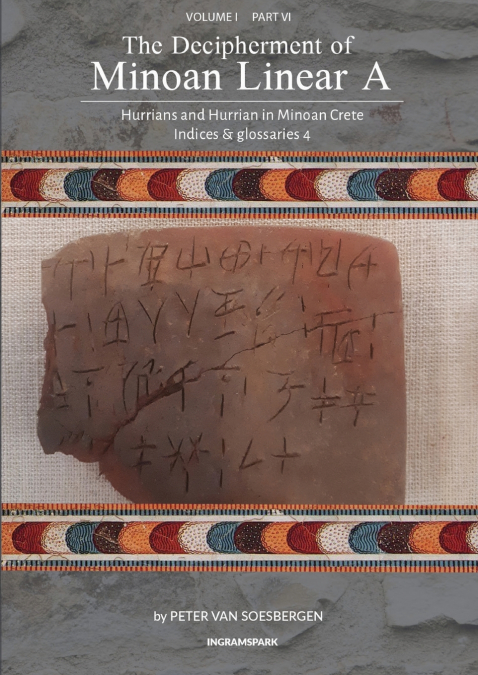
    A photograph of Linear A tablet KH 5 from Xανιά / Khaniá is on the front-cover.    KH 5.1-2:    a-da-ki-si-ka , a-ra-u-|da ,     KH 5.2:       wi-sa-sa-ne                        HORD+E 2        VINb+9  2    KH 5.3:       wi-na-du ,                           OVIS+na 1    KH 5.3-4:    ku-pa-do                            HORD [ ] 5 A     FIC         2 JB    Linear A a-da-ki-si-ka ...
    Disponible

    84,90 €