 Librería Samer Atenea
 Kálamo Books
 Librería Elías (Asturias)
 Librería Kolima (Madrid)
 Librería Proteo (Málaga)
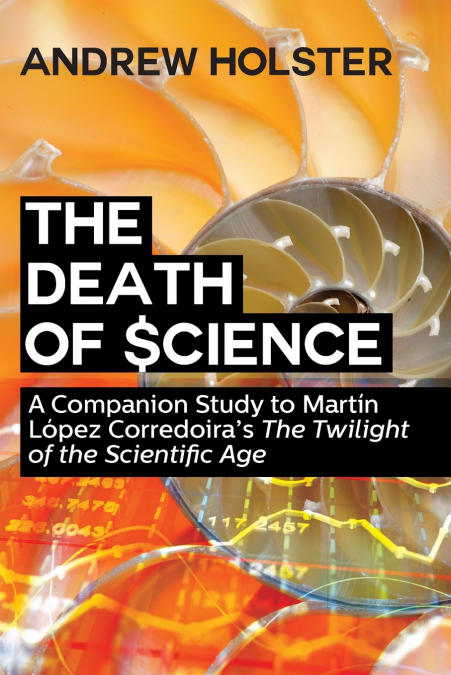
Modern science is in unprecedented crisis. It is a crisis at many levels, continuous with larger crises of modern society. It is a crisis for the vocation of the scientist working within the modern institutionalised structures of science. It is a crisis for our capacity to use science benevolently to help solve larger material, organisational, and ultimately political problems of the modern era. And it is a crisis for philosophy, for the role of natural science to help inform our world-view. The Death of Science is an account of deeper causes of this malaise. It starts by taking up the reins of López Corredoira’s (2013) The Twilight of the Scientific Age, a recent critique that concludes with modern science on its death bed. It dissects key themes in detail, illustrated in the same frank style, drawing on personal examples. It starts with deep issues in the philosophy of science, recounting failed modern concepts of scientific progress, method and truth, going on to failures of peer review and gate-keeping as quality control systems, the domination of propaganda and marketing channels as the critical tools for professional success, and the major outcome for creative scientists themselves: the destruction of scientific creativity and exclusion of heterodox thinkers in this degraded environment. It connects the behavioural symptoms with a psycho-social analysis of the bureaucratic mode of organisation under which science, like all other modern vocations, is now subsumed.The account supports López Corredoira’s appraisal, which sees a modern science industry driven by greed and ambition, repressing imagination and freedom, destructive of novelty and diversity of ideas, controlled by bureaucratic-academic power hierarchies. While science is irrevocably corrupted by its modern mass-institutionalisation, the true spirit of science can only be sustained by individuals with a real vocation as scientists, or natural philosophers, who seek understanding and meaning and wisdom, rather than technocratic specialisation and careers. But it is increasingly impossible for scientists to withstand forces of professional conformity, and maintain their personal sense of value. A number of current controversies in some core sciences are also discussed, and it is argued that the greatest revelations of real science are yet to come. While Establishment Science has locked itself into dogmatic paradigms, the failures of present theories show that we are really on the cusp of major revolutions, spanning sciences of physics and cosmology, information and intelligence, biology and evolution, and mind and consciousness. If these are realised, they will profoundly change our understanding of the nature of the world and ourselves. But any such revolutions challenge a Science Establishment locked into the self-interest of its power-brokers, and are unlikely to occur except through independent scientists working outside the institutional system. The book concludes with a brief discussion of the place of independent scientists.