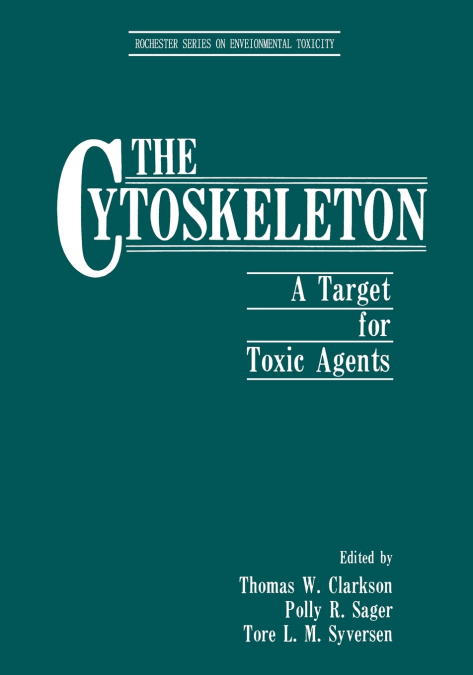
The Cytoskeleton

The Cytoskeleton

Polly R. Sager / Thomas W. Clarkson / Tore L. M. Syversen

68,01 €
IVA incluido
Disponible
Editorial:
Springer Nature B.V.
Año de edición:
2011
Materia
Bioquímica
ISBN:
9781461292746
68,01 €
IVA incluido
Disponible

Selecciona una librería:

  • Librería Samer Atenea
  • Librería Aciertas (Toledo)
  • Kálamo Books
  • Librería Perelló (Valencia)
  • Librería Elías (Asturias)
  • Donde los libros
  • Librería Kolima (Madrid)
  • Librería Proteo (Málaga)

This book is based on reviews and research presentations given at the 16th Rochester International Conference on Environmental Toxicity, entitled liThe Cytoskeleton: A Target for Toxic Agents,' held on June 4, 5 and 6 in 1984. The conference provided an in-depth discussion of the effects a~d mechanism of action of some toxic agents on the cytoskeleton. Mamma'lian and other eukaryotic cells contain protein networks within the cytoplasm comprised of microfilaments, intermediate Hlaments and microtubules. These components of the cytoskeleton playa key role in cell shape, motility, intracellular organization and transport, and cell division. Furthermore, the cytoskeleton, via associations with the cell membrane, appears to function in intracellular communication and cellular responses to membrane events. Because of the complex functional roles of the cytoskeleton which vary with cell type, degree of differentiation, and cell cycle, its disruption may result in a variety of cellular changes. This expanding field in cell biology has already attracted the interest of toxicologists and environmental health scientists as a potentially fruitful area of research. Indeed, there is mounting evidence that certain toxic and chemotherapeutic compounds, as well as physical agents such as radiation and hydrostatic pressure, disrupt the normal structure and function of the cytoskeleton. This may be an important step in the overall expression of their action. It was, therefore, an opportune time to hold a conference to encourage the development of this area of toxicology and to suggest directions for future research.
Artículos relacionados

  • Implementation of Automated Urinary Sediment Analyzer UF1000
    Adriana Manuel
    Comparative work of Urinary Sediment between data obtained in automated platform, Roche UF 1000 flow cytometer versus the gold standard optical microscopy method. This work was carried out with raw data from known patients whose expected results allowed us to define the non-pathological sample parameters obtained in automated equipment. The experience was enriching, working wit...
    Disponible

    48,30 €

  • Bioprocess Technology
    I Arul Pandi / P T Kalaichelvan
    Dive into the dynamic world of Bioprocess Technology, where biology, engineering, materials science, and clinical procedures seamlessly converge to create a multidisciplinary marvel. In an era where innovation knows no bounds, Bioprocessing stands at the forefront, transcending boundaries to shape diverse facets of the biological landscape.This illuminating book is meticulously...
    Disponible

    45,13 €

  • Produção De Membrana Barreira Para Regeneração Óssea Guiada Com Zeína
    Cristiane Michele Bonadio De Oliveira
    O Presente Estudo Desenvolveu Uma Membrana Com Proteína De Origem Vegetal Conhecida Por Zeína, Com Possibilidades Biodegradáveis Para Regeneração Óssea Guiada (Rog), Sendo Suas Particularidades Discutidas Ao Longo Do Trabalho. Para Melhor Entendimento A Respeito Do Tema, Serão Discutidos Alguns Conceitos E Definições Acerca Da Proteína E Da Rog. 10 ...
    Disponible

    17,16 €

  • Hydrolysis of cashew bagasse to obtain bioethanol
    João Paulo Dantas de Carvalho
    Recently, the global demand for fuel ethanol has been expanding very rapidly, and almost all fuel ethanol is produced by fermenting sucrose in Brazil or corn glucose in the United States, but these raw materials will not be enough to satisfy international demand. Agro-industrial lignocellulosic residues, such as cashew bagasse, sugarcane bagasse, soybean hulls, etc., are abunda...
    Disponible

    54,32 €

  • Hydrolyse de la bagasse de cajou pour obtenir du bioéthanol
    João Paulo Dantas de Carvalho
    Récemment, la demande mondiale d’éthanol-carburant a augmenté très rapidement, et presque tout l’éthanol-carburant est produit par fermentation de saccharose au Brésil ou de glucose de maïs aux États-Unis, mais ces matières premières ne suffiront pas à satisfaire la demande internationale. Les résidus lignocellulosiques agro-industriels, tels que la bagasse de cajou, la bagasse...
    Disponible

    54,38 €

  • Hydrolyse von Cashew-Bagasse zur Gewinnung von Bioethanol
    João Paulo Dantas de Carvalho
    In letzter Zeit ist die weltweite Nachfrage nach Ethanol-Kraftstoff sehr schnell gestiegen, und fast der gesamte Ethanol-Kraftstoff wird durch die Fermentierung von Saccharose in Brasilien oder Maisglukose in den Vereinigten Staaten hergestellt, aber diese Rohstoffe reichen nicht aus, um die internationale Nachfrage zu decken. Agroindustrielle lignozellulosehaltige Rückstände w...
    Disponible

    54,38 €