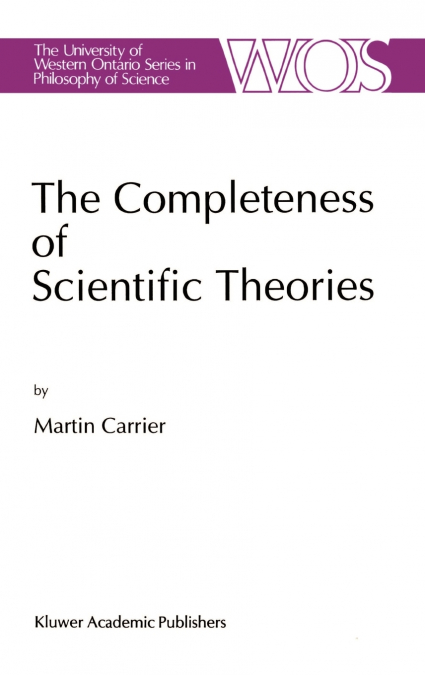
The Completeness of Scientific Theories

The Completeness of Scientific Theories

Martin Carrier

207,65 €
IVA incluido
Disponible
Editorial:
Springer Nature B.V.
Año de edición:
2012
Materia
Influencia de la ciencia y la tecnología sobre la sociedad
ISBN:
9789401043939
207,65 €
IVA incluido
Disponible

Selecciona una librería:

  • Librería Samer Atenea
  • Librería Aciertas (Toledo)
  • Kálamo Books
  • Librería Perelló (Valencia)
  • Librería Elías (Asturias)
  • Donde los libros
  • Librería Kolima (Madrid)
  • Librería Proteo (Málaga)

Earlier in this century, many philosophers of science (for example, Rudolf Carnap) drew a fairly sharp distinction between theory and observation, between theoretical terms like ’mass’ and ’electron’, and observation terms like ’measures three meters in length’ and ’is _2° Celsius’. By simply looking at our instruments we can ascertain what numbers our measurements yield. Creatures like mass are different: we determine mass by calculation; we never directly observe a mass. Nor an electron: this term is introduced in order to explain what we observe. This (once standard) distinction between theory and observation was eventually found to be wanting. First, if the distinction holds, it is difficult to see what can characterize the relationship between theory :md observation. How can theoretical terms explain that which is itself in no way theorized? The second point leads out of the first: are not the instruments that provide us with observational material themselves creatures of theory? Is it really possible to have an observation language that is entirely barren of theory? The theory-Iadenness of observation languages is now an accept­ ed feature of the logic of science. Many regard such dependence of observation on theory as a virtue. If our instruments of observation do not derive their meaning from theories, whence comes that meaning? Surely - in science - we have nothing else but theories to tell us what to try to observe.

Artículos relacionados

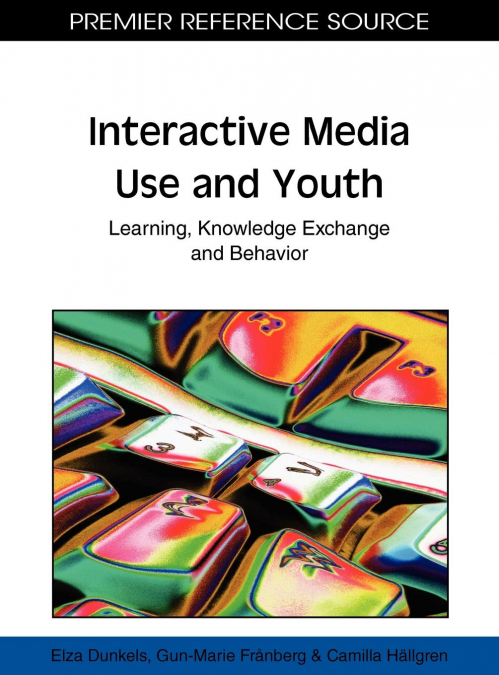
  • Interactive Media Use and Youth
    Modern advancements in technology have changed the way that young people use interactive media. Learning from such methods was not even considered until recently. It is now slowly defining the landscape of contemporary pedagogical practices. Interactive Media Use and Youth: Learning, Knowledge Exchange and Behavior provides a comprehensive collection of knowledge based on diffe...
  • Social and Economic Effects of Community Wireless Networks and Infrastructures
    Abdelaal
    It is surprising to think that in today’s rapidly evolving world of technology, over half of the globe still does not have access to high speed internet. Creating community wireless networks has in the past been a way to provide remote communities with internet and network access. Social and Economic Effects of Community Wireless Networks and Infrastructures highlights the succ...
  • The New Atlantis
    Francis Bacon
    In this work, Bacon portrayed a vision of the future of human discovery and knowledge, expressing his aspirations and ideals for humankind. The novel depicts the creation of a utopian land where 'generosity and enlightenment, dignity and splendour, piety and public spirit' are the commonly held qualities of the inhabitants of 'Bensalem'. ...
  • Sport 2.0
    Andy Miah
    ...
    Disponible

    28,86 €

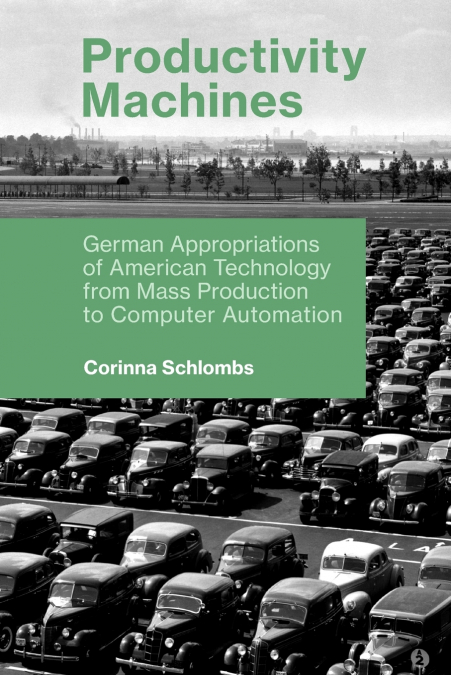
  • Productivity Machines
    Corinna Schlombs
    ...
    Disponible

    48,52 €

  • Open Space
    Mariel Borowitz
    ...
    Disponible

    38,25 €

Otros libros del autor

  • Executive Politics in Semi-Presidential Regimes
    Martin Carrier
    This book analyzes the variation of power distribution between presidents and prime ministers in semi-presidential regimes. Through selected case studies, it exposes the necessity to understand power variation in a configurative perspective and to further consider contextual factors. ...
  • The Completeness of Scientific Theories
    Martin Carrier
    Earlier in this century, many philosophers of science (for example, Rudolf Carnap) drew a fairly sharp distinction between theory and observation, between theoretical terms like ’mass’ and ’electron’, and observation terms like ’measures three meters in length’ and ’is _2° Celsius’. By simply looking at our instruments we can ascertain what numbers ou...