
The Complete Essays of Plutarch (Deluxe Library Edition)

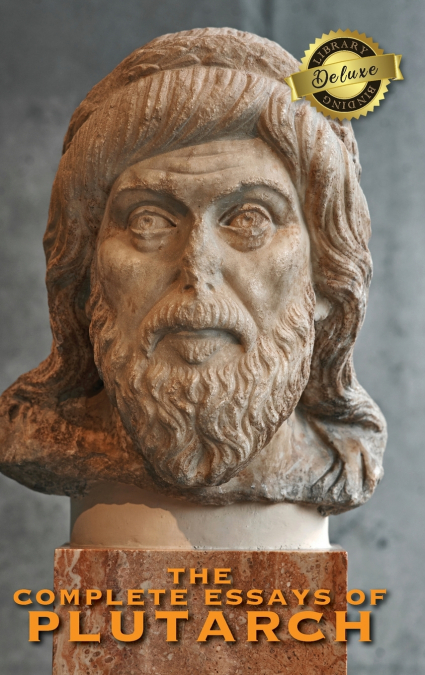
The Complete Essays of Plutarch (Deluxe Library Edition)

Plutarch

54,43 €
IVA incluido
Consulta disponibilidad
Editorial:
Engage Books
Año de edición:
2020
Materia
Filosofía occidental: antigua, hasta c. 500
ISBN:
9781774760611

Selecciona una librería:

  • Librería Samer Atenea
  • Librería Aciertas (Toledo)
  • Kálamo Books
  • Librería Perelló (Valencia)
  • Librería Elías (Asturias)
  • Donde los libros
  • Librería Kolima (Madrid)
  • Librería Proteo (Málaga)

The Complete Essays of Plutarch includes 133 chapters on nature, Plutarch’s Symposiacs, as well as his collection of literary essays. Plutarch was a Platonist, but was open to the influence of the Peripatetics, and in some details even to Stoicism despite his criticism of their principles. He rejected only Epicureanism absolutely. He attached little importance to theoretical questions and doubted the possibility of ever solving them. He was more interested in moral and religious questions.Plutarch’s writings had an enormous influence on English and French literature. Shakespeare paraphrased parts of Thomas North’s translation of selected Lives in his plays, and occasionally quoted from them verbatim. Plutarch’s influence declined in the 19th and 20th centuries, but it remains embedded in the popular ideas of Greek and Roman history. One of his most famous quotes was one that he included in one of his earliest works. 'The world of man is best captured through the lives of the men who created history.'


Artículos relacionados

  • The Nature of Things
    Lucretius Lucretius
    De rerum natura (On the Nature of Things) is a 1st century BC didactic poem by the Roman poet and philosopher Lucretius with the goal of explaining Epicurean philosophy to a Roman audience. Lucretius presents the principles of atomism; the nature of the mind and soul; explanations of sensation and thought; the development of the world and its phenomena; and explains a variety o...
  • Pompeii
    Fergus Mason
    Pompeii was one of most advanced cities of its time; it had a complex water system, gymnasium, and an amphitheater. Despite it's advancements, there was one thing it wasn't ready for: Mount Vesuvius—the volcano that led to its ultimate doom.  The 79 AD eruption of Mount Vesuvius was one of the worst disasters in all of European history. In a near instant, over 15,000 p...
    Disponible

    10,36 €

  • Middle Platonism and Neoplatonism, Volume 1
    Stephen Gersh
    'It is generally agreed that those types of philosophy that are loosely called ’Platonic’ and ’Neoplatonic’ played a crucial role in the history of European culture during the centuries between antiquity and the Renaissance. However, until now no scholar has attempted to describe the evolution of these forms of thought in a single comprehensive academic study.' So writes Stephe...
  • Middle Platonism and Neoplatonism, Volume 2
    Stephen Gersh
    It is generally agreed that those types of philosophy that are loosely called 'Platonic' and 'Neoplatonic' played a crucial role in the history of European culture during the centuries between antiquity and the Middle Ages. However, until now no scholar has attempted to describe the evolution of these forms of thought in a single comprehensive academic study. Middle Platonism a...
  • Porphyry’s Commentary on Ptolemy’s Harmonics
    Andrew Barker
    ...
    Disponible

    77,17 €

  • The Roots of Platonism
    John Dillon
    ...
    Disponible

    25,29 €

Otros libros del autor

  • Plutarch’s Lives Vol. 3
    Plutarch
    Plutarch’s Lives of the Noble Greeks and Romans, commonly called Parallel Lives or Plutarch’s Lives, is a series of biographies of famous men, arranged in tandem to illuminate their common moral virtues or failings. The surviving Parallel Lives, contain twenty-three pairs of biographies, each pair consisting of one Greek and one Roman, as well as four unpaired, single lives. It...
  • Plutarch’s Lives Vol. 1
    Plutarch
    Plutarch’s Lives of the Noble Greeks and Romans, commonly called Parallel Lives or Plutarch’s Lives, is a series of biographies of famous men, arranged in tandem to illuminate their common moral virtues or failings. The surviving Parallel Lives, contain twenty-three pairs of biographies, each pair consisting of one Greek and one Roman, as well as four unpaired, single lives. It...
  • Lives of the Noble Grecians and Romans Vol. 4
    Plutarch
    Plutarch’s Lives of the Noble Greeks and Romans, commonly called Parallel Lives or Plutarch’s Lives, is a series of biographies of famous men, arranged in tandem to illuminate their common moral virtues or failings. The surviving Parallel Lives, contain twenty-three pairs of biographies, each pair consisting of one Greek and one Roman, as well as four unpaired, single lives. ...
  • Lives of the Noble Grecians and Romans Vol. 1
    Plutarch
    Plutarch’s Lives of the Noble Greeks and Romans, commonly called Parallel Lives or Plutarch’s Lives, is a series of biographies of famous men, arranged in tandem to illuminate their common moral virtues or failings. The surviving Parallel Lives, contain twenty-three pairs of biographies, each pair consisting of one Greek and one Roman, as well as four unpaired, single lives. ...
  • Plutarch’s Lives - Volume I (Esprios Classics)
    Plutarch
    Plutarch’s Lives of the Noble Greeks and Romans, commonly called Parallel Lives or Plutarch’s Lives, is a series of 48 biographies of famous men, arranged in tandem to illuminate their common moral virtues or failings, probably written at the beginning of the second century AD. The surviving Parallel Lives comprises 23 pairs of biographies, each pair consisting of one Greek and...
  • The Boys’ and Girls’ Plutarch (Esprios Classics)
    Plutarch
    Plutarch (AD 46-after 119) was a Greek Middle Platonist philosopher, biographer, essayist, and priest at the Temple of Apollo. He is known primarily for his Parallel Lives, a series of biographies of illustrious Greeks and Romans, and Moralia, a collection of essays and speeches. Upon becoming a Roman citizen, he was named Lucius Mestrius Plutarchus. Plutarch’s best-known work ...