 Librería Samer Atenea
 Kálamo Books
 Librería Elías (Asturias)
 Librería Kolima (Madrid)
 Librería Proteo (Málaga)
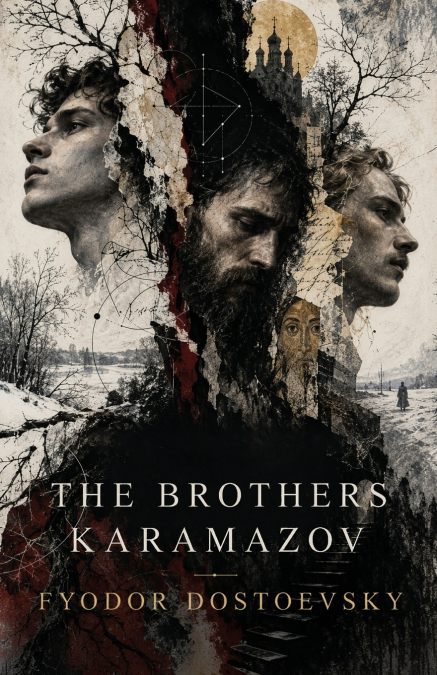
Three brothers-passionate Dmitri, intellectual Ivan, and spiritual Alyosha-are drawn into the destructive orbit of their vulgar, selfish father, Fyodor Pavlovich Karamazov. Rivalries over money, inheritance, desire, and resentment deepen until the family’s private hatreds move toward murder.Dmitri’s volatile conflict with his father places him immediately under suspicion, but the crime reaches far beyond a single act of violence. Ivan’s intellectual rebellion against suffering and religious belief, Alyosha’s commitment to compassion and spiritual responsibility, and the shadowed role of Smerdyakov turn the murder into a test of what guilt really means. Dostoevsky asks whether responsibility belongs only to the person who acts, or also to those whose ideas, desires, indifference, or hatred help make an action possible.The investigation and trial intensify those questions. Legal evidence, public opinion, family history, and psychological interpretation compete to produce a version of the truth, while the characters themselves struggle with guilt that is moral, emotional, spiritual, and sometimes independent of legal blame.Around the murder plot, Dostoevsky builds some of his most searching discussions of faith and doubt. Ivan confronts the suffering of innocent children and the problem of a just God; Alyosha represents a vision of active love and spiritual responsibility; Dmitri wrestles with passion, shame, and the desire for renewal. Their arguments are never merely abstract. Each philosophy is tested through relationships, choices, and consequences.The novel’s power also comes from its refusal to make any single character a simple embodiment of an idea. Faith contains uncertainty, skepticism carries moral seriousness, love can coexist with selfishness, and guilt does not always align neatly with crime. The Karamazov family becomes a stage on which questions of freedom, responsibility, suffering, justice, and redemption collide.Serialized from 1879 to 1880 and published in book form in 1880, The Brothers Karamazov was Dostoevsky’s final novel. It brings together the psychological intensity, religious questioning, dark humor, courtroom drama, and moral conflict that define his mature fiction.Part family tragedy, part murder mystery, and part philosophical novel, The Brothers Karamazov asks one of Dostoevsky’s most difficult questions: how much responsibility do we bear for one another? Its answer remains deliberately unsettled, giving the novel its enduring force.