 Librería Samer Atenea
 Kálamo Books
 Librería Elías (Asturias)
 Librería Kolima (Madrid)
 Librería Proteo (Málaga)
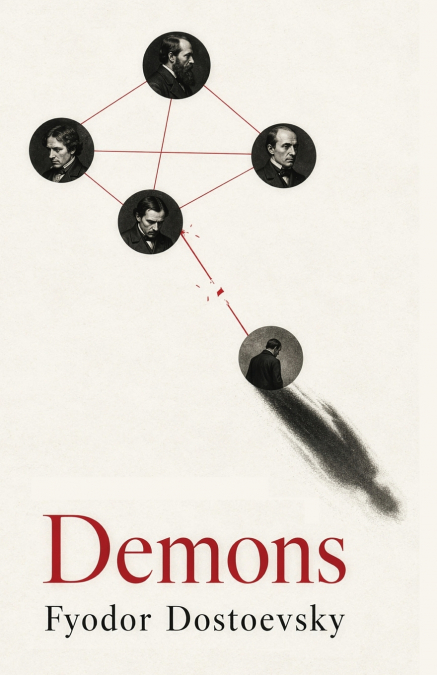
Pyotr Verkhovensky returns to a provincial Russian town with revolutionary ambitions and a talent for manipulation. Claiming connections to a larger underground movement, he begins assembling a secret political cell while trying to use the enigmatic Nikolai Stavrogin as a source of prestige and authority. What begins as conspiracy soon draws an entire community into a web of secrecy, resentment, ideological fanaticism, and violence.At the center of the novel stand two very different forms of danger. Pyotr is energetic, calculating, and determined to organize others around his revolutionary aims. Stavrogin, by contrast, possesses an unsettling charisma combined with moral detachment. Other characters project their beliefs and ambitions onto him, turning his apparent emptiness into a kind of power. Around them gather intellectuals, officials, idealists, social climbers, disillusioned radicals, and families whose private conflicts become inseparable from the political unrest surrounding them.Dostoevsky also sets one generation against another. Stepan Trofimovich Verkhovensky and his circle represent an older world of liberal intellectualism, cultivated conversation, and abstract ideals. The younger radicals take some of those ideas in far more extreme directions, demanding action, secrecy, obedience, and the destruction of existing institutions. The contrast allows Dostoevsky to examine how theories that appear harmless in discussion can acquire very different consequences when transformed into political programs.As Pyotr tightens his control over the conspirators, loyalty is maintained through fear, suspicion, and the belief that each member belongs to something larger than himself. Personal grievances become political weapons, while ideological conviction mixes with vanity, humiliation, ambition, and the desire for power. The result is not a simple argument about one doctrine, but a darker investigation into the psychological forces that can make extremism attractive.First serialized from 1871 to 1872, Demons was written during a period of intense political debate in Russia and was partly inspired by a notorious revolutionary murder. Dostoevsky transformed those immediate concerns into a much broader novel about nihilism, radicalism, moral responsibility, and the destructive potential of ideas separated from conscience.Darkly comic, psychologically intense, and increasingly ominous, Demons is both a political novel and a study of collective moral collapse. It asks what happens when people surrender individual responsibility to ideology, when charismatic figures become vessels for other people’s beliefs, and when the promise of liberation begins to justify manipulation, secrecy, and violence.