
The Book of Sirach (or Ecclesiasticus)

The Book of Sirach (or Ecclesiasticus)

Anonymous

16,39 €
IVA incluido
Disponible
Editorial:
Bibliotech Press
Año de edición:
2023
Materia
Historia social y cultural
ISBN:
9798888305188
16,39 €
IVA incluido
Disponible

Selecciona una librería:

  • Librería Samer Atenea
  • Librería Aciertas (Toledo)
  • Kálamo Books
  • Librería Perelló (Valencia)
  • Librería Elías (Asturias)
  • Donde los libros
  • Librería Kolima (Madrid)
  • Librería Proteo (Málaga)

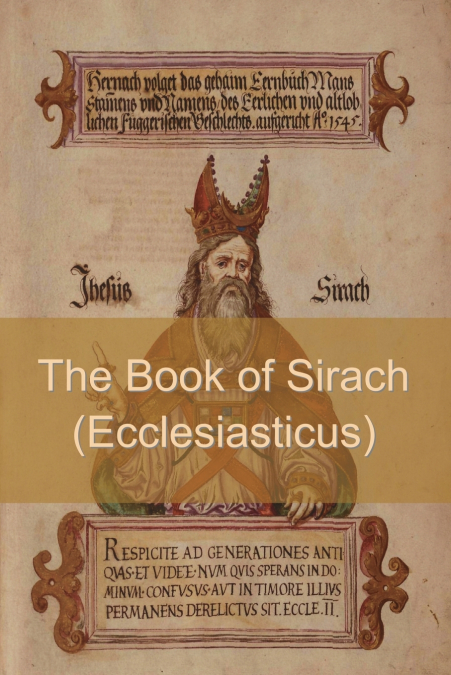
The Book of Sirach (Ecclesiasticus ; abbreviated Ecclus.) is a Jewish work, originally in Hebrew, of ethical teachings, from approximately 200 to 175 BCE, written by the Judahite scribe Ben Sira of Jerusalem, on the inspiration of his father Joshua son of Sirach, sometimes called Jesus son of Sirach or Yeshua ben Eliezer ben Sira.In Egypt, it was translated into Greek by the author’s unnamed grandson, who added a prologue. This prologue is generally considered the earliest witness to a canon of the books of the prophets, and thus the date of the text is the subject of intense scrutiny. The book itself is the largest wisdom book from antiquity to have survived. Although excluded from the Jewish canon, Sirach was read and quoted as authoritative from the beginning of the rabbinic period. There are numerous citations to Sirach in the Talmud and works of rabbinic literature (as 'ספר בן סירא', e.g., Hagigah 13a, Niddah 16b; Ber. 11b). Some of those (Sanhedrin 100b) record an unresolved debate between R’Joseph and Abaye as to whether it is forbidden to read the book of Sirach, wherein Abaye repeatedly draws parallels between statements in Sirach cited by R’Joseph as objectionable and similar statements appearing in canonical books.Sirach may have been used as a basis for two important parts of the Jewish liturgy. In the Mahzor (High Holiday prayer book), a medieval Jewish poet may have used Sirach as the basis for a poem, Mar’e Kohen, in the Yom Kippur musaf ('additional') service for the High Holidays. Yosef Tabori questioned whether this passage in Sirach is referring at all to Yom Kippur, and thus argued it cannot form the basis of this poem. Some early 20th-century scholars also argued that the vocabulary and framework used by Sirach formed the basis of the most important of all Jewish prayers, the Amidah, but that conclusion is disputed as well.Current scholarship takes a more conservative approach. On one hand, scholars find that 'Ben Sira links Torah and wisdom with prayer in a manner that calls to mind the later views of the Rabbis', and that the Jewish liturgy echoes Sirach in the 'use of hymns of praise, supplicatory prayers and benedictions, as well as the occurrence of [Biblical] words and phrases [that] take on special forms and meanings.' However, they stop short of concluding a direct relationship existed; rather, what 'seems likely is that the Rabbis ultimately borrowed extensively from the kinds of circles which produced Ben Sira and the Dead Sea Scrolls ....' Some Christians regard the catalogue of famous men in Sirach as containing several messianic references. The first occurs during the verses on David. Sirach 47:11 reads 'The Lord took away his sins, and exalted his power for ever; he gave him the covenant of kings and a throne of glory in Israel.' This references the covenant of 2 Samuel 7, which pointed toward the Messiah. 'Power' (Hebrew qeren) is literally translated as ’horn’. This word is often used in a messianic and Davidic sense (e.g. Ezekiel 29:21, Psalms 132:17, Zechariah 6:12, Jeremiah 33:15). It is also used in the Benedictus to refer to Jesus ('and has raised up a horn of salvation for us in the house of his servant David').Another verse (47:22) that Christians interpret messianically begins by again referencing 2 Samuel 7. This verse speaks of Solomon and goes on to say that David’s line will continue forever. The verse ends stating that 'he gave a remnant to Jacob, and to David a root of his stock.' This references Isaiah’s prophecy of the Messiah: 'There shall come forth a shoot from the stump of Jesse, and a branch shall grow out of his roots'; and 'In that day the root of Jesse shall stand as an ensign to the peoples; him shall the nations seek...' (Isaiah 11:1, 10). (wikipedia.org)
Artículos relacionados

  • Arizal
    Raphael Afilalo
    The Ari overflowed with Torah. He was expert in Scripture, Mishnah, Talmud, Midrash, Maaseh Bereishit and Maaseh Merkavah. About all the different levels of prophecy, their details and from which level the prophets had their revelations.  He understood the whistling of the trees, the grass and stones, the language of the birds and other animals, the conversations of angels, the...
  • Rose-tinted Memory
    Michael S Fryer
    “Those who deny Auschwitz would be ready to remake it”.  ~ Primo Levi, Holocaust survivor and author Seventy years after the mass murder of the Jews of Europe, Holocaust denial and Holocaust revisionism are creeping into our overall perception of what actually happened.Christendom has not ‘denied’ Holocaust, but it has attempted to create a memory of Holocaust which suggests th...
    Disponible

    8,84 €

  • Pan Kapitan of Jordanow
    William Leibner
    Yeshayahu Drucker devoted a good part of his life to rescuing Jewish children from non-Jewish homes. Many parents had given their children to Polish neighbors for safekeeping during the war. Unfortunately most of the parents did not survive the Shoah. At the end of the war, there was no one to claim the children and they remained with the “adopted” Polish families. Following hi...
  • Holy Dissent
    Glenn Dynner
    BThe religious communities of early modern Eastern Europe—particularly those with a mystical bent—are typically studied in isolation. Yet the heavy Slavic imprint on Jewish popular mysticism and pervasive Judaizing tendencies among Christian dissenters call into question the presumed binary quality of Jewish-Christian interactions. In Holy Dissent: Jewish and Christian Mystics ...
  • AL-FARD
    Ali Mahdi Muhammad
    The Al-Fard, or the The Dawn, has captured the early rays of Our history. This history is essential if we are to be brought face to face with the One true and living God of the universe. The purpose of this writing is to bring the reader step by step, one degree at a time to the reality of God in person. The teachings of Our Father elevates the believer to the level of Godhood ...
  • Wild Things. Nature and the Social Imagination
    HISTORIES OF HUMAN CONSTRUCTIONS OF NATUREWild Things: Nature and the Social Imagination assembles eleven substantive and original essays on the cultural and social dimensions of environmental history. They address a global cornucopia of social and ecological systems, from Africa to Europe, North America and the Caribbean, and their temporal range extends from the 1830s into th...

Otros libros del autor

  • The Martyr of the Catacombs
    Anonymous
    The Martyr of the Catacombs chronicles the treatment of early Christian’s by the Romans. A well written novel with a message. ...
  • The Cloud of Unknowing
    Anonymous
    The Cloud of Unknowing draws on the mystical tradition of Pseudo-Dionysius the Areopagite and Christian Neoplatonism, which focuses on the via negativa road to discovering God as a pure entity, beyond any capacity of mental conception and so without any definitive image or form. This tradition has reputedly inspired generations of mystical searchers from John Scotus Erigena, th...
  • Scottish Psalter and Paraphrases
    Anonymous
    This contains the Scottish Psalter and Scripture Paraphrases, the primary hymnal of the Church of Scotland up through the 19th century. The Church of Scotland is a Presbyterian church, decisively shaped by the Scottish Reformation. ...
  • Westminster Confession of Faith
    Anonymous
    The Westminster Confession of Faith is a Reformed confession of faith, in the Calvinist theological tradition. Although drawn up by the 1646 Westminster Assembly, largely of the Church of England, it became and remains the ’subordinate standard’ of doctrine in the Church of Scotland, and has been influential within Presbyterian churches worldwide. ...
  • The Westminster Larger Catechism
    Anonymous
    In 1643 when the Long Parliament of England called the Westminster Assembly to produce the Westminster Confession, it also asked for a directory of 'catechising'. The Assembly asked Herbert Palmer to produce a draft of the Larger Catechism. Robert Baillie and other Scottish delegates found the work disappointing. In December 1643 a committee was formed to write the Catechism. I...
  • The Martyr of the Catacombs
    Anonymous
    The Martyr of the Catacombs is a great old Christian fiction classic text done by an anonymous author that deals with the subjects of ancient Rome and the early history of the Christian Church.This Christian classic features this opening passage: 'Butchered to make a Roman holiday.'It was a great festival day in Rome. From all quarters vast numbers of people came pouring forth...