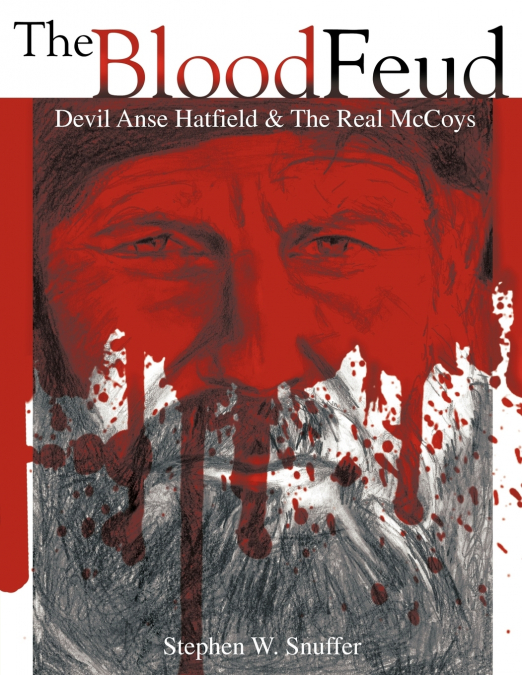
The Blood Feud

The Blood Feud

The Blood Feud

Stephen W. Snuff / Stephen WSnuff

49,94 €
IVA incluido
Disponible
Editorial:
Trafford Publishing
Año de edición:
2012
Materia
Historia de América
ISBN:
9781466952041
49,94 €
IVA incluido
Disponible

Selecciona una librería:

  • Librería Samer Atenea
  • Librería Aciertas (Toledo)
  • Kálamo Books
  • Librería Perelló (Valencia)
  • Librería Elías (Asturias)
  • Donde los libros
  • Librería Kolima (Madrid)
  • Librería Proteo (Málaga)

The Hatfield-McCoy feud of the 1880s and some time thereafter is one of the noted stories of folklore in America. Today the causes of that family and friends war between the Hatfields and the McCoys will be considered-the events which led up to the tragedy. There were many causes, an accumulation of things, which finally touched off the feud, or private war, which it actually was, between two determined families. First cause I think can be attributed to the very natures of those concerned. Both families were people of nerve because blood of British origin pulsed in their veins. That blood bespoke stubborn resistance and unflinching determination, an unwavering set. Came the Civil War of 1861-65 and neighbor lined up against neighbor. In the Union corner was Randolph McCoy, leader of the McCoy clan. In the Confederate corner, 'six feet of devil and 180 pounds of hell,' according to Randolph McCoy, was Anderson ('Devil Anse') Hatfield, head of the Hatfield horde. When the war ended in 1865, the internecine feelings of these two neighboring families-only the narrow Tug River separated them-did not make for friendly relations. Indeed it had been rumored that 'Devil Anse' Hatfield, in the course of his warfare sometime before the Civil War ended, had slain Harmon McCoy, a brother of Randolph McCoy. This rumor was never proven. In fact, some stated that Jim Vance, later to die in the feud as a friend of the Hatfields, was the one who murdered Harmon McCoy. Whoever killed Harmon McCoy is unknown for sure even to this day, but one thing is sure, his death created ill feeling between the McCoys and the Hatfields, from the McCoy corner, of course. A third cause of the feud was a family quarrel, which wound up in the court of a justice of the peace. That was eight years after the Civil War had ended. In those days in the rugged regions of the Tug, the people let their hogs run loose and fatten on the mast of nut-bearing trees, chestnut, acorn, hazel, and other trees. Hogs were marked, their ears being cut with definite earmarks. In fact, a farmer then had his own earmarks registered with the county court just as he put deeds to his real estate on record.
Artículos relacionados

  • Pan-Africanism and Education
    Kenneth J. King / Kenneth JKing
    This is an analysis of the complex links between Black America and Africa in the period of 1880 to 1945. It examines an extended white attempt to pattern politics and education in colonial Africa upon the example of the U.S. South. This export of United States race relations to Africa was resisted by Black intellectuals in the United States and many of the early nationalists in...
    Disponible

    24,60 €

  • The Native American Cookbook Recipes From Native American Tribes
    G.W. Mullins
    Light Of The Moon Publishing along with Author G.W. Mullins and Illustrator / Artist C.L. Hause have joined together to explore Native American Indian Cooking.  More than just a cookbook, this Native American recipe collection offers a look into a forgotten past.  'The Native American Cookbook Recipes From Native American Tribes,' offers a large collection of recipes from and i...
    Disponible

    24,56 €

  • A Public Spirit
    George H. Atkinson
    George Henry Atkinson (1819-89) was a son of New England who arrived in the Oregon Territory in 1848, sent by the American Home Missionary Society. Although his commission from the Society specified that his work was to be ecclesiastical and educational, he took an approach to that assignment which went well beyond his mandate. Well-informed and energetic, he made an impact on ...
    Disponible

    10,45 €

  • North Carolina Women of the Confederacy
    Lucy London Anderson
    Long out of print, this volume of recollections, stories, and verse provides a glimpse of women's lives on the home front-and sometimes in the thick of battle-during the War between the States. Nearly fifty years after the American Civil War, Lucy Worth London Anderson (Mrs. John Huske Anderson) of Fayetteville, N.C., compiled one of the first memorial collections honoring the...
    Disponible

    17,20 €

  • Freedom by a Thread
    Freedom by a Thread: The History of Quilombos in Brazil brings together some of the best scholars in the world working on the history of quilombos (maroon societies) in Brazil from a variety of perspectives and approaches. Over 40 percent of the total volume of captive Africans arrived in Brazil during a 400-year period of legal and contraband transatlantic slaving. If slavery ...
    Disponible

    36,71 €

  • Nashville Baseball History
    Bill Traughber
    Nashville is a Big League city despite never having been home to a major league team. From the Civil War era, to star-studded exhibitions, to outstanding Negro Leagues teams, to some of the great minor league franchises of all time, few cities have as rich a baseball tradition as Nashville, Tennessee.Nashville sports historian Bill Traughber, who has been writing about baseball...
    Disponible

    13,15 €