 Librería Samer Atenea
 Kálamo Books
 Librería Elías (Asturias)
 Librería Kolima (Madrid)
 Librería Proteo (Málaga)
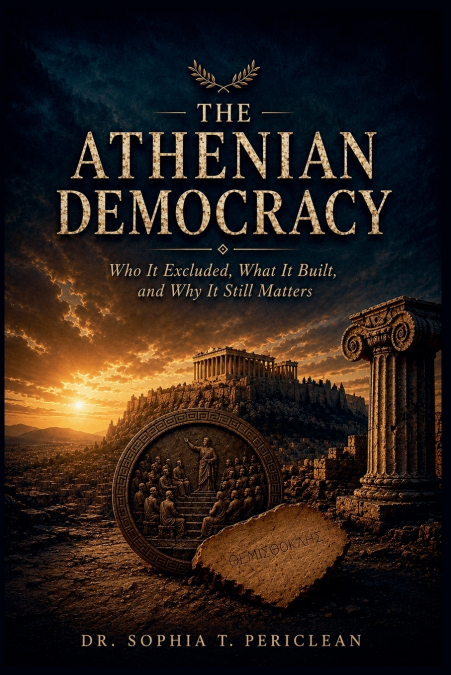
In the spring of 431 BC, Pericles stood before his fellow citizens and called Athens a school for all of Greece, a city where power belonged to the many rather than the few. It is one of the most quoted speeches in history. It was also delivered to a room that did not contain most of the people it claimed to represent.The Athenian Democracy tells the full story, the one usually left half told. Yes, Athens invented mass citizen government: an Assembly open to any man who could climb a hill, a Council of Five Hundred chosen by lottery, courts where six hundred ordinary citizens, not judges, decided whether a man lived or died. These were genuine, radical inventions, and this book explains exactly how they worked, in vivid, human detail.But the same afternoon Pericles spoke, an enslaved woman ground grain in a house she could never own. A merchant who had lived in Athens for thirty years, paid its taxes, and buried his children in its soil packed his cart knowing he would die a foreigner. A few hours’ walk away, thousands of enslaved men worked the silver mines that financed the fleet, the pay, and the democracy itself.Dr. Sophia T. Periclean takes you inside both Athens at once. You will stand on the Pnyx as six thousand citizens debate, reverse themselves overnight, and nearly execute their own victorious generals. You will watch Themistocles, the man who saved Greece from Persia, exiled by the very system he saved. You will meet Aspasia, the one woman whose voice history preserved, and understand exactly why it was preserved, and what that says about every voice it did not. You will descend into the mines at Laurion, sit in judgment with a jury of five hundred and one strangers, and follow the amnesty that let a broken city forgive itself after the Thirty Tyrants nearly finished it for good.This is not a textbook. It reads like the story it actually is: a city inventing self government while standing on the labor of the people it refused to let govern themselves, a tension it never resolved and that every democracy since, including your own, has inherited.Written with the pace of narrative history and the precision of a scholar who has spent a career in these sources, The Athenian Democracy answers the questions your high school class skipped. Who actually got to vote, and how many people is that, really? What happened to the people who did not? Why did Athens, of all places, put its own philosopher to death? And what, if anything, does any of this actually have to do with the democracy you live in now?You will finish this book understanding Athens the way its own citizens understood it: imperfect, unfinished, occasionally magnificent, and built by people solving one urgent problem after another rather than following any grand design. You will also understand the roughly eighty percent of Athens that never got a vote, and why their absence from the story is the story.If you have ever wondered where the word democracy actually came from, who it was actually for, and why that question still will not go away, this is the book that answers it honestly, without flattering anyone, including us.