Librería Samer Atenea
 Kálamo Books
 Librería Elías (Asturias)
 Librería Kolima (Madrid)
 Librería Proteo (Málaga)
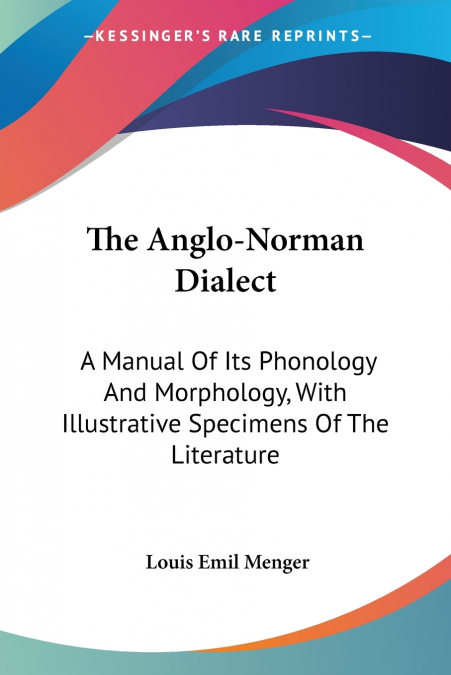
Language forged by conquest and law. A vital map of tongues. Louis Emil Menger’s The Anglo-Norman Dialect is a lucid manual of phonology and morphology, accompanied by illustrative specimens of medieval literature that reveal usage and change. Part handbook, part annotated archive, it functions as a medieval linguistics manual and a thorough historical phonology guide: clear sound descriptions, systematic morphological analysis and authentic specimens combine to make it indispensable for comparative philology and for any anglo-norman language study. Those tracing the romance languages evolution or the shifting speech of 12th century England will find here immediate evidence of influence and adaptation in the Norman Conquest era. The prose is exacting without being forbidding, so the dedicated linguistics student and the curious reader alike can follow the argument and inspect the original forms.Out of print for decades and now republished by Alpha Editions. Restored for today’s and future generations. More than a reprint - a collector’s item and a cultural treasure. As republished, this title sits comfortably in an academic reference collection and serves as a practical linguistics students resource: librarians, scholars of comparative philology and language history enthusiasts will value the specimen passages and methodological rigour. At the same time casual readers attracted to medieval literature specimens will be rewarded by readable examples of Anglo-Norman in context, while classic-literature collectors will welcome a heritage title that honours the scholarship and the era it records. Accessible introductions and systematic headings make it useful in teaching; editors preparing editions of medieval texts will find the specimen evidence instructive, and researchers working on historical lexicography or the reconstruction of phonetic developments will also value the methodical presentation. In short, this volume bridges scholarly exactitude and readable exposition, a resource as suited to classroom study as to the private cabinet of a collector.