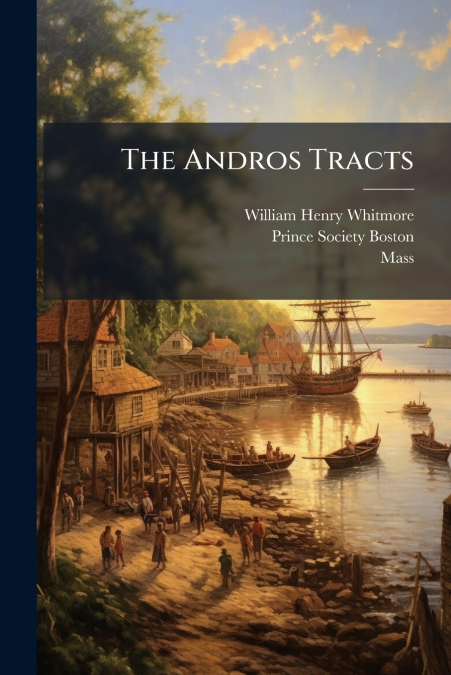
Mass.) / William Henry Whitmore / Prince Society (Boston
 Librería Samer Atenea
 Kálamo Books
 Librería Elías (Asturias)
 Librería Kolima (Madrid)
 Librería Proteo (Málaga)
'The Andros Tracts' is a collection of original papers and official documents relating to the administration of Sir Edmund Andros in colonial New England during the late 17th century. This compilation, originally published by the Prince Society, provides a detailed look into the political and legal controversies surrounding Andros’s governorship and the revocation of colonial charters. These tracts offer insights into the colonists’ struggle to maintain their rights and liberties against royal authority. Included are arguments over land titles, taxation without representation, and the imposition of English law. The documents shed light on the grievances that ultimately fueled the colonists’ resistance and contributed to the overthrow of Andros’s regime. 'The Andros Tracts' serves as a valuable resource for understanding the constitutional and political history of colonial America and the early development of American legal thought. This edition preserves the original texts and annotations, making it accessible to scholars and researchers interested in the formative years of the United States.This work has been selected by scholars as being culturally important, and is part of the knowledge base of civilization as we know it. This work was reproduced from the original artifact, and remains as true to the original work as possible. Therefore, you will see the original copyright references, library stamps (as most of these works have been housed in our most important libraries around the world), and other notations in the work.This work is in the public domain in the United States of America, and possibly other nations. Within the United States, you may freely copy and distribute this work, as no entity (individual or corporate) has a copyright on the body of the work.As a reproduction of a historical artifact, this work may contain missing or blurred pages, poor pictures, errant marks, etc. Scholars believe, and we concur, that this work is important enough to be preserved, reproduced, and made generally available to the public. We appreciate your support of the preservation process, and thank you for being an important part of keeping this knowledge alive and relevant.