
Inicio > Economía, finanzas, empresa y gestión > Empresa y gestión > TENDENCIES AND CHANGES IN THE NATIONAL CURRENCY RATE OF UZBEKISTAN
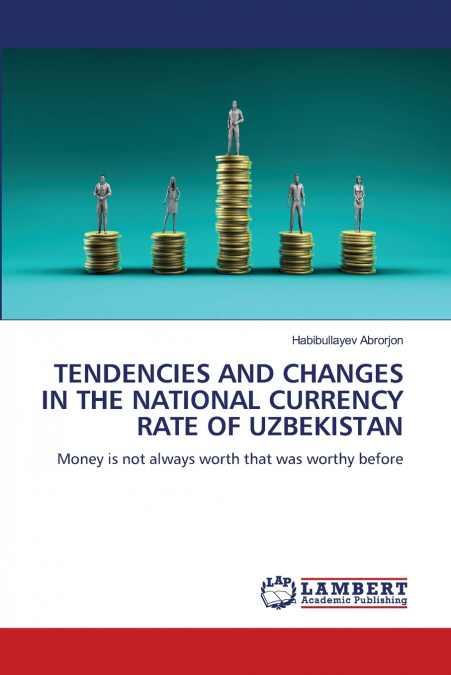
TENDENCIES AND CHANGES IN THE NATIONAL CURRENCY RATE OF UZBEKISTAN

TENDENCIES AND CHANGES IN THE NATIONAL CURRENCY RATE OF UZBEKISTAN

Habibullayev Abrorjon

53,16 €
IVA incluido
Disponible
Editorial:
KS OmniScriptum Publishing
Año de edición:
2024
Materia
Empresa y gestión
ISBN:
9786208171063
53,16 €
IVA incluido
Disponible

Selecciona una librería:

  • Librería Samer Atenea
  • Librería Aciertas (Toledo)
  • Kálamo Books
  • Librería Perelló (Valencia)
  • Librería Elías (Asturias)
  • Donde los libros
  • Librería Kolima (Madrid)
  • Librería Proteo (Málaga)

It is well known from history that each state introduced its own currency for commodity-money circulation within the territory of the country. This brought income to the treasury of the state on the one hand, and on the other, it facilitated the exchange of goods between the producer and the buyer through money.When selling and buying goods between neighboring countries, it took a certain equivalent of the exchange of national monetary units, which contributed to the formation of the exchange rate. The rate of the national currency grew (strengthened) with an increase in demand for goods for export, weakened with an increase in supply or a decrease in external demand.At the present stage of development of the world economy, many factors affect the changes in the exchange rate, which are characteristic only of the modern world: political instability, the global financial crisis or instability in commodity markets and others.


Artículos relacionados

  • Managing TrumPolitical Projects
    Yasser Osman
    Corrupt politicians and businessmen have been using construction projects to funnel money to secret projects since the first iron shovels broke ground. Yet today, throughout the world, there is little if any protection from it. In many countries, governments themselves don’t just ignore these affairs. They sponsor them.Individual project managers – hired to manage a project’s o...
    Disponible

    14,97 €

  • Climbing The Ladder
    Delroy Constantine-Simms
    Climbing The Ladder is an introductory book to mentoring, for organizational decision makers, that may be considering, the feasibility of maintaining, adopting and diversify their organizational mentoring strategies.Most importantly, the author explains that mentoring can take the form of a one-time intervention or a lifelong partnership, which can be a formal structured progra...
    Disponible

    96,53 €

  • The Gen-Savvy Financial Advisor
    Cam Marston
    There have been big changes in consumers’ buying habits, and financial services are no exception, says Cam Marston, a world-renowned expert on generational issues in the marketplace. Understanding clients’ age-based points of view is an indispensable soft skill that you can use to establish connections and make sales. New attitudes about investing break down along generationa...
    Disponible

    14,82 €

  • Your First Job
    Mark Blayney
    Each year in the UK approximately half a million young people enter the world of work for the first time and begin to compete in their careers.And how well you cope with the pressures and demands of your first year of work can help determine how successful a career you will go on to have, and how far you will reach.But with Your First Job, you can get an unfair advantage over y...
    Disponible

    7,82 €

  • Successful Customer Relationship Management Programs and Technologies
    Riyad Eid
    The field of Customer Relationship Management (CRM) has broadened greatly in recent years as technological applications have expanded. Successful Customer Relationship Management Programs and Technologies: Issues and Trends offers the latest research and developments for researchers, practitioners, and academics alike. This volume contains case studies, methodologies, framework...
  • Feral Information Systems Development
    Kerr
    Management invests in large information systems in order to improve the effectiveness of their organization. However, when these systems fail to meet the needs of organizational employees, feral information systems (FIS) are created in order to assist workers with their jobs or to avoid existing organizational information systems. Feral Information Systems Development: Manageri...

Otros libros del autor

  • TENDENZE E VARIAZIONI DEL TASSO DI CAMBIO NAZIONALE DELL’UZBEKISTAN
    Habibullayev Abrorjon
    È noto che ogni Stato ha introdotto la propria moneta per la circolazione delle merci all’interno del territorio nazionale. Ciò portava da un lato un reddito alle casse dello Stato e dall’altro facilitava lo scambio di merci tra il produttore e l’acquirente attraverso la moneta.Quando si vendevano e compravano beni tra Paesi vicini, occorreva un certo equivalente dello scambio ...
    Disponible

    52,14 €

  • TENDÊNCIAS E ALTERAÇÕES NA TAXA DE CÂMBIO DA MOEDA NACIONAL DO UZBEQUISTÃO
    Habibullayev Abrorjon
    É bem conhecido da história que cada Estado introduziu a sua própria moeda para a circulação de dinheiro-mercadoria no território do país. Por um lado, isso trazia receitas para o tesouro do Estado e, por outro, facilitava a troca de mercadorias entre o produtor e o comprador através do dinheiro.Na compra e venda de mercadorias entre países vizinhos, era necessário um certo equ...
    Disponible

    52,14 €

  • TENDENZEN UND VERÄNDERUNGEN DES NATIONALEN WÄHRUNGSKURSES USBEKISTANS
    Habibullayev Abrorjon
    Aus der Geschichte ist bekannt, dass jeder Staat seine eigene Währung für den Warengeldumlauf im Staatsgebiet einführte. Dies brachte zum einen Einnahmen in die Staatskasse, zum anderen erleichterte es den Warenaustausch zwischen Erzeuger und Käufer durch Geld.Beim Verkauf und Kauf von Waren zwischen benachbarten Ländern war ein gewisser Gegenwert für den Austausch nationaler G...
    Disponible

    52,20 €

  • TENDANCES ET VARIATIONS DU TAUX DE LA MONNAIE NATIONALE DE L’OUZBEKISTAN
    Habibullayev Abrorjon
    L’histoire nous apprend que chaque État a introduit sa propre monnaie pour la circulation des marchandises sur son territoire. Cela permettait d’une part d’alimenter le trésor de l’État et d’autre part de faciliter l’échange de marchandises entre le producteur et l’acheteur par le biais de la monnaie.Lors de la vente et de l’achat de marchandises entre pays voisins, il fallait ...
    Disponible

    52,14 €