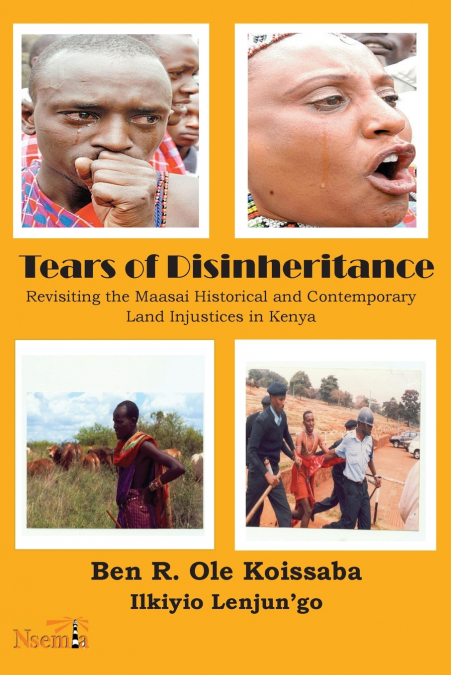

Tears of Disinheritance

Tears of Disinheritance

Ben R. Ole Koissaba

52,02 €
IVA incluido
Disponible
Editorial:
Nsemia
Año de edición:
2021
Materia
Sociedad y cultura: general
ISBN:
9781989928097
52,02 €
IVA incluido
Disponible

Selecciona una librería:

  • Librería Samer Atenea
  • Librería Aciertas (Toledo)
  • Kálamo Books
  • Librería Perelló (Valencia)
  • Librería Elías (Asturias)
  • Donde los libros
  • Librería Kolima (Madrid)
  • Librería Proteo (Málaga)

The land question remains an emotive issue across Kenya regardless of one’s ethnic origins. Today, almost every Kenyan seeks to own a kaplot, a piece of earth however small, that one can call one’s own. The resultant conflicts that arise with this mindset are many and are at the centre of displacement and marginalization of many Kenyans while enriching a few in the privileged class. Yet this need not be the case if we all learnt from our past and especially the manner in which communities perceived land and the relationship that existed between the people (communities) and the land.In Tears of Disinheritance, Ben Ole Koissaba systematically analyzes many of the issues arising from matters of land from the perspective of the Maasai. Going as far back as memory and written records reach, Dr. Koissaba captures the story of the Maasai, their origins, belief system, and migrations to vast stretches of land that form most of the Rift Valley, both in Kenya and Tanzania. He succinctly captures the genesis of many a conflict, displacement, and subsequent impoverishment, including treaties purportedly signed on behalf of the Maasai at the advent of colonialism; treaties that even independent Kenya has failed to address. Tears of Disinheritance makes the case for the rights of indigenous peoples in Kenya, drawing parallels with similar cases in countries like Canada, Australia, and the USA.This book is thought-provoking in more ways than one on matters of land and how best to view and use the land as well as how best to protect the land rights of indigenous people in Kenya.


Artículos relacionados

  • The Gandhian Iceberg
    Chris D Moore-Backman
    The Gandhian Iceberg presents a bold, new interpretation of Gandhian nonviolence from the rare perspective of an author who is equal parts writer, scholar, and frontlines practitioner. The book faces the current crisis of climate change and the intensification of social unrest around the world, and calls for a new convergence of serious, spiritually-rooted US nonviolence activi...
    Disponible

    11,52 €

  • Contemporary Developments in Child Protection
    Nigel Parton
    Volume 1 "Policy Changes and Challenges" takes as its central theme the ongoing and challenging issues which child protection agencies have to address and the policy and practice initiatives that are developed to try and address these. The volume includes papers on: the relationship between the decline in the rate of ‘unnatural’ deaths and the growth of concern about child abus...
  • Diversity in Information Technology Education
    Goran Trajkovski
    ...
  • Model-Driven Software Development
    Model-driven software development (MDSD) drastically alters the software development process, characterized by a high degree of innovation and productivity. However, quality assurance application in the domain of software models and model-driven software development is still in an emergent phase. Model-Driven Software Development: Integrating Quality Assurance provides in-depth...
  • Evidence-Based Practice in Nursing Informatics
    Andrew Chasin
    Because of the constant advances and dynamics within the nascent field of nursing informatics, many nurses struggle in practice as they continue to try and apply habitual communication practices in the new environment without any critical reflection on, and adaptation of, those practices. Evidence-Based Practice in Nursing Informatics: Concepts and Applications serves as a valu...
  • Actor-Network Theory and Technology Innovation
    Arthur Tatnall
    About 25 years ago, the first developments of ANT (Actor-Network Theory) took place, but it wasn’t until much later that researchers began to take it seriously. In the late 1990s, ANT began to take hold in the scientific community as a new and exciting approach to socio-technical research and social theory. Actor-Network Theory and Technology Innovation: Advancements and New Co...