United States. Bureau Of Naturalization
 Librería Samer Atenea
 Kálamo Books
 Librería Elías (Asturias)
 Librería Kolima (Madrid)
 Librería Proteo (Málaga)
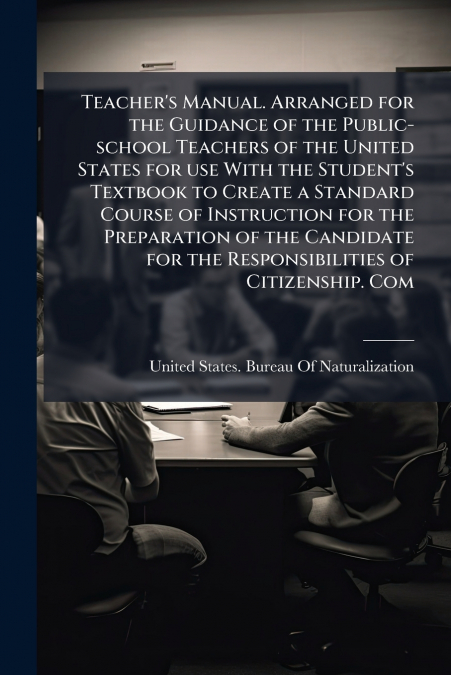
This Teacher’s Manual, originally published in 1918 by the United States Bureau of Naturalization, is designed to guide public-school teachers in preparing students for the responsibilities of citizenship. Intended as a companion to the Student’s Textbook, it aims to establish a standard course of instruction, emphasizing the fundamental principles and duties of American citizenship. The manual provides structured lessons and pedagogical strategies tailored for educators to effectively convey the significance of civic engagement and the role of informed citizens within a democratic society. It represents a valuable historical resource, offering insights into early 20th-century approaches to civics education and the development of responsible citizenship among young Americans. This book remains relevant for educators, historians, and anyone interested in the evolution of civic education in the United States.This work has been selected by scholars as being culturally important, and is part of the knowledge base of civilization as we know it. This work was reproduced from the original artifact, and remains as true to the original work as possible. Therefore, you will see the original copyright references, library stamps (as most of these works have been housed in our most important libraries around the world), and other notations in the work.This work is in the public domain in the United States of America, and possibly other nations. Within the United States, you may freely copy and distribute this work, as no entity (individual or corporate) has a copyright on the body of the work.As a reproduction of a historical artifact, this work may contain missing or blurred pages, poor pictures, errant marks, etc. Scholars believe, and we concur, that this work is important enough to be preserved, reproduced, and made generally available to the public. We appreciate your support of the preservation process, and thank you for being an important part of keeping this knowledge alive and relevant.