Inicio > Tecnología, ingeniería, agricultura > > Química industrial > Supercritical Antisolvent Precipitation Process
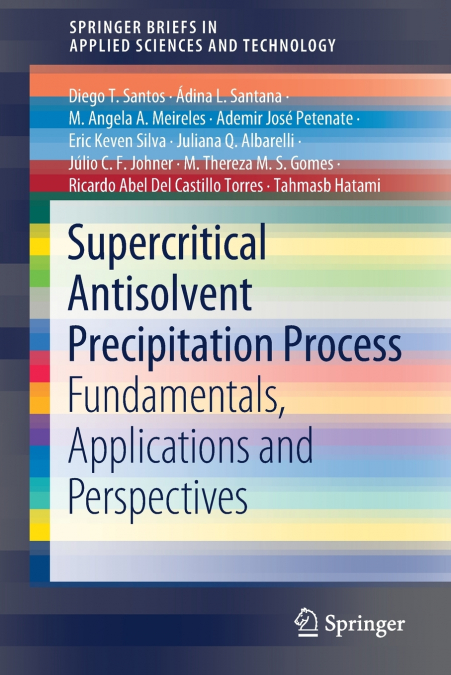
Supercritical Antisolvent Precipitation Process

Supercritical Antisolvent Precipitation Process

Ádina L. Santana / Diego T. Santos / M. Angela A. Meireles

68,01 €
IVA incluido
Disponible
Editorial:
Springer Nature B.V.
Año de edición:
2019
Materia
Química industrial
ISBN:
9783030269975
68,01 €
IVA incluido
Disponible

Selecciona una librería:

  • Librería Samer Atenea
  • Librería Aciertas (Toledo)
  • Kálamo Books
  • Librería Perelló (Valencia)
  • Librería Elías (Asturias)
  • Donde los libros
  • Librería Kolima (Madrid)
  • Librería Proteo (Málaga)

This book provides deep insights on the fundamentals, applications and perspectives of the Supercritical AntiSolvent (SAS) Precipitation Process. Chapter 1 provides recent (2013-2018) reports on the use of supercritical CO2 (SC-CO2) antisolvent for micronization, coprecipitation and fractionation of high-value products for the food, cosmetic and pharmaceutical industries. Chapter 2 discusses another variant of the SAS precipitation process called Supercritical fluid extraction of emulsions (SFEE). This chapter provides recent data from 2016-2018 reports investigation of supercritical extraction of emulsions (SFEE) to encapsulate compounds of great interest to the food and non-food industry. Chapter 3 details the design and construction of a SAS Precipitation equipment. Chapter 4 presents experimental results regarding the validation of the supercritical particle formation equipment. Chapter 5 shows the effects of process parameters during particle precipitation using Combined High Turbulence Extraction Assisted by Ultrasound and Supercritical Antisolvent Fractionation (SAF) processes applied to semi-defatted annatto seeds, as a model raw material plant, were investigated. Chapter 6 shows experimental results regarding the process Ultrasound Emulsification Assisted by Nitrogen Hydrostatic Pressure (UEANHP), during the emulsification preparation step of the Supercritical Fluid Extraction of Emulsions (SFEE) process, one of the options of the SAS Precipitation-based process. Finally, Chaptesr 7 and 8 present some perspectives about the economics and process integration with other processes aiming the development of novel conceptual biorefinering approaches for plant materials valorization.

Artículos relacionados

  • Quantitative Structure-Activity Relationships in Drug Design, Predictive Toxicology, and Risk Assessment
    Kunal Roy
    Quantitative structure-activity relationships (QSARs) represent predictive models derived from the application of statistical tools correlating biological activity or other properties of chemicals with descriptors representative of molecular structure and/or property. Quantitative Structure-Activity Relationships in Drug Design, Predictive Toxicology, and Risk Assessment discus...
  • Chemical Compound Structures and the Higher Dimension of Molecules
    Gennadiy Vladimirovich Zhizhin
    Originally, scientists believed that molecules were three-dimensional; however, studies have proven that geometric dimensions are continuous. Therefore, molecules are able to have higher dimensions which influences how they interact with other molecules leading to advances in various fields including nanomedicine, nanotoxicology and quantum biology. Chemical Compound Structures...
  • CHEMICAL THERMODYNAMICS, 2ND EDITION
    Byung Chan Eu / BYUNG CHAN EU & MAZEN AL-GHOUL / EU BYUNG CHAN / Mazen Al-Ghoul
    This book enables the reader to learn, in a single volume, equilibrium and nonequilibrium thermodynamics as well as generalized forms of hydrodynamics for linear and nonlinear processes applied to various hydrodynamic flow processes — including chemical oscillation phenomena and pattern formations, shock wave phenomena, sound wave propagations, and Liesegang pattern formation, ...
  • CARBOHYDRATE CHEMISTRY
    ALEN RAIMO / Raimo Alen
     This book presents a comprehensive approach to the versatile and fascinating field of carbohydrate chemistry. It covers, besides the colorful historical perspective within the utilization of carbohydrates and their derivatives, all modern aspects on their properties, nomenclature, uses, and natural occurrence as such or as residues in a variety of biologically active molecules...
  • Recent Developments in Geopolymers and Alkali-Activated Materials
    Sujeong Lee
    We are compiling and publishing a collection of the latest research papers in the fields of Geopolymer and Alkali-Activated Materials (AAM). This compilation includes eight original research and two review papers covering a diverse range of topics, including various raw materials, manufacturing processes, and applications in the realms of Geopolymer and AAM. The publication aim...
  • Introduction to Chemical Engineering Fluid Mechanics
    William M. Deen
    ...