 Librería Samer Atenea
 Kálamo Books
 Librería Elías (Asturias)
 Librería Kolima (Madrid)
 Librería Proteo (Málaga)
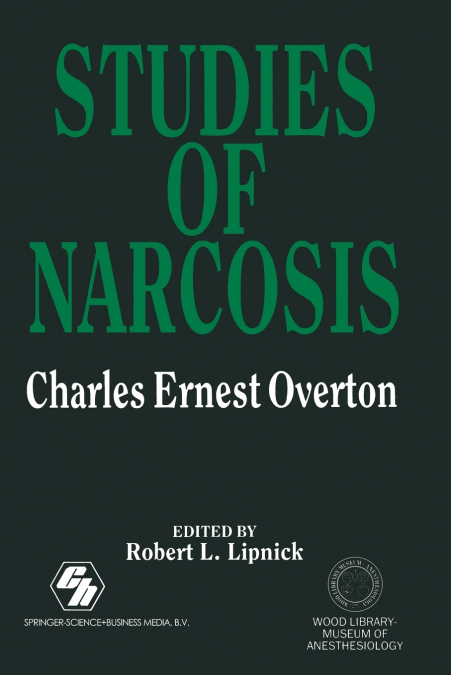
1 Introduction.- 2 Introduction.- 3 Charles Ernest Overton: narcosis studies and a contribution to general pharmacology.- Studies of Narcosis and a Contribution to General Pharmacology.- Preface.- One General Section.- 1 Background.- 1.1 Introduction.- 1.2 Attempts to distinguish between anaesthetics and narcotics.- 1.3 Inhalation anaesthetics and other non-specific narcotics.- 1.4 Non-specific and basic narcotics.- 1.5 Factors to be considered in developing a theory of narcosis.- 1.6 Relationship between dose and means of administration.- 1.7 Calculation of the concentration of a toxicant in the blood plasma.- 1.8 Conditions affecting blood plasma toxicant concentration.- 1.9 Bert’s method for maintaining a constant concentration of an anaesthetic in the blood.- 1.10 Bert’s experiments with chloroform and ethyl ether.- 1.11 Concentration of an anaesthetic in the blood plasma.- 1.12 The intercellular lymph as a pathway between the blood and the tissue cells.- 1.13 Three groups of compounds differing with respect to their permeability to tissue cells.- 1.13.1 Compounds unable to penetrate living cells.- 1.13.2 Compounds that readily penetrate living cells.- 1.13.3 Compounds that slowly penetrate living cells.- 1.14 Method of producing known and constant concentrations of non-volatile compounds in the blood: limits of applicability.- 2 Critical review of the major hypotheses on the mechanism of narcosis.- 2.1 Hypotheses based upon the circulation in the brain.- 2.2 Hypothesis of Claude Bernard.- 2.3 Hypothesis of Binz.- 2.4 Hypothesis of Dubois.- 2.5 Richet’s principle.- 2.6 Hypotheses based upon the chemical composition of the brain.- 2.6.1 Chemistry of the nervous system.- 2.6.2 Hypothesis of Bibra and Harless.- 2.6.3 Contribution of Hermann.- 2.7 Theory of H. Meyer and the author on narcosis induced by non-specific narcotics.- 3 Lipoid theory of narcosis and partition coefficients.- 3.1 Theory of partition coefficients.- 3.2 Methods for measuring partition coefficients.- 3.2.1 Physical methods.- 3.2.2 Physiological methods.- 3.3 Measurement of partition coefficients between water and cerebral lipoids.- 3.4 General foundation of the lipoid theory of narcosis.- Two Experimental Results.- 4 Narcosis induced by ether and chloroform.- 4.1 Ether narcosis.- 4.1.1 Experiments with ethyl ether.- 4.1.2 Calculation of the ether concentration in the blood plasma of narcotized mammals and man from the data of Bert.- 4.1.3 Concentration of ether in the blood plasma of narcotized tadpoles.- 4.1.4 Concentration of ether in the blood plasma of other narcotized organisms and in narcotized plants.- 4.1.5 Biological transport of ether and other non-specific narcotics into the blood and cerebral lipoids of aquatic organisms.- 4.1.6 Partition coefficient of ether between water and olive oil.- 4.2 Chloroform narcosis.- 4.2.1 Experiments with chloroform.- 4.2.2 Calculations of the chloroform concentration in the blood plasma of mammals from the data of Bert.- 4.2.3 Chloroform concentration in the blood plasma of narcotized tadpoles.- 5 Aliphatic non-electrolyte organic compounds and narcosis.- 5.1 Monohydric alcohols.- 5.2 Aliphatic hydrocarbons and their halogen derivatives.- 5.3 Nitriles and nitroparaffins.- 5.4 Monovalent aldehydes, paraldehyde, chloral hydrate and chloralformamide.- 5.5 Ketones, sulfonals, aldoximes and ketoximes.- 5.6 Esters of mineral acids.- 5.7 Esters of organic acids: significance of the rate of saponification, and effect of the presence of hydroxyl groups.- 5.8 Dihydric and polyhydric alcohols and some of their derivatives.- 5.9 Acid amides: urea and its derivatives.- 5.10 Chloralose.- 6 Aromatic compounds.- 6.1 Aromatic hydrocarbons and azobenzene.- 6.1.1 Potent narcotic action of phenanthrene.- 6.2 Phenols and their ethers, vanillin and piperonal.- 6.2.1 Monovalent phenols and their ethers.- 6.2.2 Divalent phenols and their ethers.- 6.2.3 Vanillin and piperonal.- 6.3 Oil of turpentine, camphor and volatile oils.- 6.4 ...