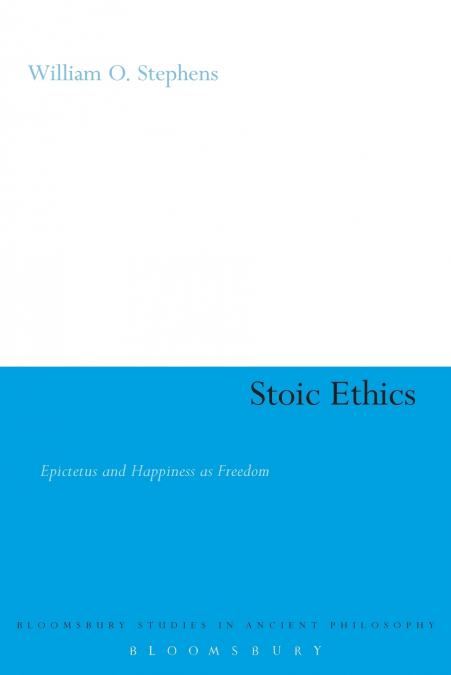
Stoic Ethics

Stoic Ethics

William O. Stephens

259,04 €
IVA incluido
Disponible
Editorial:
Bloomsbury Publishing plc
Año de edición:
2007
Materia
Filosofía occidental: antigua, hasta c. 500
ISBN:
9780826496089
259,04 €
IVA incluido
Disponible

Selecciona una librería:

  • Librería Samer Atenea
  • Librería Aciertas (Toledo)
  • Kálamo Books
  • Librería Perelló (Valencia)
  • Librería Elías (Asturias)
  • Donde los libros
  • Librería Kolima (Madrid)
  • Librería Proteo (Málaga)

Soon after Aristotle’s death, several schools of ancient philosophy arose, each addressing the practical question of how to live a good, happy life. The two biggest rivals, Stoicism and Epicureanism, came to dominate the philosophical landscape for the next 500 years. Epicureans advised pursuing pleasure to be happy, and Stoics held that true happiness could only be achieved by living according to nature, which required accepting what happens and fulfilling one’s roles. Stoicism, more than Epicureanism, attracted followers from many different walks of life: slaves, laborers, statesmen, intellectuals, and an emperor. The lasting impact of these philosophies is seen from the fact that even today ’Stoic’ and ’Epicurean’ are household words. Although very little of the writings of the early Stoics survive, our knowledge of Stoicism comes largely from a few later Stoics. In this unique book, William O. Stephens explores the moral philosophy of Epictetus, a former Roman slave and dynamic Stoic teacher whose teachings are the most compelling defense of ancient Stoicism that exists. Epictetus’ philosophy dramatically captures the spirit of Stoicism by examining and remedying our greatest human disappointments, such as the death of a loved one. Stephens shows how, for Epictetus, happiness results from focusing our concern on what is up to us while not worrying about what is beyond our control. He concludes that the strength of Epictetus’ thought lies in his conception of happiness as freedom from fear, worry, grief, and dependence upon luck.

Artículos relacionados

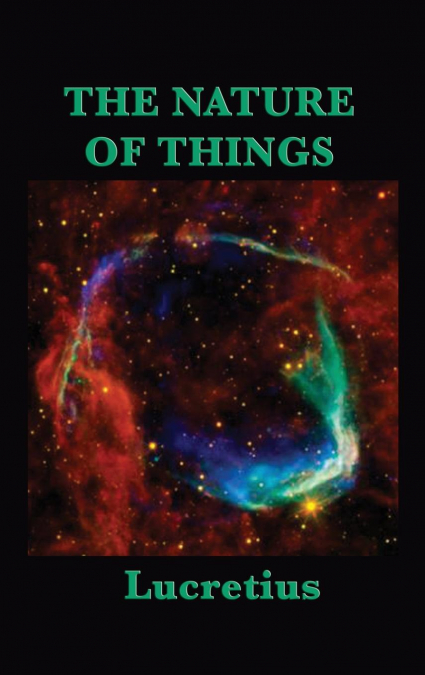
  • The Nature of Things
    Lucretius Lucretius
    De rerum natura (On the Nature of Things) is a 1st century BC didactic poem by the Roman poet and philosopher Lucretius with the goal of explaining Epicurean philosophy to a Roman audience. Lucretius presents the principles of atomism; the nature of the mind and soul; explanations of sensation and thought; the development of the world and its phenomena; and explains a variety o...
    Disponible

    36,76 €

  • Pompeii
    Fergus Mason
    Pompeii was one of most advanced cities of its time; it had a complex water system, gymnasium, and an amphitheater. Despite it's advancements, there was one thing it wasn't ready for: Mount Vesuvius—the volcano that led to its ultimate doom.  The 79 AD eruption of Mount Vesuvius was one of the worst disasters in all of European history. In a near instant, over 15,000 p...
    Disponible

    10,36 €

  • Middle Platonism and Neoplatonism, Volume 1
    Stephen Gersh
    'It is generally agreed that those types of philosophy that are loosely called ’Platonic’ and ’Neoplatonic’ played a crucial role in the history of European culture during the centuries between antiquity and the Renaissance. However, until now no scholar has attempted to describe the evolution of these forms of thought in a single comprehensive academic study.' So writes Stephe...
    Disponible

    179,17 €

  • Middle Platonism and Neoplatonism, Volume 2
    Stephen Gersh
    It is generally agreed that those types of philosophy that are loosely called 'Platonic' and 'Neoplatonic' played a crucial role in the history of European culture during the centuries between antiquity and the Middle Ages. However, until now no scholar has attempted to describe the evolution of these forms of thought in a single comprehensive academic study. Middle Platonism a...
    Disponible

    215,18 €

  • Porphyry’s Commentary on Ptolemy’s Harmonics
    Andrew Barker
    ...
    Disponible

    77,17 €

  • The Roots of Platonism
    John Dillon
    ...
    Disponible

    25,29 €

Otros libros del autor

  • Stoic Ethics
    William O. Stephens
    Soon after Aristotle’s death, several schools of ancient philosophy arose, each addressing the practical question of how to live a good, happy life. The two biggest rivals, Stoicism and Epicureanism, came to dominate the philosophical landscape for the next 500 years. Epicureans advised pursuing pleasure to be happy, and Stoics held that true happiness could only be achieved by...
    Disponible

    61,76 €

  • Marcus Aurelius
    William O. Stephens
    This book is a clear and concise introduction to the Roman Emperor Marcus Aurelius Antoninus. His one major surviving work, often titled ’meditations’ but literally translated simply as ’to himself’, is a series of short, sometimes enigmatic reflections divided seemingly arbitrarily into twelve books and apparently written only to be read by him. For these reasons Marcus is a p...
    Disponible

    44,74 €

  • Marcus Aurelius
    William O. Stephens
    This book is a clear and concise introduction to the Roman Emperor Marcus Aurelius Antoninus. His one major surviving work, often titled ’meditations’ but literally translated simply as ’to himself’, is a series of short, sometimes enigmatic reflections divided seemingly arbitrarily into twelve books and apparently written only to be read by him. For these reasons Marcus is a p...
    Disponible

    167,56 €