 Librería Samer Atenea
 Kálamo Books
 Librería Elías (Asturias)
 Librería Kolima (Madrid)
 Librería Proteo (Málaga)
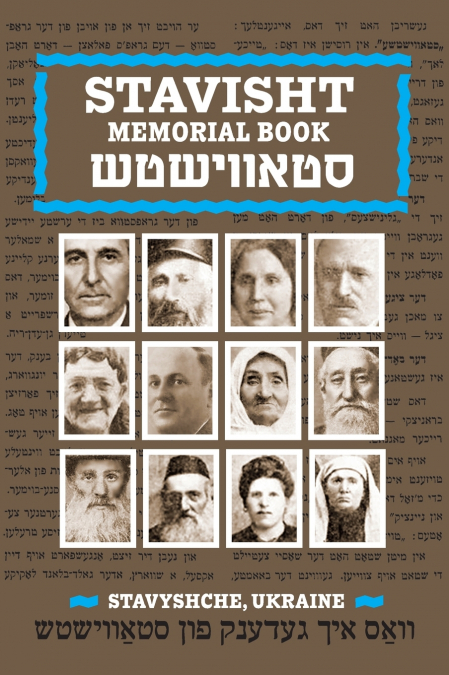
What I Remember About StavishtThe name of the town was spelled Stavisht. In Russian that means ponds, because the town was surrounded by ponds on three sides. More accurately, we should call them lakes, large wide lakes which teemed with delicious fish. There were carp, perch, and other kinds of fish which provided tasty meals for the holy Sabbath feasts. I shall never forget the Friday and Sabbath nights.Even though the town was quite small, it had a number of small prayer houses and the large old wooden synagogue. The school boys would shiver when they walked past it on dark winter nights, carrying their lanterns, for they feared the dead who would arise in the night to pray.The Makarov Kloyz and the big Bet Hamidrash were where the elite went to pray. Nevertheless, if someone did not get the honors he felt due him, there could be quarreling and even candelabra flying from the pulpit towards the heads of the offenders.People did not use surnames in Stavisht. Everyone was called by a father’s or grandfather’s or wife’s name. Sometimes a nickname was given for the color of one’s beard. Thus, for example, there were two Yoeliks, both fine men, owners of dry goods stores. One was called Yoelik the black because he had a fine respectable black beard and the other was called Yoelik the red because of his red beard. My grandfather was called Arye Meir Dina’s for both his grandfather and grandmother. My mother’s brother was called Fishl Moshe Yosi’s and my mother was called Shifra Moshe Yosi’s. My uncle Pesah Hersh Salganik was called Pesah Hersh Trayne’s for his wife’s name was Trayne.On Tisha B’Av and Rosh Hodesh all the inhabitants of the town would come to visit the graves, to ask for help for the living. Meanwhile, the boys would collect burrs which they would then throw at one another in the synagogue during the reading of Kines.At the border of the Count’s estate stood the Russian Orthodox church. After prayer services the gentile families would come to the market place and go shopping in the Jewish stores, which stood in two long rows, built of wooden weather-beaten boards. Sunday was market day, almost a fair. The gentiles would buy everything and the Jews earned a living from the gentiles. In general, the local gentiles and the Jews got along on a friendly basis.There were frequent fights after the men had drunk a great deal in the Monopol near the whiskey shop, but the old town policeman, Sergei, would quickly make peace. He would cuss the Russian Orthodox people who laughed at him and beat some of them with his club. Then they would once more crowd into the Jewish inns to drink and eat some good food, and Jews would again, thank God, earn some money.The weekly fair took place on Tuesdays. Thousands of gentiles would come in their wagons to wheel and deal. They would bring their produce to sell to the Jews and they would buy their household goods, material for a dress or a kerchief, a pair of pants and boots for themselves and their children.On Jewish holidays the peasants would bring their Jewish friends gifts of produce from their orchards and gardens, and fat fish from the river for the Sabbath. In the wintertime, for Christmas, they would come in the greatest frost and snow to bless their Jewish friends, pouring wheat and barley over them, as was the custom, and receiving in return halot.Excerpt (edited) from Meir Spektor’s article