 Librería Samer Atenea
 Kálamo Books
 Librería Elías (Asturias)
 Librería Kolima (Madrid)
 Librería Proteo (Málaga)
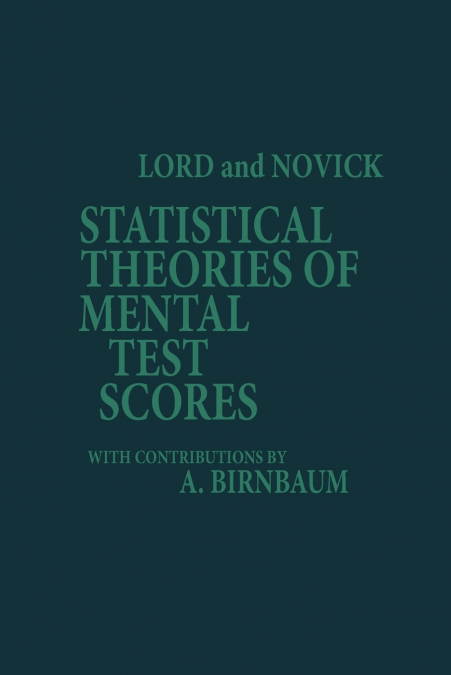
This is a reprint of the orginal book released in 1968. Our primary goal in this book is to sharpen the skill, sophistication, and in- tuition of the reader in the interpretation of mental test data, and in the construction and use of mental tests both as instruments of psychological theory and as tools in the practical problems of selection, evaluation, and guidance. We seek to do this by exposing the reader to some psychologically meaningful statistical theories of mental test scores.Although this book is organized in terms of test-score theories and models, the practical applications and limitations of each model studied receive substantial emphasis, and these discussions are presented in as nontechnical a manner as we have found possible. Since this book catalogues a host of test theory models and formulas, it may serve as a reference handbook. Also, for a limited group of specialists, this book aims to provide a more rigorous foundation for further theoretical research than has heretofore been available.One aim of this book is to present statements of the assumptions, together with derivations of the implications, of a selected group of statistical models that the authors believe to be useful as guides in the practices of test construction and utilization. With few exceptions we have given a complete proof for each major result presented in the book. In many cases these proofs are simpler, more complete, and more illuminating than those originally offered. When we have omitted proofs or parts of proofs, we have generally provided a reference containing the omitted argument. We have left some proofs as exercises for the reader, but only when the general method of proof has already been demonstrated. At times we have proved only special cases of more generally stated theorems, when the general proof affords no additional insight into the problem and yet is substantially more complex mathematically.