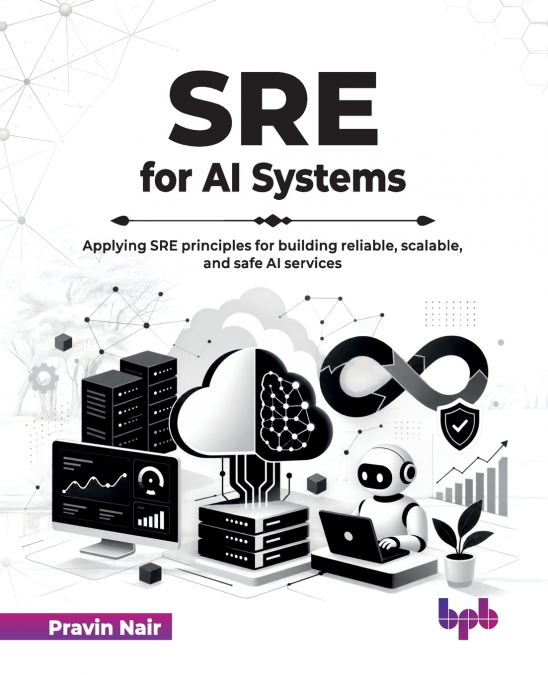

SRE for AI Systems

SRE for AI Systems

Pravin Nair

49,55 €
IVA incluido
Disponible
Editorial:
BPB Publications
Año de edición:
2026
Materia
Inteligencia artificial
ISBN:
9789378544194
49,55 €
IVA incluido
Disponible

Selecciona una librería:

  • Librería Samer Atenea

  • Kálamo Books
  • Librería Elías (Asturias)
  • Librería Kolima (Madrid)
  • Librería Proteo (Málaga)

As AI and ML rapidly power modern digital services from recommendation engines to generative models, moving these workloads into production exposes critical gaps in traditional operations. Site reliability engineering (SRE) applies software engineering principles to infrastructure, making SRE uniquely positioned to own the reliability, observability, and resilience of complex AI-driven environments.This book bridges the gap between traditional SRE practices and the innovative strategies required to manage AI-driven infrastructures such as LLM models effectively, offering readers a focused guide for this transformative era. Each chapter walks the reader through core concepts such as versioning of models and data, pipeline monitoring, and security testing for AI APIs, while providing concrete SRE patterns for uptime, rollback, and incident management in AI-driven environments. You will learn how to design service-level objectives that reflect AI-specific quality metrics, implement robust monitoring and alerting for model drift and data quality, secure AI-backed APIs against prompt injection and other attacks, and coordinate releases across code, data, and models in a complex environment.By the end of this book, as an SRE engineer, you will be equipped to design, operate, and scale AI systems with the same rigor that you applied to traditional infrastructure. You will gain skills in building observable AI pipelines, managing versioned data and models at scale, securing AI APIs, and applying SRE principles such as error budgets, incident response, and automation to complex ML and generative AI workloads.WHAT YOU WILL LEARN● Applying SRE principles to AI and ML workloads.● Monitoring AI pipelines for model quality, data drift, and output correctness.● Defining SLIs and SLOs that reflect business metrics.● Building resilient deployment and rollback strategies for LLM models.● Equipping SRE teams to own AI pipelines and ML lifecycle.● Building and scaling SRE teams to manage AI systems.WHO THIS BOOK IS FORThis book is for site reliability engineers, ML engineers, software developers, and SRE managers supporting AI workloads. Readers should possess basic cloud infrastructure knowledge, a foundational understanding of software development, and familiarity with general machine learning principles.
Artículos relacionados

  • Artificial Cognition Systems
    ...
  • Cross-Disciplinary Applications of Artificial Intelligence and Pattern Recognition
    Vijay Kumar Mago
    The need for intelligent machines in areas such as medical diagnostics, biometric security systems, and image processing motivates researchers to develop and explore new techniques, algorithms, and applications in this evolving field. Cross-Disciplinary Applications of Artificial Intelligence and Pattern Recognition: Advancing Technologies provides a common platform for researc...
  • Emerging Applications of Natural Language Processing
    Over the last few years, the area of Natural Language Processing has drastically grown in recognition, not only within the research and development community, but also with industry professionals. As NLP continues to be discussed and researched, certain areas continue to grow and mature. As a result, the need for advanced research and information is in high demand. Emerging App...
  • Androids, Cyborgs, and Robots in Contemporary Culture and Society
    Steven John Thompson
    Mankind’s dependence on artificial intelligence and robotics is increasing rapidly as technology becomes more advanced. Finding a way to seamlessly intertwine these two worlds will help boost productivity in society and aid in a variety of ways in modern civilization. Androids, Cyborgs, and Robots in Contemporary Culture and Society is an essential scholarly resource that delve...
  • Deep Learning Innovations and Their Convergence With Big Data
    The expansion of digital data has transformed various sectors of business such as healthcare, industrial manufacturing, and transportation. A new way of solving business problems has emerged through the use of machine learning techniques in conjunction with big data analytics. Deep Learning Innovations and Their Convergence With Big Data is a pivotal reference for the latest sc...
  • Computational Psychoanalysis and Formal Bi-Logic Frameworks
    Giuseppe Iurato
    Computational psychoanalysis is a new field stemming from Freudian psychoanalysis. The new area aims to understand the primary formal structures and running mechanisms of the unconscious while implementing them into computer sciences. Computational Psychoanalysis and Formal Bi-Logic Frameworks provides emerging information on this new field which uses psychoanalysis and the unc...