
Soviet-American Relations, 1953-1960

Soviet-American Relations, 1953-1960

Victor Rosenberg

73,52 €
IVA incluido
Disponible
Editorial:
McFarland and Company, Inc.
Año de edición:
2005
Materia
Sociedad y cultura: general
ISBN:
9780786419340
73,52 €
IVA incluido
Disponible

Selecciona una librería:

  • Librería Samer Atenea
  • Librería Aciertas (Toledo)
  • Kálamo Books
  • Librería Perelló (Valencia)
  • Librería Elías (Asturias)
  • Donde los libros
  • Librería Kolima (Madrid)
  • Librería Proteo (Málaga)

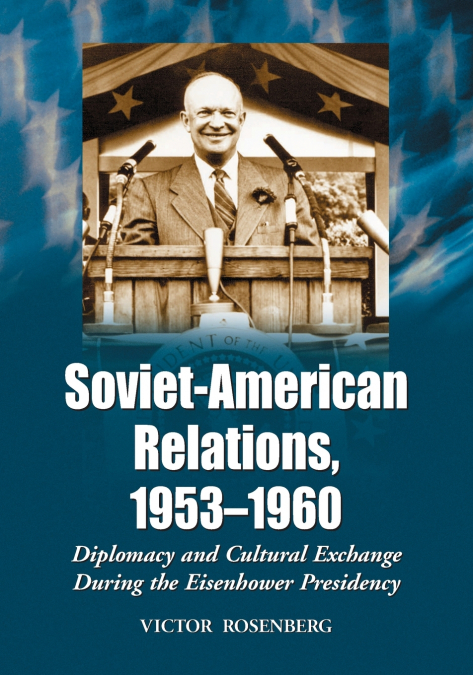
Dwight D. Eisenhower and Nikita Khrushchev presided over a pivotal period in Soviet-American relations. The ongoing Korean War and the lack of an American ambassador in Moscow illustrate the strain in Soviet-American relations at the start of Eisenhower’s presidency, but things changed after Stalin died only 44 days later. Stalin’s successors began to liberalize both domestic and foreign policy in what became known as the Thaw. There was an increase in diplomatic exchanges, including the first modern summit conferences. Of even greater importance, the Soviet leaders began to reestablish the scientific, cultural, and tourist contacts that had been broken under Stalin. Because political and ideological tensions remained and there were still restrictions on contacts, the Soviet overtures can best be described as a half-offered hand of friendship, and perhaps it was less of a thaw than the end of a blizzard. Nevertheless, these contacts began a process which would help end the Cold War three decades later. This history of relations between the Soviet Union and the United States during the Eisenhower and Khrushchev administrations explores political, social and cultural exchanges, and assesses their impact upon the two countries. Besides diplomatic documents, memoirs from Americans and Soviets, and works of history, it relies upon eyewitness accounts by journalists, tourists and others to paint a detailed picture of the era. Notes are included for each chapter, and there is a bibliography and an index.


Artículos relacionados

  • The Gandhian Iceberg
    Chris D Moore-Backman
    The Gandhian Iceberg presents a bold, new interpretation of Gandhian nonviolence from the rare perspective of an author who is equal parts writer, scholar, and frontlines practitioner. The book faces the current crisis of climate change and the intensification of social unrest around the world, and calls for a new convergence of serious, spiritually-rooted US nonviolence activi...
    Disponible

    11,52 €

  • Contemporary Developments in Child Protection
    Nigel Parton
    Volume 1 "Policy Changes and Challenges" takes as its central theme the ongoing and challenging issues which child protection agencies have to address and the policy and practice initiatives that are developed to try and address these. The volume includes papers on: the relationship between the decline in the rate of ‘unnatural’ deaths and the growth of concern about child abus...
  • Diversity in Information Technology Education
    Goran Trajkovski
    ...
  • Model-Driven Software Development
    Model-driven software development (MDSD) drastically alters the software development process, characterized by a high degree of innovation and productivity. However, quality assurance application in the domain of software models and model-driven software development is still in an emergent phase. Model-Driven Software Development: Integrating Quality Assurance provides in-depth...
  • Evidence-Based Practice in Nursing Informatics
    Andrew Chasin
    Because of the constant advances and dynamics within the nascent field of nursing informatics, many nurses struggle in practice as they continue to try and apply habitual communication practices in the new environment without any critical reflection on, and adaptation of, those practices. Evidence-Based Practice in Nursing Informatics: Concepts and Applications serves as a valu...
  • Actor-Network Theory and Technology Innovation
    Arthur Tatnall
    About 25 years ago, the first developments of ANT (Actor-Network Theory) took place, but it wasn’t until much later that researchers began to take it seriously. In the late 1990s, ANT began to take hold in the scientific community as a new and exciting approach to socio-technical research and social theory. Actor-Network Theory and Technology Innovation: Advancements and New Co...