
Inicio > > Ciencias de la computación > Inteligencia artificial > Soft Computing in Green and Renewable Energy Systems
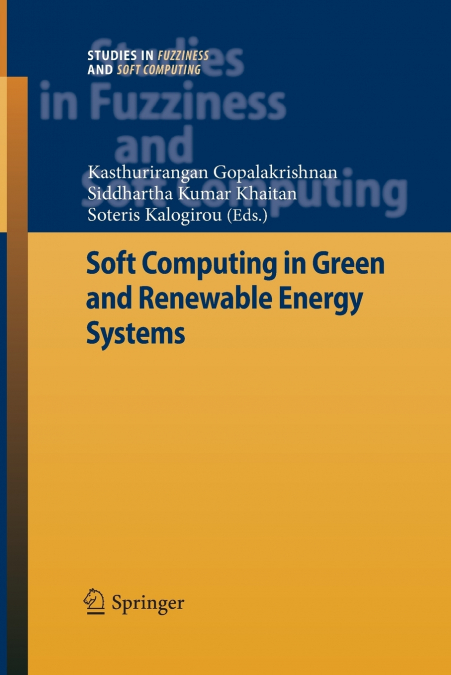
Soft Computing in Green and Renewable Energy Systems

Soft Computing in Green and Renewable Energy Systems


210,13 €
IVA incluido
Consulta disponibilidad
Editorial:
Springer Nature B.V.
Año de edición:
2016
Materia
Inteligencia artificial
ISBN:
9783662520000

Selecciona una librería:

  • Librería Samer Atenea
  • Librería Aciertas (Toledo)
  • Kálamo Books
  • Librería Perelló (Valencia)
  • Librería Elías (Asturias)
  • Donde los libros
  • Librería Kolima (Madrid)
  • Librería Proteo (Málaga)

Soft Computing in Green and Renewable Energy Systems provides a practical introduction to the application of soft computing techniques and hybrid intelligent systems for designing, modeling, characterizing, optimizing, forecasting, and performance prediction of green and renewable energy systems. Research is proceeding at jet speed on renewable energy (energy derived from natural resources such as sunlight, wind, tides, rain, geothermal heat, biomass, hydrogen, etc.) as policy makers, researchers, economists, and world agencies have joined forces in finding alternative sustainable energy solutions to current critical environmental, economic, and social issues. The innovative models, environmentally benign processes, data analytics, etc. employed in renewable energy systems are computationally-intensive, non-linear and complex as well as involve a high degree of uncertainty. Soft computing technologies, such as fuzzy sets and systems, neural science and systems, evolutionary algorithms and genetic programming, and machine learning, are ideal in handling the noise, imprecision, and uncertainty in the data, and yet achieve robust, low-cost solutions. As a result, intelligent and soft computing paradigms are finding increasing applications in the study of renewable energy systems. Researchers, practitioners, undergraduate and graduate students engaged in the study of renewable energy systems will find this book very useful.
Artículos relacionados

  • Artificial Cognition Systems
    ...
  • Cross-Disciplinary Applications of Artificial Intelligence and Pattern Recognition
    Vijay Kumar Mago
    The need for intelligent machines in areas such as medical diagnostics, biometric security systems, and image processing motivates researchers to develop and explore new techniques, algorithms, and applications in this evolving field. Cross-Disciplinary Applications of Artificial Intelligence and Pattern Recognition: Advancing Technologies provides a common platform for researc...
  • Emerging Applications of Natural Language Processing
    Over the last few years, the area of Natural Language Processing has drastically grown in recognition, not only within the research and development community, but also with industry professionals. As NLP continues to be discussed and researched, certain areas continue to grow and mature. As a result, the need for advanced research and information is in high demand. Emerging App...
  • Androids, Cyborgs, and Robots in Contemporary Culture and Society
    Steven John Thompson
    Mankind’s dependence on artificial intelligence and robotics is increasing rapidly as technology becomes more advanced. Finding a way to seamlessly intertwine these two worlds will help boost productivity in society and aid in a variety of ways in modern civilization. Androids, Cyborgs, and Robots in Contemporary Culture and Society is an essential scholarly resource that delve...
  • Deep Learning Innovations and Their Convergence With Big Data
    The expansion of digital data has transformed various sectors of business such as healthcare, industrial manufacturing, and transportation. A new way of solving business problems has emerged through the use of machine learning techniques in conjunction with big data analytics. Deep Learning Innovations and Their Convergence With Big Data is a pivotal reference for the latest sc...
  • Computational Psychoanalysis and Formal Bi-Logic Frameworks
    Giuseppe Iurato
    Computational psychoanalysis is a new field stemming from Freudian psychoanalysis. The new area aims to understand the primary formal structures and running mechanisms of the unconscious while implementing them into computer sciences. Computational Psychoanalysis and Formal Bi-Logic Frameworks provides emerging information on this new field which uses psychoanalysis and the unc...