Inicio > Sociedad y ciencias sociales > Educación pedagogía > Socioeconomic Inequality and Educational Outcomes
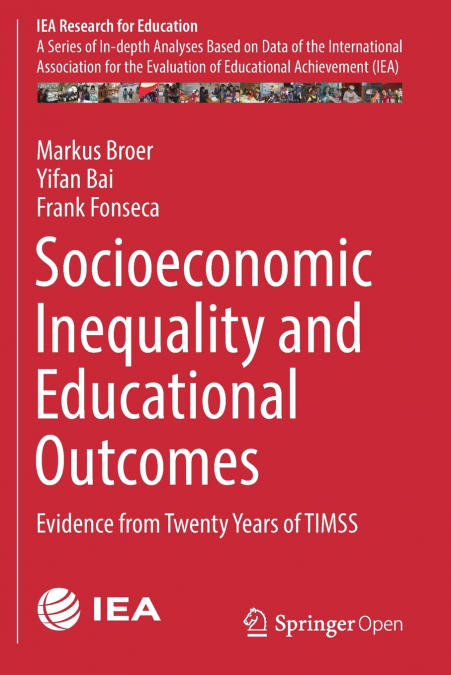
Socioeconomic Inequality and Educational Outcomes

Socioeconomic Inequality and Educational Outcomes

Frank Fonseca / Markus Broer / Yifan Bai

66,91 €
IVA incluido
Disponible
Editorial:
Springer Nature B.V.
Año de edición:
2020
Materia
Educación pedagogía
ISBN:
9783030119935
66,91 €
IVA incluido
Disponible

Selecciona una librería:

  • Librería Samer Atenea
  • Librería Aciertas (Toledo)
  • Kálamo Books
  • Librería Perelló (Valencia)
  • Librería Elías (Asturias)
  • Donde los libros
  • Librería Kolima (Madrid)
  • Librería Proteo (Málaga)

This open access book focuses on trends in educational inequality using twenty years of grade 8 student data collected from 13 education systems by the IEA’s Trends in Mathematics and Science Study (TIMSS) between 1995 and 2015. While the overall positive association between family socioeconomic status (SES) and student achievement is well documented in the literature, the magnitude of this relationship is contingent on social contexts and is expected to vary by education system. Research on how such associations differ across societies and how the strength of these relationships has changed over time is limited. This study, therefore, addresses an important research and policy question by examining changes in the inequality of educational outcomes due to SES over this 20-year period, and also examines the extent to which the performance of students from disadvantaged backgrounds has improved over time in each education system. Education systems generally aim to narrow the achievement gap between low- and high-SES students and to improve the performance of disadvantaged students. However, the lack of quantifiable and comprehensible measures makes it difficult to assess and monitor the effect of such efforts. In this study, a novel measure of SES that is consistent across all TIMSS cycles allows students to be categorized into different socioeconomic groups. This measure of SES may also contribute to future research using TIMSS trend data. Readers will gain new insight into how educational inequality has changed in the education systems studied and how such change may relate to the more complex picture of macroeconomic changes in those societies. 

Artículos relacionados

  • Beekeeping At The End Of The Earth
    Mark David Leech
    Beekeeping at the End of the Earth, an essential read for learning about beekeeping in a cool temperate climate with a focus on Tasmania our island home.  One hundred beekeepers one hundred different ways to keep bees.Beekeeping At The End Of The Earth is a practical insight into cool climate beekeeping with a focus on Tasmania, our island home.Richly illustrated with unique di...
    Disponible

    45,16 €

  • Be the One for Kids
    Ryan Sheehy
    One person can make a difference.That person can be you. “I want to show others that one person can make the difference in a child’s life. I want all educators, parents, coaches, and everyone in between to know they have power to Be the One for Kids.” —Ryan Sheehy If you ever feel like you’re all alone or think that no one gets you, just imagine how your students feel. Kids wan...
    Disponible

    27,99 €

  • Handbook of Research on E-Learning Standards and Interoperability
    As the e-learning industry continues to expand and the methods and tools necessary to create and maintain content and infrastructure applications become more complicated, there is an inherent need for these applications to interoperate and exchange data in order to better support the needs of learners and educators. Handbook of Research on E-Learning Standards and Interoperabil...
  • Teaching in the Knowledge Society
    Antonio Cartelli
    ...
  • Enhancing Learning Through Human Computer Interaction
    Elspeth McKay
    ...
  • Learning Objects for Instruction
    Pamela Taylor Northrup
    ...