African American Pamphlet Collection (Li / Horace Thomas] 1807-1895. [from o [Love
 Librería Samer Atenea
 Kálamo Books
 Librería Elías (Asturias)
 Librería Kolima (Madrid)
 Librería Proteo (Málaga)
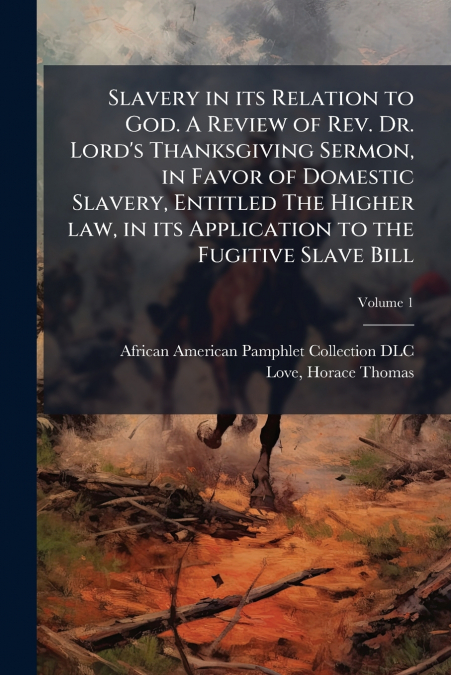
In 'Slavery in its Relation to God,' Horace Thomas Love delivers a powerful rebuttal to pro-slavery arguments rooted in religious justifications. This 1851 pamphlet directly confronts Rev. Dr. Lord’s sermon, 'The Higher Law, in its Application to the Fugitive Slave Bill,' critiquing its theological defense of domestic slavery. Love meticulously dismantles the biblical interpretations used to support slavery, arguing that true Christian ethics are fundamentally incompatible with the institution. This volume offers invaluable insights into the complex moral and religious debates surrounding slavery in antebellum America. It showcases the intellectual and ethical arguments employed by abolitionists, providing a critical perspective on a pivotal moment in American history. This is a vital resource for understanding the intersection of religion, politics, and the struggle for human rights.This work has been selected by scholars as being culturally important, and is part of the knowledge base of civilization as we know it. This work was reproduced from the original artifact, and remains as true to the original work as possible. Therefore, you will see the original copyright references, library stamps (as most of these works have been housed in our most important libraries around the world), and other notations in the work.This work is in the public domain in the United States of America, and possibly other nations. Within the United States, you may freely copy and distribute this work, as no entity (individual or corporate) has a copyright on the body of the work.As a reproduction of a historical artifact, this work may contain missing or blurred pages, poor pictures, errant marks, etc. Scholars believe, and we concur, that this work is important enough to be preserved, reproduced, and made generally available to the public. We appreciate your support of the preservation process, and thank you for being an important part of keeping this knowledge alive and relevant.