 Librería Samer Atenea
 Kálamo Books
 Librería Elías (Asturias)
 Librería Kolima (Madrid)
 Librería Proteo (Málaga)
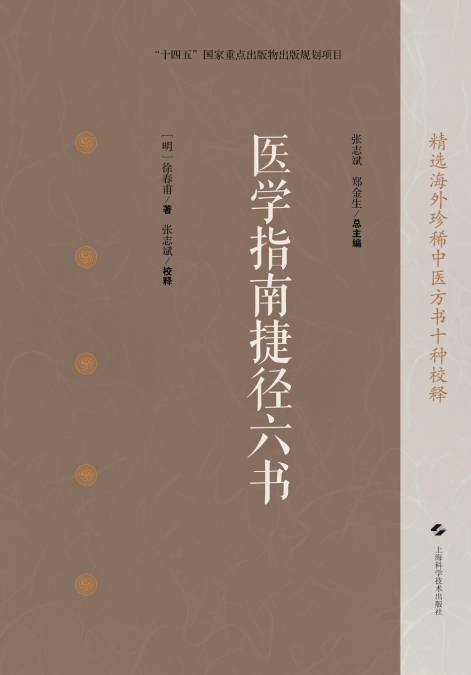
A Classic Work of Collation and Annotation of Traditional Chinese Medicine Ancient Texts Repatriated from Overseas海外回归中医古籍校释经典之作This book was completed in 1586 by Xu Chunfu, a renowned physician of the Ming Dynasty. The present punctuated and collated edition is based on the complete re-printed edition of 1597 preserved in Japan. The work consists of six volumes, comprising six subsidiary texts: The Orthodox Lineage of the Inner Canon, Elucidation of Master Lei’s Four Essentials, Song-Poems on Pathomechanisms and Medicinal Properties, Rhymed Summaries of Essential Formulas for Various Patterns, Twenty-Four Formulas, and Thirty-Six Assessed and Annotated Formulas for Benefiting the World. Each of these six texts has its own focus, expressing Xu Chunfu’s views on the study and practice of medicine from different perspectives. This book is a popularizing medical series; although its content is relatively elementary, it is highly practical and fully presents many of Xu’s clinical diagnostic and therapeutic insights. The content covers various aspects of knowledge including diagnosis, pattern differentiation, pathomechanisms, and medicinal properties.The Orthodox Lineage of the Inner Canon (Neijing Zhengmai): This text discusses pulse diagnosis. It is titled with reference to the Inner Canon because Xu believed that the study of pulse should be rooted in the Inner Canon. Accordingly, the book devotes considerable space to citing pulse-related content from the Inner Canon. The term 'Orthodox Lineage' (Zhengmai) signifies the authentic and orthodox tradition of pulse study. Xu cites the pulse theories of renowned experts such as Pang Anchang, Cai Xishan, and Hua Shou, demonstrating a well-grounded scholarly foundation.Elucidation of Master Lei’s Four Essentials (Leigong Siyao Gangling Fawei): The so-called 'Four Essentials' refer to pulse examination, pattern differentiation, therapeutic principles, and formula prescription-i.e., the four key clinical issues of diagnosis, pattern identification, treatment determination, and formula selection. As for 'Master Lei,' there is no specific reference. Ming Dynasty scholars held Master Lei in high esteem; whether in processing methods or pulse studies, they often invoked the name of Lei, a minister of the Yellow Emperor. The term 'Essentials' (Gangling) refers to fundamental medical knowledge, including the physiology of yin and yang, exterior and interior, defensive and nutrient qi, the Triple Burner, the five viscera, the six bowels, the twelve meridians, and the twelve organs, as well as issues of formula composition and medicinals application.*Song-Poems on Pathomechanisms and Medicinal Properties (Bingji Yaoxing Gefu): This subsidiary text begins with 'Song-Poems on Pathomechanisms,' which are organized by disease and composed in seven-character verses of varying lengths to facilitate recitation and memorization. Following these are 'Essential Summaries of Five Movements and Six Qi' and 'Song-Poems on Diseases Caused by Six Qi Governing Heaven and Abiding in Earth.' The second half of this text is 'Rhymed Formulas on Medicinal Properties,' which categorizes medicinals according to four natures-cold, neutral, warm, and hot-and lists the simple properties and functions of over 180 medicinals in verse form.*Rhymed Summaries of Essential Formulas for Various Patterns (Zhu Zheng Yao Fang Ge Kuo): This subsidiary text is organized by common disease patterns and lists rhymed summaries of the formulas used for each. Occasionally, it also includes rhymed summaries of certain therapeutic methods.Twenty-Four Formulas (Ershisi Fang): These twenty-four formulas were used by Xu Chunfu in teaching his disciples and serve as representative formulas for twenty-four categories of therapeutic approaches.*Thirty-Six Assessed and Annotated Formulas for Benefiting the World (Pingmi Jishi Sanshiliu Fang): This is the most treasured and secret portion of Xu Chunfu’s