 Librería Samer Atenea
 Kálamo Books
 Librería Elías (Asturias)
 Librería Kolima (Madrid)
 Librería Proteo (Málaga)
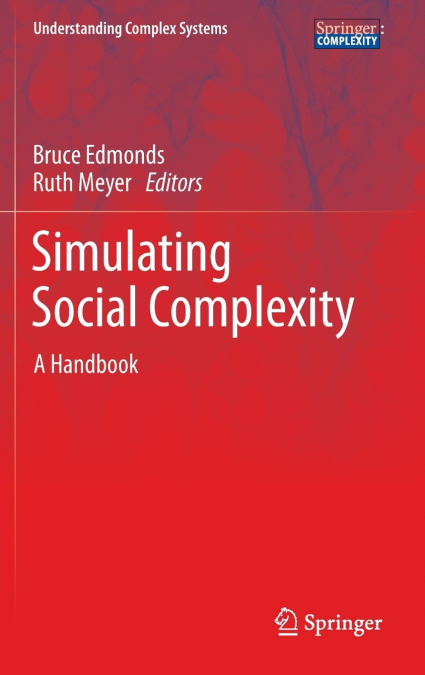
Social systems are among the most complex known. This poses particular problems for those who wish to understand them. The complexity often makes analytic approaches infeasible and natural language approaches inadequate for relating intricate cause and effect. However, individual- and agent-based computational approaches hold out the possibility of new and deeper understanding of such systems. Simulating Social Complexity examines all aspects of using agent- or individual-based simulation. This approach represents systems as individual elements having each their own set of differing states and internal processes. The interactions between elements in the simulation represent interactions in the target systems. What makes these elements 'social' is that they are usefully interpretable as interacting elements of an observed society. In this, the focus is on human society, but can be extended to include social animals or artificial agents where such work enhances our understanding of human society. The phenomena of interest then result (emerge) from the dynamics of the interaction of social actors in an essential way and are usually not easily simplifiable by, for example, considering only representative actors. The introduction of accessible agent-based modelling allows the representation of social complexity in a more natural and direct manner than previous techniques. In particular, it is no longer necessary to distort a model with the introduction of overly strong assumptions simply in order to obtain analytic tractability. This makes agent-based modelling relatively accessible to a range of scientists. The outcomes of such models can be displayed and animated in ways that also make them more interpretable by experts and stakeholders. This handbook is intended to help in the process of maturation of this new field. It brings together, through the collaborative effort of many leading researchers, summaries of the best thinking and practice in this area and constitutes a reference point for standards against which future methodological advances are judged. This book will help those entering into the field to avoid 'reinventing the wheel' each time, but it will also help those already in the field by providing accessible overviews of current thought. The material is divided into four sections: Introductory, Methodology, Mechanisms, and Applications. Each chapter starts with a very brief section called ’Why read this chapter?’ followed by an abstract, which summarizes the content of the chapter. Each chapter also ends with a section of ’Further Reading’ briefly describing three to eight items that a newcomer might read next.