Silence in the Land of Logos

Silence in the Land of Logos

Silvia Montiglio

60,76 €
IVA incluido
Disponible
Editorial:
Princeton University Press
Año de edición:
2010
Materia
Historia social y cultural
ISBN:
9780691146584
60,76 €
IVA incluido
Disponible

Selecciona una librería:

  • Librería Samer Atenea
  • Librería Aciertas (Toledo)
  • Kálamo Books
  • Librería Perelló (Valencia)
  • Librería Elías (Asturias)
  • Donde los libros
  • Librería Kolima (Madrid)
  • Librería Proteo (Málaga)

In ancient Greece, the spoken word connoted power, whether in the free speech accorded to citizens or in the voice of the poet, whose song was thought to know no earthly bounds. But how did silence fit into the mental framework of a society that valued speech so highly? Here Silvia Montiglio provides the first comprehensive investigation into silence as a distinctive and meaningful phenomenon in archaic and classical Greece. Arguing that the notion of silence is not a universal given but is rather situated in a complex network of associations and values, Montiglio seeks to establish general principles for understanding silence through analyses of cultural practices, including religion, literature, and law. Unlike the silence of a Christian before an ineffable God, which signifies the uselessness of words, silence in Greek religion paradoxically expresses the power of logos--for example, during prayer and sacrifice, it serves as a shield against words that could offend the gods. Montiglio goes on to explore silence in the world of the epic hero, where words are equated with action and their absence signals paralysis or tension in power relationships. Her other examples include oratory, a practice in which citizens must balance their words with silence in very complex ways in order to show that they do not abuse their right to speak. Inquiries into lyric poetry, drama, medical writings, and historiography round out this unprecedented study, revealing silence as a force in its own right.
Artículos relacionados

  • Arizal
    Raphael Afilalo
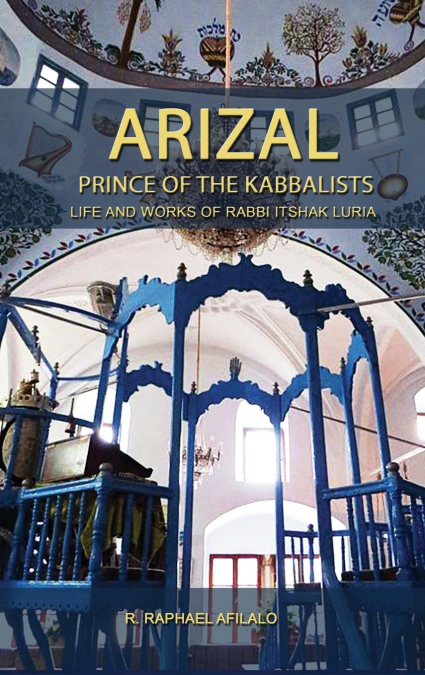
    The Ari overflowed with Torah. He was expert in Scripture, Mishnah, Talmud, Midrash, Maaseh Bereishit and Maaseh Merkavah. About all the different levels of prophecy, their details and from which level the prophets had their revelations.  He understood the whistling of the trees, the grass and stones, the language of the birds and other animals, the conversations of angels, the...
  • Rose-tinted Memory
    Michael S Fryer
    “Those who deny Auschwitz would be ready to remake it”.  ~ Primo Levi, Holocaust survivor and author Seventy years after the mass murder of the Jews of Europe, Holocaust denial and Holocaust revisionism are creeping into our overall perception of what actually happened.Christendom has not ‘denied’ Holocaust, but it has attempted to create a memory of Holocaust which suggests th...
    Disponible

    8,84 €

  • Pan Kapitan of Jordanow
    William Leibner
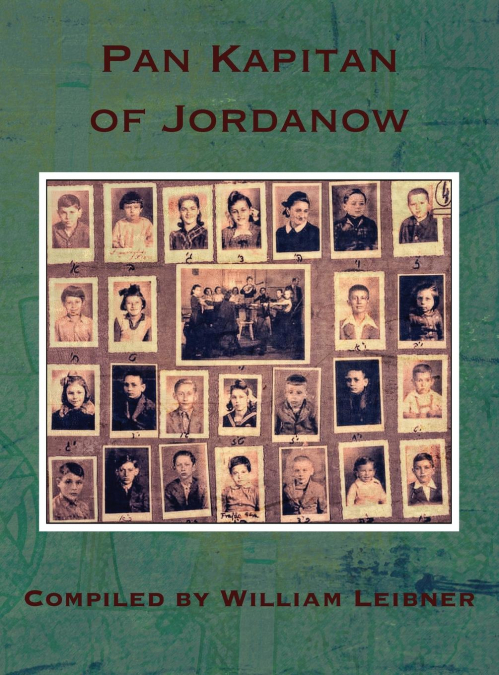
    Yeshayahu Drucker devoted a good part of his life to rescuing Jewish children from non-Jewish homes. Many parents had given their children to Polish neighbors for safekeeping during the war. Unfortunately most of the parents did not survive the Shoah. At the end of the war, there was no one to claim the children and they remained with the “adopted” Polish families. Following hi...
  • Holy Dissent
    Glenn Dynner
    BThe religious communities of early modern Eastern Europe—particularly those with a mystical bent—are typically studied in isolation. Yet the heavy Slavic imprint on Jewish popular mysticism and pervasive Judaizing tendencies among Christian dissenters call into question the presumed binary quality of Jewish-Christian interactions. In Holy Dissent: Jewish and Christian Mystics ...
  • AL-FARD
    Ali Mahdi Muhammad
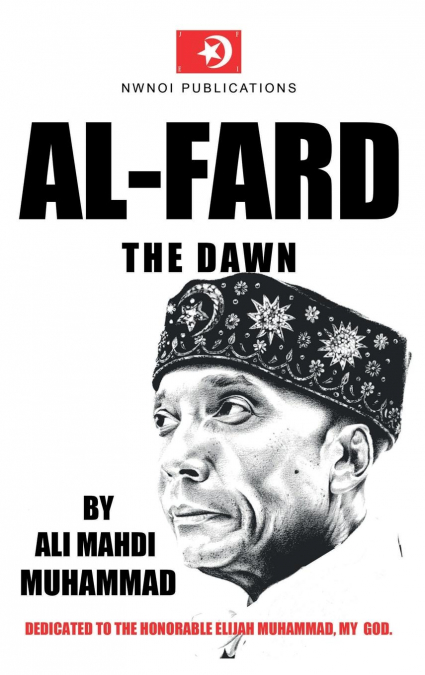
    The Al-Fard, or the The Dawn, has captured the early rays of Our history. This history is essential if we are to be brought face to face with the One true and living God of the universe. The purpose of this writing is to bring the reader step by step, one degree at a time to the reality of God in person. The teachings of Our Father elevates the believer to the level of Godhood ...
  • Wild Things. Nature and the Social Imagination
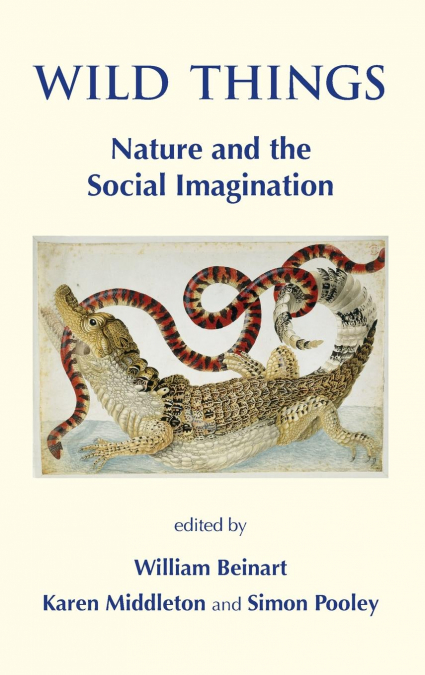
    HISTORIES OF HUMAN CONSTRUCTIONS OF NATUREWild Things: Nature and the Social Imagination assembles eleven substantive and original essays on the cultural and social dimensions of environmental history. They address a global cornucopia of social and ecological systems, from Africa to Europe, North America and the Caribbean, and their temporal range extends from the 1830s into th...

Otros libros del autor

  • Musaeus’ Hero and Leander
    Silvia Montiglio
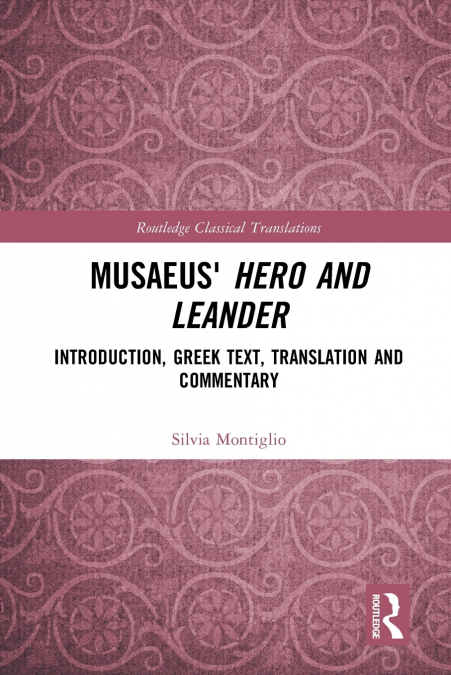
    This book offers a new English translation of Musaeus’ poem Hero and Leander, with the original Greek on the facing page, a substantial introduction and a detailed commentary. ...
    Disponible

    83,26 €

  • The Spell of Hypnos
    Silvia Montiglio
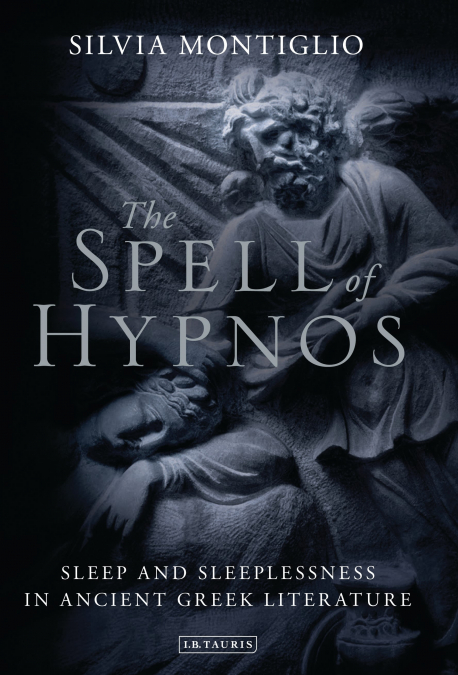
    Sleep was viewed as a boon by the ancient Greeks: sweet, soft, honeyed, balmy, care-loosening, as the Iliad has it. But neither was sleep straightforward, nor safe. It could be interrupted, often by a dream. It could be the site of dramatic intervention by a god or goddess. It might mark the transition in a narrative relationship, as when Penelope for the first time in weeks sl...
    Disponible

    54,59 €

  • Musaeus’ Hero and Leander
    Silvia Montiglio
    This book offers a new English translation of Musaeus’ poem Hero and Leander, with the original Greek on the facing page, a substantial introduction and a detailed commentary. ...
  • The Myth of Hero and Leander
    Silvia Montiglio
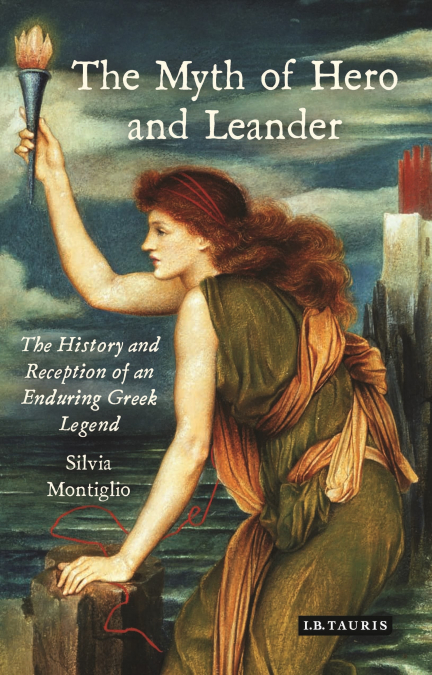
    Hero and Leander are the protagonists in a classical tale of epic but tragic love. Hero lives secluded in a tower on the European shore of the Hellespont, and Leander on the opposite side of the passage. Since they cannot hope to marry, the couple resolves to meet in secret: each night he swims across to her, guided by the light of her torch. But the time comes when a winter st...
  • The Spell of Hypnos
    Silvia Montiglio
    Sleep was viewed as a boon by the ancient Greeks: sweet, soft, honeyed, balmy, care-loosening, as the Iliad has it. But neither was sleep straightforward, nor safe. It could be interrupted, often by a dream. It could be the site of dramatic intervention by a god or goddess. It might mark the transition in a narrative relationship, as when Penelope for the first time in weeks sl...
  • Love and Providence
    Silvia Montiglio
    ...