Samuel J. Kostic / Samuel JKostic
 Librería Samer Atenea
 Kálamo Books
 Librería Elías (Asturias)
 Librería Kolima (Madrid)
 Librería Proteo (Málaga)
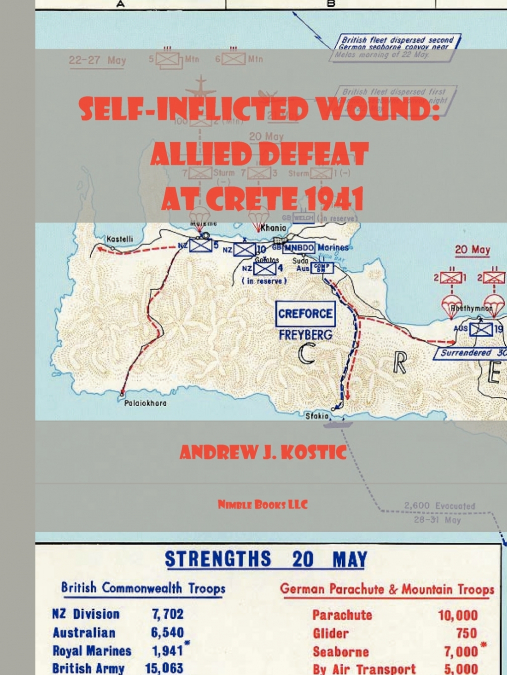
Leadership failures in the defense of Crete were essential factors contributing to Allied defeat on the island in May 1941. The Germans appeared unstoppable during the early stages of World War II. Inexperienced Allied forces were willing to fight, but the sentiment was the Germans were too powerful. Defeat became a foregone conclusion. To defend at all costs no longer appeared viable. Withdrawal and evacuation seemed almost commonplace in Allied strategy. Great Britain and Germany identified early in the war the strategic importance of the island of Crete for conducting military operations in the Mediterranean. Operationally the British maintained naval supremacy in the Mediterranean, while the German Luftwaffe ruled the skies. The Allies began defending Crete in November 1940. However, the Middle East Command put little effort into defending the island and changed Crete Force Commanders on a monthly basis. Allied intelligence uncovered the details of the German invasion plan for Crete. In a last ditch effort, forces evacuated from Greece were sent to Crete to bolster the defenses. This brought the total number of Allied defenders to 42,500 to repel an estimated enemy assault of 5,000 men. The German plan for the occupation of Crete, Operation MERCURY, called for gliders and Hitler’s elite paratroops to conduct the largest airborne operation to date. The plan pitted 22,000 men and 1280 aircraft against an erroneously estimated enemy strength of 5,000 men. The success of this plan relied upon surprise and the paratroops securing one of the three airfields on the island so reinforcements could be flown in. A reluctant Crete Force Commander set the tone for subordinate commanders’ leadership failures. The invasion began the morning of 20 May 1941. The Germans suffered heavy casualties. At the end of the first day of fighting, they were short ammunition, and the Allies maintained control of the airfields. However, the battalion commander defending the airfield at Maleme, lacking communications and situational awareness, was unaware of the success of his unit and that night mistakenly ordered its withdrawal from the airfield. The Germans occupied the airfield in the morning and reinforcements were flown in. The Allies conducted an attack the night of 21 May to retake the airfield, but poor Allied leadership at the Brigade and Division level resulted in failure. Consequently, the Germans were able to mass combat power on the island and defeat the Allies.The defenders outnumbered the attackers nearly 2 to 1, knew the invasion plan, and established their defense accordingly. By all accounts, the Allies should have defeated the Germans and in fact came quite close to doing so. However, failures in Allied leadership afforded the Germans opportunities that were quickly exploited. Subsequently, they were able to defeat the Allies within 12 days. Failure in Allied leadership, not overwhelming German combat power, was responsible for the Allied defeat on Crete.