
Inicio > Derecho > Derecho internacional > Self-Determination and Secession
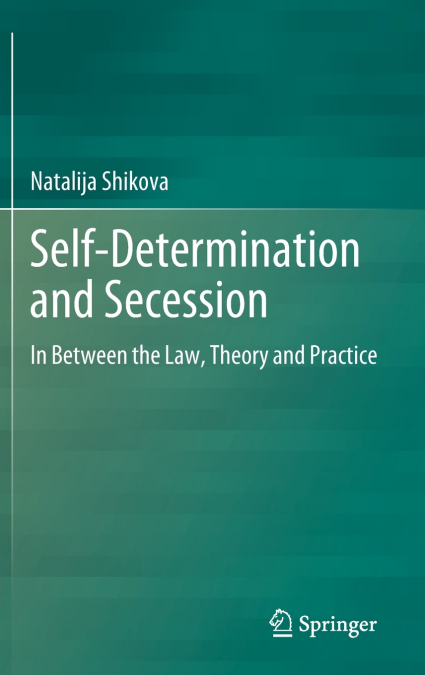
Self-Determination and Secession

Self-Determination and Secession

Natalija Shikova

218,66 €
IVA incluido
Consulta disponibilidad
Editorial:
Springer Nature B.V.
Año de edición:
2023
Materia
Derecho internacional
ISBN:
9783031343216

Selecciona una librería:

  • Librería Samer Atenea
  • Librería Aciertas (Toledo)
  • Kálamo Books
  • Librería Perelló (Valencia)
  • Librería Elías (Asturias)
  • Donde los libros
  • Librería Kolima (Madrid)
  • Librería Proteo (Málaga)

This book offers a comprehensive summary of extant international law scholarship on the topics of self-determination and secession and positions the concepts among present-day theory and relevant practice, illustrated through various ongoing cases and historical examples. The right to self-determination is among the least understood rights within international law. Theoretical dilemmas - as to whether there is a link between self-determination and secession - are nothing new. In essence, self-determination is a much broader concept than secession and obtaining independent statehood. Unilateral secession is not prohibited by international law, but neither is it per se welcomed or accepted in practice. Beyond the context of decolonization, secession claims have long been viewed with disapproval in international law, and lawyers have been extremely skeptical about the issue. Although this is still the case, there are also new trends and opportunities to explore situations in which secession can be accepted, legitimized, or even legally permissible. The yardstick for this is the diplomatic response to secessionism and the growing involvement of the international community in mediation and conflict resolution. Though finding solutions can be difficult, within the existing frame, the ongoing tension between the duty of every society to recognize pluralism and diversity on the one hand, and the inherent desire of every culture - whether majority, minority or indigenous - to protect its values and ensure conformity on the other, must be resolved. The practices and modalities that envisage the internal dimension of the right to self-determination as a right that is exercised within the state borders can offer such opportunities. The appropriate role of the state and the international community is to serve as mediators between competing forces and to set parameters that can transform destructive conflicts into productive political models.
Artículos relacionados

  • Comparative regulation, economic analysis, and applications of private equity in the united states and european union
    Irini Liakopoulou
    The present work examines the economics and legal doctrine of private equity. After a consideration of private equity’s origins, the book will explore the evolution of private equity in the United States and Europe. The reference economic model then will be reconstructed, with particular attention to financial flows to and from private equity firms and funds. This reconstructio...
  • Complicity in International Law
    Dimitris Liakopoulous
    Complicity in International Law aims to analyze questions arising from a state’s complicity in conflict with another state or an international organization. On the basis of international legal provisions, a state that assists the illicit fact of another state or an international organization in turn commits an offense if it is aware of the main fact and is bound by the same obl...
  • Command responsibility
    James B Whisker / Kevin R Spiker
    Command responsibility, or executive accountability, assumes that leaders are responsible for the actions of their subordinates. If subordinates misbehave, violate basic moral laws, transgress international law, or thwart international standards of behavior, their leader may be called before to justice. Standards that set the boundaries of human action have been evolving for ma...
  • International Organizations and Reparations
    Dimitris Liakopoulos
    In the first part of this book, noted legal scholar Dimtris Liakopoulos deals with reconstructing the legal regulatory framework governing human rights violations in the activities of organizations. After identifying rules that are generally applicable to organizations’ offenses and govern the profile of reparations, this study assesses primary rules that guarantee the right to...
  • International Organizations and Legal Sanctions Against Governments
    Dimitris Liakopoulos
    This book examines the relationship between governments and international organizations under international law. After surveying the policing powers of international organizations under international law, it illustrates some normative aspects of law that distinguish regulation from enforcement via study of recent legal cases before international judicial bodies. According to Di...
  • The EU Foreign Subsidies Regulation
    Andreas Reindl / Isabelle Van Damme
    'The EU Foreign Subsidies Regulation' is a pioneering manual authored by legal experts Andreas Reindl and Isabelle Van Damme. This essential guide, the first of its kind, is tailored for legal practitioners, offering a thorough exploration of the tools and mechanisms embedded within this novel European regulatory framework. The authors meticulously dissect the EU Foreign Subsid...

Otros libros del autor

  • Self-Determination and Secession
    Natalija Shikova
    This book offers a comprehensive summary of extant international law scholarship on the topics of self-determination and secession and positions the concepts among present-day theory and relevant practice, illustrated through various ongoing cases and historical examples. The right to self-determination is among the least understood rights within international law. Theoretical ...
    Disponible

    47,86 €