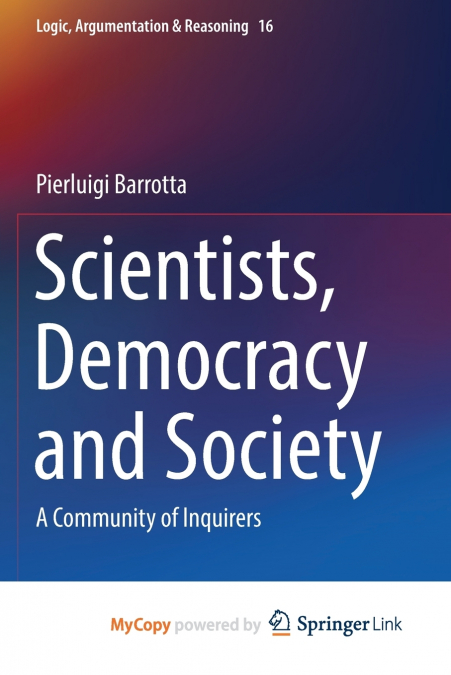
Scientists, Democracy and Society

Scientists, Democracy and Society

Pierluigi Barrotta

132,87 €
IVA incluido
Consulta disponibilidad
Editorial:
Springer Nature B.V.
Año de edición:
2018
Materia
Estudios mediáticos
ISBN:
9783319749372

Selecciona una librería:

  • Librería Samer Atenea
  • Librería Aciertas (Toledo)
  • Kálamo Books
  • Librería Perelló (Valencia)
  • Librería Elías (Asturias)
  • Donde los libros
  • Librería Kolima (Madrid)
  • Librería Proteo (Málaga)

This monograph examines the relationship between science and democracy. The author argues that there is no clear-cut division between science and the rest of society. Rather, scientists and laypeople form a single community of inquiry, which aims at the truth.To defend his theory, the author shows that science and society are both heterogeneous and fragmented. They display variable and shifting alliances between components. He also explains how information flow between science and society is bi-directional through 'transactional' processes. In other words, science and society mutually define themselves. The author also explains how science is both objective and laden with values.Coverage includes a wide range of topics, such as: the ideal of value-free science, the is/ought divide, 'thick terms' and the language of science, inductive risk, the dichotomy between pure science and applied science, constructivism and the philosophy of risk. It also looks at the concepts of truth and objectivity, the autonomy of science, moral and social inquiry, perfectionism and democracy, and the role of experts in democratic societies. The style is philosophical, but the book features many examples and case-studies. It will appeal to philosophers of science, those in science and technology studies as well as interested general readers.

Artículos relacionados

  • Impact of Communication and the Media on Ethnic Conflict
    Throughout the world, cultural and racial clashes remain a major hurdle to development and progress. Though some areas are experiencing successful intercultural communications which pave the way for peaceful negotiations, there are still many regions experiencing severe turmoil. Impact of Communication and the Media on Ethnic Conflict focuses on both the positive and negative o...
  • The Game to Show the Games
    Morgan Wick
    ESPN collects hundreds of millions of dollars in rights fees from cable subscribers, before selling a single advertisement. In The Game to Show the Games, Morgan Wick exposes how this lucrative revenue stream and the competition between media conglomerates has become a billion-dollar boon for sports leagues across the nation and the world, and how this has shaken up the rest o...
    Disponible

    9,42 €

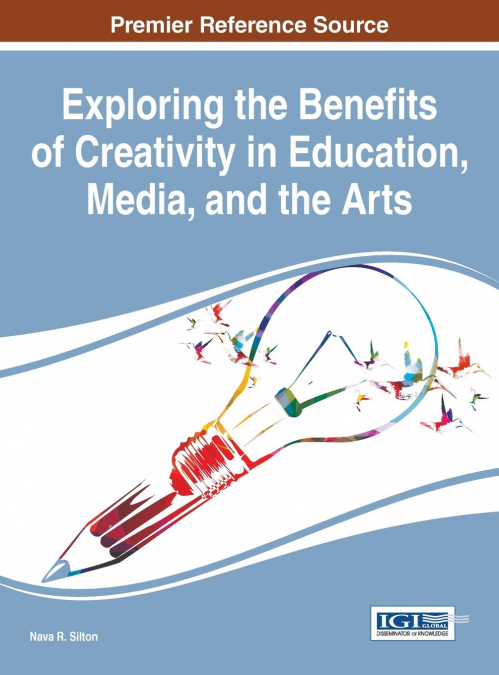
  • Exploring the Benefits of Creativity in Education, Media, and the Arts
    The use of imagination can lead to greater outcomes in problem solving, innovation, and critical thinking. By providing access to creative outlets, productivity increases in schools, businesses, and other professional settings. Exploring the Benefits of Creativity in Education, Media, and the Arts is a pivotal reference source for the latest scholarly research on the stimulatio...
  • Celebrity, Pedophilia, and Ideology in American Culture
    Jason Lee
    Celebrity, Pedophilia, and Ideology in American Culture reveals the connections between rapacious capitalism and the rape of children. The twenty chapters, which span the analysis of childhood, celebrity culture, important books and films on pedophilia and violence, post-9/11 theology and public rhetoric, and killing for fame, in an interrelated fashion cover intrinsically impo...
  • Researching Digital Media and Society
    Moa Eriksson Krutrök / Simon Lindgren
    ...
    Disponible

    86,42 €

  • Researching Digital Media and Society
    Moa Eriksson Krutrök / Simon Lindgren
    ...

Otros libros del autor

  • Scientists, Democracy and Society
    Pierluigi Barrotta
    This monograph examines the relationship between science and democracy. The author argues that there is no clear-cut division between science and the rest of society. Rather, scientists and laypeople form a single community of inquiry, which aims at the truth.To defend his theory, the author shows that science and society are both heterogeneous and fragmented. They display vari...
    Disponible

    48,16 €