
Science, Technology, and Society

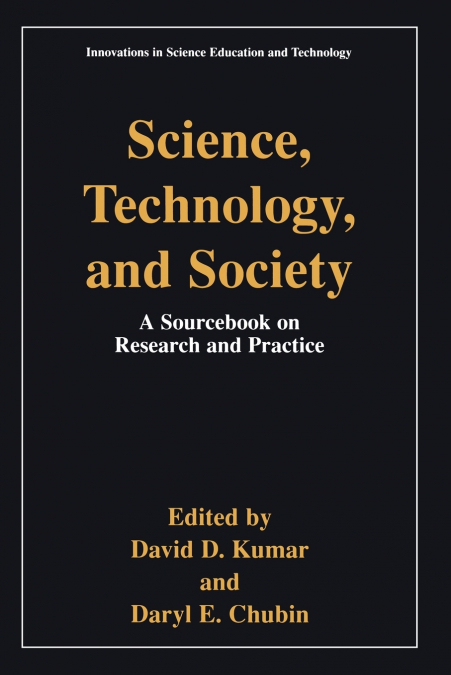
Science, Technology, and Society


121,68 €
IVA incluido
Disponible
Editorial:
Springer Nature B.V.
Año de edición:
2000
Materia
Sociedad y cultura: general
ISBN:
9780306461736
121,68 €
IVA incluido
Disponible

Selecciona una librería:

  • Librería Samer Atenea
  • Librería Aciertas (Toledo)
  • Kálamo Books
  • Librería Perelló (Valencia)
  • Librería Elías (Asturias)
  • Donde los libros
  • Librería Kolima (Madrid)
  • Librería Proteo (Málaga)

David D. Kumar and Daryl E. Chubin We live in an information age. Technology abounds: information tech­ nology, communication technology, learning technology. As a once popular song went, 'Something’s happening here, but it’s just not exactly clear.' The world appears to be a smaller, less remote place. We live in it, but we are not necessarily closely tied to it. We lack a satisfactory understanding of it. So we are left with a paradox: In an information age, information alone will neither inform nor improve us as citizens nor our democracy, society, or in­ stitutions. No, improvement will take some effort. It is a heavy burden to be reflective, indeed analytical, and disciplined but only constructively constrained by different perspectives. The science-based technology that makes for the complexity, contro­ versy, and uncertainty of life sows the seeds of understanding in Science, Technology, and Society. STS, as it is known, encompasses a hybrid area of scholarship now nearly three decades old. As D. R. Sarewitz,a former geologist now congressional staffer and an author, put it After all, the important and often controversial policy dilemmas posed by issues such as nuclear energy, toxic waste disposal, global climate change, or biotech­ nology cannot be resolved by authoritative scientific knowledge; instead, they must involve a balancing of technical considerations with other criteria that are explicitly nonscientific: ethics, esthetics, equity, ideology. Trade-offs must be made in light of inevitable uncertainties (Sarewitz, 1996, p. 182).


Artículos relacionados

  • The Gandhian Iceberg
    Chris D Moore-Backman
    The Gandhian Iceberg presents a bold, new interpretation of Gandhian nonviolence from the rare perspective of an author who is equal parts writer, scholar, and frontlines practitioner. The book faces the current crisis of climate change and the intensification of social unrest around the world, and calls for a new convergence of serious, spiritually-rooted US nonviolence activi...
    Disponible

    11,52 €

  • Contemporary Developments in Child Protection
    Nigel Parton
    Volume 1 "Policy Changes and Challenges" takes as its central theme the ongoing and challenging issues which child protection agencies have to address and the policy and practice initiatives that are developed to try and address these. The volume includes papers on: the relationship between the decline in the rate of ‘unnatural’ deaths and the growth of concern about child abus...
  • Diversity in Information Technology Education
    Goran Trajkovski
    ...
  • Model-Driven Software Development
    Model-driven software development (MDSD) drastically alters the software development process, characterized by a high degree of innovation and productivity. However, quality assurance application in the domain of software models and model-driven software development is still in an emergent phase. Model-Driven Software Development: Integrating Quality Assurance provides in-depth...
  • Evidence-Based Practice in Nursing Informatics
    Andrew Chasin
    Because of the constant advances and dynamics within the nascent field of nursing informatics, many nurses struggle in practice as they continue to try and apply habitual communication practices in the new environment without any critical reflection on, and adaptation of, those practices. Evidence-Based Practice in Nursing Informatics: Concepts and Applications serves as a valu...
  • Actor-Network Theory and Technology Innovation
    Arthur Tatnall
    About 25 years ago, the first developments of ANT (Actor-Network Theory) took place, but it wasn’t until much later that researchers began to take it seriously. In the late 1990s, ANT began to take hold in the scientific community as a new and exciting approach to socio-technical research and social theory. Actor-Network Theory and Technology Innovation: Advancements and New Co...