
Inicio > Humanidades > Religión y creencias > Scepticism and Belief in Hume’s Dialogues Concerning Natural Religion
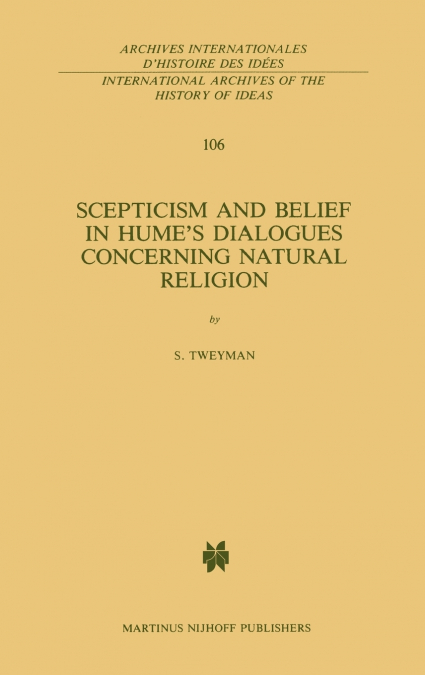
Scepticism and Belief in Hume’s Dialogues Concerning Natural Religion

Scepticism and Belief in Hume’s Dialogues Concerning Natural Religion

S. Tweyman

133,08 €
IVA incluido
Consulta disponibilidad
Editorial:
Springer Nature B.V.
Año de edición:
1986
Materia
Religión y creencias
ISBN:
9789024730902

Selecciona una librería:

  • Librería Samer Atenea
  • Librería Aciertas (Toledo)
  • Kálamo Books
  • Librería Perelló (Valencia)
  • Librería Elías (Asturias)
  • Donde los libros
  • Librería Kolima (Madrid)
  • Librería Proteo (Málaga)

In the pages that follow, an attempt is made to examine those sections of the Dialogues Concerning Natural Religion which deal with the Argument from Design - the argument which purports to prove that certain observed similarities between the design of the world and machines of human contrivance countenance reasoning by analogy to the conclusion that the cause of the design of the world resembles human intelligence. The sections which deal with the Argument from Design, and with which I am therefore concerned, are Parts I through VIII and Part XII. I argue that a clue to Hume’s discussion of the Argument from Design is to be found in Section XII of the first Enquiry, in which Hume presents his most thorough analysis of philosophic dogmatism and scepticism. The Dialogues, as will be shown, follows precisely Hume’s recommendations in this Section for bringing the dogmatist to the position which Hume himself endorses - ’mitigated scepticism. ’ It is, then, the position of the mitigated sceptic which is elaborated in Part XII of the Dialogues. The belief in an intelligent designer of the world is shown to be akin to certain other beliefs discussed by Hume - causality, physical objects, a continuing self - which are usually referred to in the literature as ’natural beliefs. ’ The mitigated sceptic’s defense of the unknowability of the divine nature is seen to be in accordance with Hume’s view that whatever is believed naturally cannot be known or understood.

Artículos relacionados

  • Cultural Diversity, Worship, and Australian Baptist Church Life
    Baptist congregations in Australia face two important and contemporary challenges: to remain faithful and to regain relevance. The authors featured in this volume model the innovative and imaginative responses that are required to meet those challenges. Pastors, Christian leaders, and theological educators together address congregational innovation and cultural transition. At...
    Disponible

    18,20 €

  • Out of yOur Hands
    Shelah D. Sandefur / Shelah DSandefur
    Most can remember a time when you knew that things were Out of yOur Hands.      I can recount several times in my life when I did not know what to do; when I felt overwhelmed by grief or pain haunted my heart.  At times, I wanted to give up.  In my desperation, I would cry out to God, “Help me, please...”.  Each time, although I may not have realized His presence at the time, G...
    Disponible

    11,96 €

  • Kabbalah Dictionary
    Rabbi Raphael Afilalo
    ...
    Disponible

    28,03 €

  • Resurrection
    Neville Goddard
    An Exact reprint of a lost spiritual classic by Neville Goddard. Contains the complete text of the books, Prayer-The Art of Believing, Feeling is the Secret, Freedom For All, Out of this World and ResurrectionIntroduction I can think of no greater privilege then to republish 'Resurrection' by Neville Goddard. As more and more of his first editions are disappearing, it is impor...
    Disponible

    23,42 €

  • Thomas Merton and the Celts
    Monica Weis
    Thomas Merton and the Celts offers a new lens through which to view Merton’s life and spirituality. By examining unpublished letters, notebooks, and taped conferences for the Trappist novices--previously unavailable to the general reader--the author breaks new ground in Merton studies, revealing Merton’s growing fascination with his Welsh ancestry, Celtic monasticism, and early...
  • Orthodoxy
    G. K. Chesterton / GKChesterton
    In Orthodoxy, Gilbert K. Chesterton explains how and why he came to believe in Christianity. In the book, Chesterton takes the spiritually curious reader on an intellectual quest. While looking for the meaning of life, he finds truth that uniquely fulfills human needs. This is the truth revealed in Christianity. Chesterton likens this discovery to a man setting off from the sou...

Otros libros del autor

  • Scepticism and Belief in Hume’s Dialogues Concerning Natural Religion
    S. Tweyman
    In the pages that follow, an attempt is made to examine those sections of the Dialogues Concerning Natural Religion which deal with the Argument from Design - the argument which purports to prove that certain observed similarities between the design of the world and machines of human contrivance countenance reasoning by analogy to the conclusion that ...
    Disponible

    134,43 €

  • Reason and Conduct in Hume and his Predecessors
    S. Tweyman
    Can reason play a significant role in making moral distinctions and in generating moral precepts? In this book I attempt to provide Hume’s answers to these questions in the light of his employment of the ’Experimen­ tal Method’, his doctrine of perceptions, and his analysis of reason. In addition to this, attention is paid to some of Hume’s rationalis...
    Disponible

    66,75 €