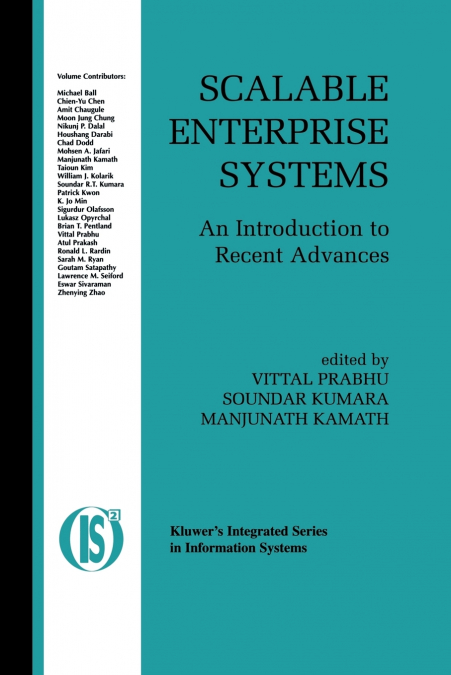

Scalable Enterprise Systems

Scalable Enterprise Systems


133,52 €
IVA incluido
Disponible
Editorial:
Springer Nature B.V.
Año de edición:
2012
Materia
Sociedad y cultura: general
ISBN:
9781461350521
133,52 €
IVA incluido
Disponible

Selecciona una librería:

  • Librería Samer Atenea
  • Librería Aciertas (Toledo)
  • Kálamo Books
  • Librería Perelló (Valencia)
  • Librería Elías (Asturias)
  • Donde los libros
  • Librería Kolima (Madrid)
  • Librería Proteo (Málaga)

The National Science Foundation (NSF) is the leading sponsor of basic academic research in engineering, and its influence far exceeds its budget. We think NSF is at its best when it uses that influence to focus interest within the researcher community on critical new challenges and technologies. NSF’s Scalable Enterprise Systems (SES) initiative, for which we were responsible in our successive terms in the division of Design, Manufacture and Industrial Innovation (DMII), was just such a venture. A collaborative effort spanning NSF’s engineering and computer science directorates, SES sought to concentrate the energies of the academic engineering research community on developing a science base for designing, planning and controlling the extended, spatially and managerially distributed enterprises that have become the norm in the manufacture, distribution and sale of the products of U. S. industry. The of associated issues addressed included everything from management supply chains, to product design across teams of collaborating companies, to e-marketing and make-to-order manufacturing, to the information technology challenges of devising inter-operable planning and control tools that can scale with exploding enterprise size and scope. A total of 27 teams with nearly 100 investigators were selected from the 89 submitted proposals in the Phase I, exploratory part of the effort (see the list below). Seven of these were awarded larger multi-year grants to continue their research in Phase II. As the contents of this book amply illustrate, these investigations continue to flourish, with and without direct NSF support.


Artículos relacionados

  • The Gandhian Iceberg
    Chris D Moore-Backman
    The Gandhian Iceberg presents a bold, new interpretation of Gandhian nonviolence from the rare perspective of an author who is equal parts writer, scholar, and frontlines practitioner. The book faces the current crisis of climate change and the intensification of social unrest around the world, and calls for a new convergence of serious, spiritually-rooted US nonviolence activi...
    Disponible

    11,52 €

  • Contemporary Developments in Child Protection
    Nigel Parton
    Volume 1 "Policy Changes and Challenges" takes as its central theme the ongoing and challenging issues which child protection agencies have to address and the policy and practice initiatives that are developed to try and address these. The volume includes papers on: the relationship between the decline in the rate of ‘unnatural’ deaths and the growth of concern about child abus...
  • Diversity in Information Technology Education
    Goran Trajkovski
    ...
  • Model-Driven Software Development
    Model-driven software development (MDSD) drastically alters the software development process, characterized by a high degree of innovation and productivity. However, quality assurance application in the domain of software models and model-driven software development is still in an emergent phase. Model-Driven Software Development: Integrating Quality Assurance provides in-depth...
  • Evidence-Based Practice in Nursing Informatics
    Andrew Chasin
    Because of the constant advances and dynamics within the nascent field of nursing informatics, many nurses struggle in practice as they continue to try and apply habitual communication practices in the new environment without any critical reflection on, and adaptation of, those practices. Evidence-Based Practice in Nursing Informatics: Concepts and Applications serves as a valu...
  • Actor-Network Theory and Technology Innovation
    Arthur Tatnall
    About 25 years ago, the first developments of ANT (Actor-Network Theory) took place, but it wasn’t until much later that researchers began to take it seriously. In the late 1990s, ANT began to take hold in the scientific community as a new and exciting approach to socio-technical research and social theory. Actor-Network Theory and Technology Innovation: Advancements and New Co...