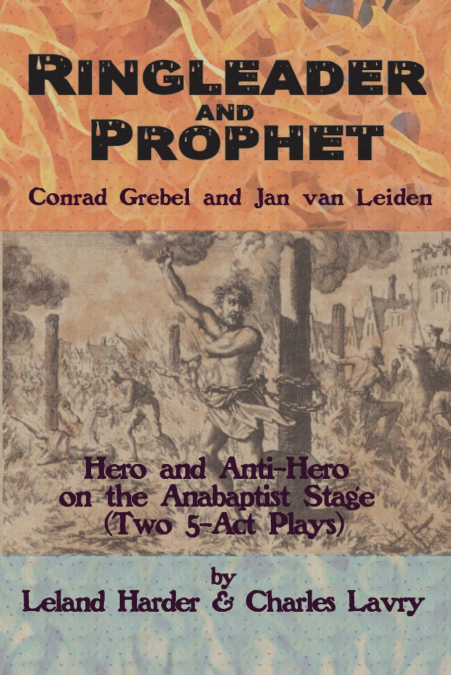
Ringleader and Prophet - Conrad Grebel and Jan van Leiden

Ringleader and Prophet - Conrad Grebel and Jan van Leiden

Charles Lavry / Leland Harder / Jonathan R. Seiling

25,47 €
IVA incluido
Disponible
Editorial:
Gelassenheit Publications
Año de edición:
2026
Materia
Revoluciones, levantamientos y rebeliones
ISBN:
9781990827266
25,47 €
IVA incluido
Disponible

Selecciona una librería:

  • Librería Samer Atenea
  • Kálamo Books
  • Librería Elías (Asturias)
  • Librería Kolima (Madrid)
  • Librería Proteo (Málaga)

The two plays in this volume, both published here for the first time, offer stark contrasts in style, content and purpose of Anabaptist theatrics. The first concerns Conrad Grebel and is moderately speculative yet faithfully historical; the second concerns Jan van Leiden and its writer took as much literary licence as he wanted. The Grebel monologue has depth of conviction, exhibiting a sincere struggle with what course he might take, given his obstacles and options. The Jan van Leiden play is a story that has largely evolved as myth that unfolds before multitudes, drawing in historical and fictional characters alike.Both Conrad Grebel and Jan van Leiden became legends, but interpretations of their motives and actions have stirred debate until the present day. While those who wish to denigrate the Anabaptist movement relish the example of Jan van Leiden at Münster in northern Germany, others point to Conrad Grebel’s social status and education level as lending some credibility to the Zurich circle of early Anabaptists. The centres of gravity of the Grebel story are south Germany, Austria, Paris and Zurich. For Jan van Leiden, the centres shift north to Flemish regions and around north-west Germany.In each case, the question of revolution and violence comes to the fore, with Grebel being hailed by some scholars as rebutting the sword-wielding movement among the radicals, as seen in the Peasants’ Revolution and the leadership of the theologian, Thomas Müntzer in the mid-1520s. The Anabaptist Kingdom of Münster in the mid-1530s, stands out as a disastrous example of religious rebellion and what is often labelled as fanaticism. And today, while some hail Grebel for his supposed pacifism, others seek to justify violence as a divine tool for vengeance upon the wicked. In the latter case, the Anabaptists are seen, for example, by Marxists, as proto-socialist revolutionaries raging against the unjust principalities and powers. 
Artículos relacionados

  • The Coming of the French Revolution
    Georges Lefebvre / R. R. Palmer
    The classic book that restored the voices of ordinary people to our understanding of the French RevolutionThe Coming of the French Revolution remains essential reading for anyone interested in the origins of this great turning point in the formation of the modern world. First published in 1939 on the eve of the Second World War and suppressed by the Vichy government, this class...
    Disponible

    27,13 €

  • French Revolution of 1830
    David H. Pinkney
    In this absorbing narrative of the fall of the last Bourbon Monarch, David H. Pinkney resconstructs events in France during the seventeen critical months between August 1829 and December 1830. Beginning with the formation of the Polignac ministry, he traces the development of the conflict betweeen the crown and its opponents, showing how the protest against Charles X’s Four Ord...
    Disponible

    95,26 €

  • French Revolution of 1830
    David H. Pinkney
    In this absorbing narrative of the fall of the last Bourbon Monarch, David H. Pinkney resconstructs events in France during the seventeen critical months between August 1829 and December 1830. Beginning with the formation of the Polignac ministry, he traces the development of the conflict betweeen the crown and its opponents, showing how the protest against Charles X’s Four Ord...
  • Terrorists, Anarchists, and Republicans
    Richard Whatmore
    A bloody episode that epitomised the political dilemmas of the eighteenth centuryIn 1798, members of the United Irishmen were massacred by the British amid the crumbling walls of a half-built town near Waterford in Ireland. Many of the Irish were republicans inspired by the French Revolution, and the site of their demise was known as Geneva Barracks. The Barracks were the remna...
    Disponible

    39,77 €

  • Revolutionary Lives
    Lauren Arrington
    Constance Markievicz (1868-1927), born to the privileged Protestant upper class in Ireland, embraced suffrage before scandalously leaving for a bohemian life in London and then Paris. She would become known for her roles as politician and Irish revolutionary nationalist. Her husband, Casimir Dunin Markievicz (1874-1932), a painter, playwright, and theater director, was a Polish...
    Disponible

    40,60 €

  • Belfast Flashbacks
    Bill Meulemans
    Bill Meulemans is an American author with no ties to Ireland. He lived and worked with working-class folks on both sides of the sectarian walls of Belfast during some of the darkest days of the conflict, building extensive personal friendships with both Catholics and Protestants. Meulemans did not waste a minute of his 14 years in Belfast. He was out on the street every day t...
    Disponible

    16,32 €