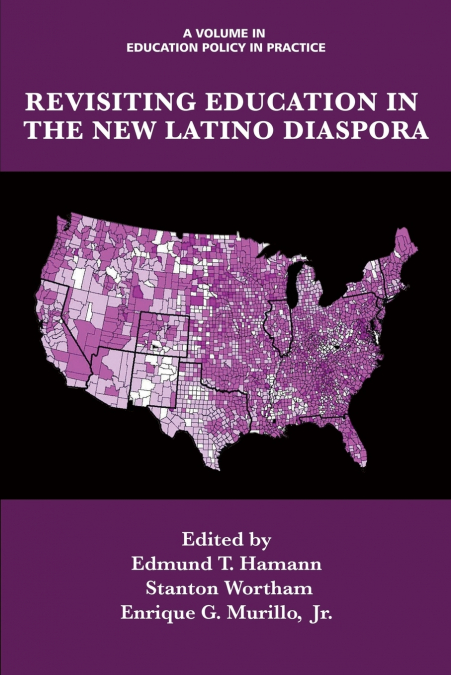

Revisiting Education in the New Latino Diaspora

Revisiting Education in the New Latino Diaspora


90,95 €
IVA incluido
Disponible
Editorial:
Emerald Publishing Ltd
Año de edición:
2015
Materia
Organización y gestión educativa
ISBN:
9781623969936
90,95 €
IVA incluido
Disponible

Selecciona una librería:

  • Librería Samer Atenea
  • Librería Aciertas (Toledo)
  • Kálamo Books
  • Librería Perelló (Valencia)
  • Librería Elías (Asturias)
  • Donde los libros
  • Librería Kolima (Madrid)
  • Librería Proteo (Málaga)

A volume in Education Policy in Practice: Critical Cultural StudiesSeries Editors Edmund T. Hamann, University of Nebraska-Lincolnand Rodney Hopson, George Mason UniversityFor most of US history, most of America’s Latino population has lived in nine states-California, Arizona, New Mexico,Colorado, Texas, Illinois, Florida, New Jersey, and New York. It follows that most education research that consideredthe experiences of Latino families with US schools came from these same states. But in the last 30 years Latinoshave been resettling across the US, attending schools, and creating new patterns of inter-ethnic interaction in educationalsettings. Much of this interaction with this New Latino Diaspora has been initially tentative and improvisational,but too often it has left intact the patterns of lower educational success that have prevailed in the traditional Latinodiaspora.Revisiting Education in the New Latino Diaspora is an extensive update, with all new material, of the groundbreakingvolume Education in the New Latino Diaspora (Ablex Publishing) that these same editors produced in 2002. This volumeconsciously includes a number of junior scholars (e.g., C. Allen Lynn, Soria Colomer, Amanda Morales, RebeccaLowenhaupt, Adam Sawyer) and more established ones (Frances Contreras, Jason Irizarry, Socorro Herrera, LindaHarklau) as it considers empirical cases from Washington State to Georgia, from the Mid-Atlantic to the Great Plains,where rural, suburban, and urban communities start their second or third decades of responding to a previously unprecedentedgrowth in newcomer Latino populations. With excuses of surprise and improvisational strategies less persuasive as Latino newcomer populations become lessnew, this volume considers the persistence, the anomie, and pragmatism of Latino newcomers on the one hand, with the variously enlightened, paternalistic, dismissive,and xenophobic responses of educators and education systems on the other. With foci as personal as accounts of growing up as an adoptee in a mixed race family and thetestimonio of a ’successful’ undocumented college graduate to the macro scale of examining state-level education policies and with an age range from early childhoodeducation to the university level, this volume insists that the worlds of education research and migration studies can both gain from considering the educational responsesin the last two decades to the ’newish’ Latino presence in the 41 U.S. states that have not long been the home to large, well-established Latino populations, but that nowenroll 2.5 million Latino students in K-12 alone.
Artículos relacionados

  • Walking the Law and History
    Michelle Janene
    The companion student workbook for the Bible curriculum of Walking the Law and History Genesis. Students will participate in deep Bible study of the creation of the world, the foundations of the Christian faith, and the formation of the Jewish nation.  ...
    Disponible

    9,81 €

  • Reforming Education for the Real World
    George P Waldheim
    Education, as we know it in America, is too often characterized as living in a world by itself; unaccountable and unimproved--so different from the Real World.  Year after year 'Band-Aid' attempts are initiated to improve education and again, year after year, those attempts only produce marginal improvement--if any.  Thus, our international ranking is still depicted as 'mediocr...
    Disponible

    12,21 €

  • Let’s Talk Sex & STDs
    Dr. Katina Davis-Kennedy / DrKatina Davis-Kennedy
    There comes a time when every person has to learn about sex; typically, students learn within their middle school years about sex education. Unfortunately, by then they have been influenced by others with the wrong information, or have heard rumors that are mostly untrue. Let's Talk Sex and STDs: The Student Edition is here to lay all of the misleading information and stori...
    Disponible

    25,31 €

  • Learning with Mobile Technologies, Handheld Devices, and Smart Phones
    Mobile Learning is a new trend in pedagogical communities. It matches the speed of fast moving methodologies in pedagogical world. The theories of activity-based learning, problem-based learning, work-based learning, and opinion-based learning, learner-centered learning, and so forth, can be integrated with these tiny handheld devices. Students and teachers communicate effectiv...
  • Cultural Awareness and Competency Development in Higher Education
    As the world becomes more globalized, student populations in university settings will continue to grow in diversity. To ensure students develop the cultural competence to adapt to new environments, universities and colleges must develop policies and programs to aid in the progression of cultural acceptance and understanding. Cultural Awareness and Competency Development in High...
  • Advancing Next-Generation Teacher Education through Digital Tools and Applications
    The implementation of the Common Core State Standards program has spearheaded many changes within the education field. As this initiative is ultimately designed to optimize student performance and success, it is critical that teacher education programs and technological tools being utilized in classrooms align with Common Core State Standards. Advancing Next-Generation Teacher ...