 Librería Samer Atenea
 Kálamo Books
 Librería Elías (Asturias)
 Librería Kolima (Madrid)
 Librería Proteo (Málaga)
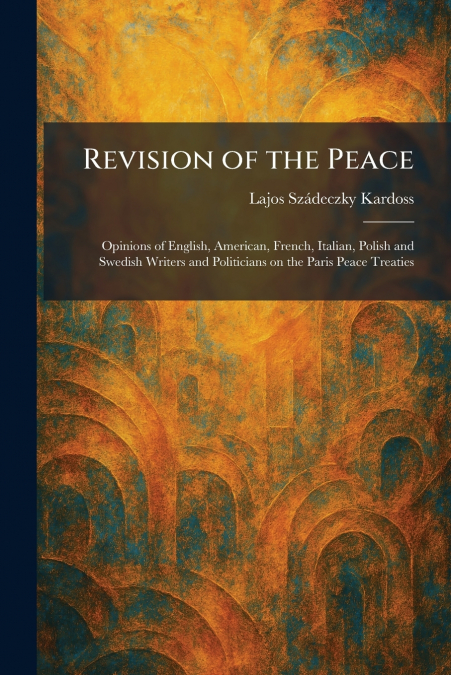
'Revision of the Peace' is a significant historical compendium compiled by Lajos Szádeczky Kardoss, offering a comprehensive look at the international reception of the Paris Peace Treaties following World War I. This work assembles a diverse array of perspectives from English, American, French, Italian, Polish, and Swedish writers and politicians, providing a unique cross-section of global opinion during the interwar period.The collection delves into the critiques and evaluations of the treaties that reshaped the map of Europe and the Middle East. By documenting the viewpoints of contemporary thinkers and statesmen, the book highlights the complexities of post-war diplomacy and the burgeoning calls for a revision of the peace settlements. It serves as an essential primary source for understanding the geopolitical tensions and the intellectual climate of the mid-1920s.Scholars and readers interested in international relations, diplomatic history, and the long-term consequences of the Great War will find this volume invaluable. It captures the intense debate over national borders, ethnic self-determination, and the pursuit of lasting stability in a fractured world.This work has been selected by scholars as being culturally important, and is part of the knowledge base of civilization as we know it. This work was reproduced from the original artifact, and remains as true to the original work as possible. Therefore, you may see the original copyright references, library stamps (as most of these works have been housed in our most important libraries around the world), and other notations in the work.This work is in the public domain in the United States of America, and possibly other nations. Within the United States, you may freely copy and distribute this work, as no entity (individual or corporate) has a copyright on the body of the work.As a reproduction of a historical artifact, this work may contain missing or blurred pages, poor pictures, errant marks, etc. Scholars believe, and we concur, that this work is important enough to be preserved, reproduced, and made generally available to the public. We appreciate your support of the preservation process, and thank you for being an important part of keeping this knowledge alive and relevant.