
Inicio > Ciencias de la tierra, geografía, medioambiente, planificación > El medioambiente > Pensamiento e ideología ecologista > Review of the New York City Department of Environmental Protection Operations Support Tool for Water Supply
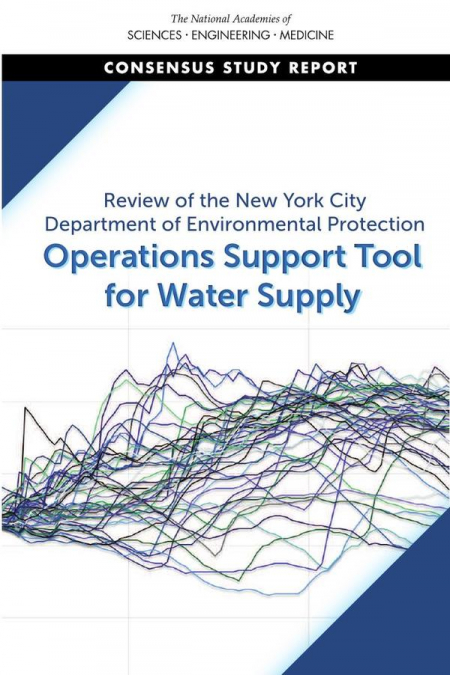
Review of the New York City Department of Environmental Protection Operations Support Tool for Water Supply

Review of the New York City Department of Environmental Protection Operations Support Tool for Water Supply

AA.VV

58,76 €
IVA incluido
Disponible
Editorial:
National Academies Press
Año de edición:
2018
Materia
Pensamiento e ideología ecologista
ISBN:
9780309482790
58,76 €
IVA incluido
Disponible

Selecciona una librería:

  • Librería Samer Atenea
  • Librería Aciertas (Toledo)
  • Kálamo Books
  • Librería Perelló (Valencia)
  • Librería Elías (Asturias)
  • Donde los libros
  • Librería Kolima (Madrid)
  • Librería Proteo (Málaga)

New York City’s water supply system is one of the oldest, largest, and most complex in the nation. It delivers more than 1.1 billion gallons of water each day from three upstate watersheds (Croton, Catskill, and Delaware) to meet the needs of more than eight million people in the City, one million people in Westchester, Putnam, Orange, and Ulster counties, and millions of commuters and tourists who visit the City throughout the year. The Catskill and Delaware portions, which make up about 90 percent of the supply, receive no filtration or treatment other than disinfection, except for rare instances of high turbidity when a coagulant is added to increase deposition of suspended solids. The remaining 10 percent of the supply comes from the Croton watershed and receives treatment via filtration.The drinking water supply is managed by the Bureau of Water Supply within the New York City Department of Environmental Protection (NYC DEP). To continue to avoid filtration of the Catskill/Delaware portion of the water supply, in 2007, NYC DEP reexamined its control of turbidity in the Catskill portion of the water supply, including both structural improvements to the system and operational changes. The Operations Support Tool (OST) was developed as part of these efforts. OST couples models of reservoir operations and water quality; it uses real-time data on streamflow, snow pack, water quality, reservoir levels, diversions, and releases; and it incorporates streamflow forecasts—all in order to predict future reservoir levels, water delivery to customers, and water quality within the system. These predictions inform the system operators, who then make decisions based on the most current data and forecasts.This report reviews the use of OST in current and future reservoir operations. It considers potential ways in which the City can more effectively use OST, makes recommendations for additional performance measures, and reviews the potential effects of climate change on the City’s water supply to help identify and enhance understanding of areas of potential future concern with regard to the use of OST.

Artículos relacionados

  • Teología verde
    Trees van Montfoort / Trees van Montfoort
    ’Teología verde’ presenta una significativa reconsideración teológica cristiana acerca de la relación entre Dios, la creación, la naturaleza y los seres humanos. Trees van Montfoort demuestra que la ecoteología no es una subdisciplina teológica, sino más bien un redescubrimiento de la teología centrada no sólo en Dios y las personas, sino en toda la creación. Éste es un libro p...
    Disponible

    23,40 €

  • Models in Environmental Regulatory Decision Making
    Many regulations issued by the U.S. Environmental Protection Agency (EPA) are based on the results of computer models. Models help EPA explain environmental phenomena in settings where direct observations are limited or unavailable, and anticipate the effects of agency policies on the environment, human health and the economy. Given the critical role played by models, the EPA a...
    Disponible

    58,76 €

  • Public Participation in Environmental Assessment and Decision Making
    Federal agencies have taken steps to include the public in a wide range of environmental decisions. Although some form of public participation is often required by law, agencies usually have broad discretion about the extent of that involvement. Approaches vary widely, from holding public information-gathering meetings to forming advisory groups to actively including citizens i...
    Disponible

    72,28 €

  • Assessing Economic Impacts of Greenhouse Gas Mitigation
    Many economic models exist to estimate the cost and effectiveness of different policies for reducing greenhouse gas (GHG) emissions. Some approaches incorporate rich technological detail, others emphasize the aggregate behavior of the economy and energy system, and some focus on impacts for specific sectors. Understandably, different approaches may be better positioned to provi...
    Disponible

    26,52 €

  • Environmental Decisions in the Face of Uncertainty
    The U.S. Environmental Protection Agency (EPA) is one of several federal agencies responsible for protecting Americans against significant risks to human health and the environment. As part of that mission, EPA estimates the nature, magnitude, and likelihood of risks to human health and the environment; identifies the potential regulatory actions that will mitigate those risks ...
    Disponible

    46,28 €

  • Modeling the Economics of Greenhouse Gas Mitigation
    Models are fundamental for estimating the possible costs and effectiveness of different policies for reducing greenhouse gas (GHG) emissions. There is a wide array of models to perform such analysis, differing in the level of technological detail, treatment of technological progress, spatial and sector details, and representation of the interaction of the energy sector to the o...
    Disponible

    42,59 €